Zscaler 블로그
Zscaler 블로그의 최신 업데이트를 이메일로 받아보세요
The economic rationale for secure digital transformation

In times of economic uncertainty, my department and others like it are called upon for guidance and creative solutions.
As the VP of Global Value Creation at Zscaler, my colleagues and I are responsible for collaborating with enterprises and articulating how digital transformations generally and zero trust architecture (ZTA) solutions precisely deliver tangible, bottom-line benefits for businesses.
Luckily for me, the business benefits are numerous. Vendor consolidation is a crucial initiative for organizations. An IBM study found that the average enterprise has around 30 security point products. Enterprises are looking to simplify security platforms and consolidate vendors. A recent Gartner Cyber Trends report states 75% of companies had plans for security vendor consolidation - a sharp increase from the previous year.
Moving away from security point products – proxies, firewalls, URL filtering, access controls, load balancers, VPN licensing and concentrators, and IPS/IDS systems – to a cloud architecture reduces CAPEX and OPEX costs associated with the purchase and maintenance of hardware-based systems. The same is true for additional networking and related infrastructure expenses. Branch connectivity, MPLS circuits, network bandwidth capacity, VDI solutions, data center-to-cloud connectivity components, web application firewalls, and network monitoring tools are cost drivers that can be reduced, replaced, or avoided by switching to direct-to-internet connectivity and adopting a model that is both more simplified and more secure.
But that’s just the beginning. Consolidation onto a much smaller ecosystem of leading zero trust platform solutions for internet and private application access, identity, endpoint, and log / service desk operations means significant efficiency gains with not only integration and automation but also advancing personnel from security admins to security practitioners.
In addition to vendor consolidation, I typically raise some other topics in conversations about the value of secure digital transformations.
It’s not just about reducing security risk
CXOs today face varied and complex challenges. These include balancing security measures with business enablement and user experience, ensuring organizations are nimble to seize opportunities in the rapidly shifting, work-from-anywhere mobile and cloud-based world.
This “CISO’s dilemma” provides an innovative context for framing discussions with stakeholders regarding digital transformation initiatives. Rather than focusing solely on security risk, forward-thinking CISOs take a holistic view of their IT capabilities. After building a deep understanding of required capabilities and potential technology use cases, CISOs can translate big-picture qualitative findings into quantitative financial analysis, demonstrating the value of transformation initiatives like moving to ZTA.
Bring a broad set of stakeholders to the table
Buy-in from stakeholders across the organization early on is vital. From the CIO, CISO, and CFO to the architects, security professionals, service desk agents, and IT support, these roles must be aligned with the transformation mission and engaged with the process. Consider all ideas and changes from the perspective of each of the stakeholders. Think of this process as a software development life cycle: from concept through design, testing, piloting, enablement, and rollout.
Lean on your vendors’ expertise
Since building a specific and credible business case for secure digital transformation - and the required investment - is not something enterprises do every day, collaborating on a business value assessment (BVA) with Zscaler can fast-track this task in a quality manner. We’ve worked with 100s of customers on this, so we can help uncover and professionally document the use cases and benefits specific to your environment, allowing you to articulate a clear economic rationale.
Again, this is about more than security risk. We study how digital transformation can reduce or eliminate redundant technology components, simplify operations, create more agile workflows, provide a competitive advantage in M&A transactions, and even lighten the organization’s carbon footprint. The point is that elements of art and science go into BVAs, and you don’t have to be an expert on them. Instead, reach out to a trusted technology partner for their input.
Think in terms of different currencies and their value to the different stakeholders
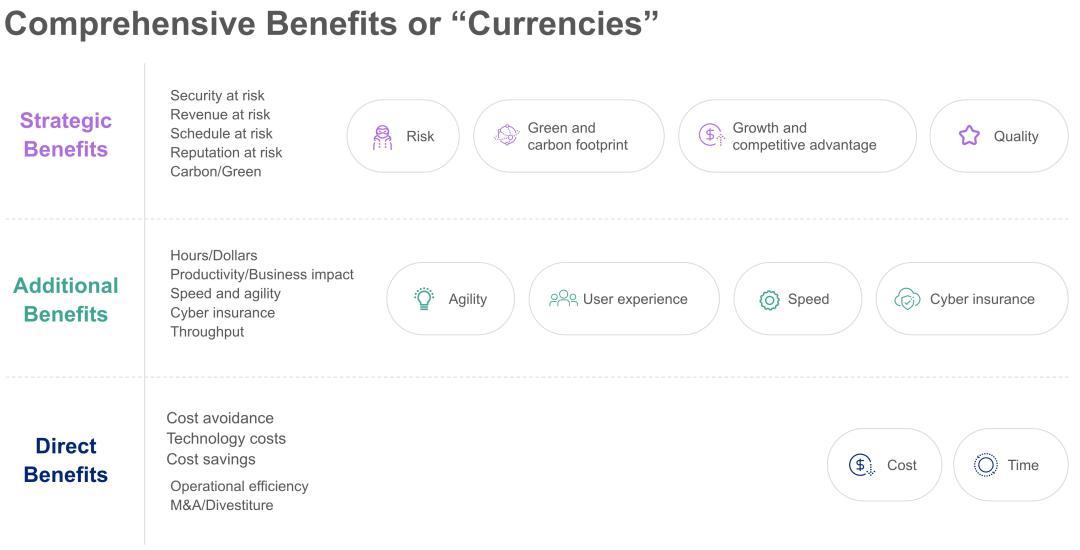
Returning to the importance of bringing diverse stakeholders to the table, everyone will inevitably want to know, “What’s in it for me?” Sure, cost savings are measured in dollars and cents, but other “currencies” often help champions garner the support they need to gain approval. Other currencies include speed, digital experience, risk mitigation, brand, ESG, and efficiency benefits. A zero trust platform can simplify the hardware and software stacks and bring these other benefits. Communicate the currencies that will resonate with each specific stakeholder and follow other best practices for change management.
Use the uncertain economic climate to your advantage
In times of market expansion, IT departments aren’t necessarily on the hook for driving efficiency. But in a challenging economic climate, this is increasingly the case. Operational efficiency is moving up the priority list: companies are restricting hiring, talent retention is difficult, and leadership is looking for teams to do more with less. It’s a perfect opportunity to evolve beyond expensive, legacy software solutions to reduce risk, save money, and boost productivity. The clock is ticking on ridding yourself of technical debt accumulated with the status quo, to achieve a competitive advantage associated with your company’s specific business and technical drivers.
Changing the status quo can be challenging, but you don’t have to do it alone. Build support one stakeholder at a time, frame the discussions around more than just security, and ask for help where you need it when building a business case. With those best practices, you can be the change agent to lead your organization to a strong foundation for further success.
In tough times, we often see the birth of startups that become successful giants. For example, Salesforce, ServiceNow, and SuccessFactors rose from the ashes of the dot-com bust. The focus, grit, and creativity of battle-hardened entrepreneurs hold a lesson for all organizations for what it takes to rise above the rest and win. Will the digital foundations of your business be prepared to solve the challenges and seize the opportunities of the future?
What to read next

이 게시물이 도움이 되었나요?


면책 조항: 이 블로그 게시물은 정보 제공만을 목적으로 Zscaler에서 작성하였으며, 정확성, 완전성 또는 신뢰성에 대한 어떠한 보증도 없이 "있는 그대로" 제공됩니다. Zscaler는 제공된 정보를 기반으로 수행된 조치나 오류 또는 누락에 대해 어떠한 책임도 지지 않습니다. 이 블로그 게시물에 링크된 제3자 웹사이트나 리소스는 편의를 위해서만 제공되며, Zscaler는 해당 웹사이트의 콘텐츠나 관행에 대해 책임을 지지 않습니다. 모든 콘텐츠는 예고 없이 변경될 수 있습니다. 이 블로그에 접속함으로써 귀하는 본 약관에 동의하며 귀하의 필요에 따라 정보를 확인하고 사용할 전적인 책임이 귀하에게 있음을 인정합니다.


