Zscaler 블로그
Zscaler 블로그의 최신 업데이트를 이메일로 받아보세요
How to ‘integrate’ an acquisition without integrating via zero trust

Editor's note: Thank you to Michael Cuneo, Managing Director - M&A / D&S Advisor, Zscaler, for this contributed article
Most acquisitions do little to nothing on Day 1 when it comes to setting up cross-company connectivity and collaboration. It’s not that the tech folks are reluctant, but rather because the complexities involved are significant or the landscape of the acquired is more unknown than known to support early action.
More often than not, early IT integration efforts are considered a risk to success, cost containment, and user experience because integrations typically require disruptive technical deployments within the acquired. Today’s M&A playbooks, along with deal-specific investment thesis recognize this time gap to the start of value capture activities. This wait-state only exists because the approach to integration has not kept up with technical advances.
Today, secure cloud-enabled capabilities have pulled the rug out from this assumed problem. Agile businesses action value capture activities on Day 1 without delay, often achieving planned synergies months to quarters ahead of schedule.
From the pressure cooker to the hot tub
The first step to grasping the idea of post-merger integration with a zero IT footprint is to fundamentally challenge the conventional wisdom of the M&A playbook that states IT deployments precede new business value creation. The revolution / evolution is that now, both IT and business units can start their efforts on Day 1 and in parallel without impacting each other's planned value capture actions.
The modern approach to M&A integrations and/or separations hinge upon the advantages, simplicity, and outcomes of cloud-delivered zero trust. Digital infrastructure alongside cybersecurity and connectivity technologies work in tandem to deliver cross-entity collaboration capabilities to the business, instantly. It allows value capture activities to commence immediately while, in parallel, IT can pragmatically plan its eventual optimized and integrated state without the pressure of each other's needs conflicting.
Doing no harm in practice
At the heart of the solution is the Zscaler Zero Trust Exchange (ZTE) and its M&A friendly capabilities, its a cloud delivered global proxy that can provide cross-entity secured connectivity without the need for any deployments in an acquired ecosystem. The ability to utilize the Buyer’s Zscaler Tenant to simply broker connectivity between the Buyer’s and Acquired’s environments, their users, and applications without ever connecting the two networks. Zscaler enables seamless integration and collaboration via the ZTE with a zero IT footprint approach to any integration.
Specifically, the Zscaler utilizes DNS to redirect cross-entity requested connectivity. Where the Zscaler Zero Trust Exchange ultimately brokers the network interaction. This is done without installing new endpoint software, without deploying IT assets like routers, switches, and firewalls at each of the acquired facilities, and without ever connecting or re-IP’ng the two networks. Hence the zero IT footprint integration.
The beauty of this design is that it allows acquired systems and workflows to be left undisturbed, without exposing current revenue-generating activities to any potential harm or disruption through IT deployments & change. Moreover, the cloud-delivered zero-trust access powers the synergistic collaboration needed to support the incremental revenue growth the Buyer pursues as part of its acquired investment business case, bringing immediate value capture potential to any inorganic deal.
Think “onboard” instead of “integrate”
Since Day 1 no longer requires deployments into an acquired ecosystem to get employees productive, Buyers have the choice to leverage more of the acquired infrastructure for longer and depreciate it rather than write off the current investments. Buyers have more time to thoughtfully think through, budget, and plan for IT standardization and optimization vs. the traditional need to deploy solutions within a time-bound constraint, often forcing one-off solutions not necessarily prudent for the longer-term Day 2 IT agenda.
This “decoupling” of Day 1+ integration projects from the Day 2 standardize and optimize IT agenda allows you to onboard the company as best seen fit in a more pragmatic timeline. This approach gives the business and IT the runway needed to better understand and plan for Day 1 synergies while allowing early value capture activities to engage on Day 1.
The value-capture chain without the IT and security overhead
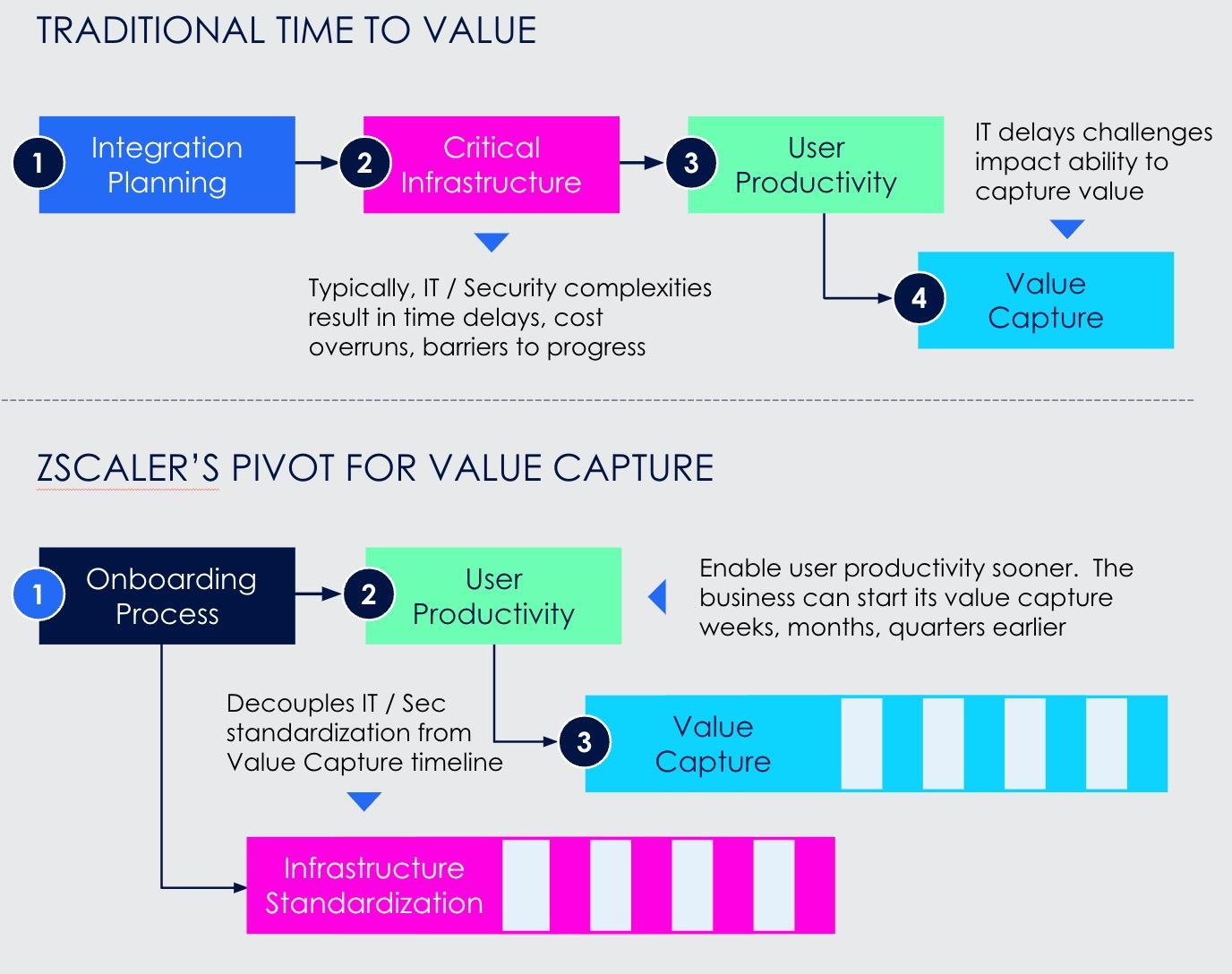
Buyers can provide secure access capabilities on the first day. Regardless of the business value capture timeline, they can consider the strategic, long-term integration, standardization, and optimization plan for the acquired IT landscapes.
Jumpstart the future
The zero IT footprint “integration” opens up further opportunity to strategically adopt zero-trust while taking out costs to better achieve desired synergy savings targets.
The zero IT footprint approach onboards the acquired ecosystem on the buyer’s Zscaler tenant. As the Zscaler platform removes the need for a multitude of traditional infrastructure and security spend. The move to standardize and optimize the acquired ecosystem, is poised to take advantage of the Zscaler cloud-delivered as-a-service model for security and connectivity to help cost-take-out targets with ease by avoiding buying, supporting, and maintaining any SD-WAN / WAN, firewalls, NAC, and security related equipment and services with demand-based pricing.
Additionally, companies can take advantage of the built-in geo-presence of Zscaler. As acquisitions can involve just about any country or region, the Zscaler Zero Trust Exchange is available in over 165 data centers worldwide. You can onboard any user-base, site, or business partner to a regional, scalable, and performing Zscaler point of presence without ever needing to consider any logistical challenge, whether supply chain, customs, or shipping and receiving.
Since the ZTE is a platform not a product, on Day 1 you can turn on relevant features like data protection, remote access, and NAC when you are ready for those users, sites, and business partners to be standardized and optimized. Buyers can drive down future-state-run costs while elevating security posture and simplifying the end-user experience across the board with the breadth of Zscaler capabilities.
The bell tolls for the traditional M&A playbook
Nearly every advisor has stated that 70% of acquisitions never achieve their intended value. The complexities, waiting-states, costs, and ineffectiveness of the traditional infrastructure and security playbook directly impact the business’s ability to achieve the intended value for the money spent. This plays out in one or more ways, unanticipated costs, unexpected delays in execution or completion, and/or ineffective solutions impacting user’s ability to efficiently and effectively function.
Why would you not want to avoid all of this risk and headache by simply bypassing it for the straightest path to deal value and enhance IT and security’s position in the business value chain?
What to read next
Solution Brief: Next Generation Post Merger Integration with Zero IT Footprint
How to save 20% up front on M&A integration costs
The magic of zero trust without the change costs

이 게시물이 도움이 되었나요?


면책 조항: 이 블로그 게시물은 정보 제공만을 목적으로 Zscaler에서 작성하였으며, 정확성, 완전성 또는 신뢰성에 대한 어떠한 보증도 없이 "있는 그대로" 제공됩니다. Zscaler는 제공된 정보를 기반으로 수행된 조치나 오류 또는 누락에 대해 어떠한 책임도 지지 않습니다. 이 블로그 게시물에 링크된 제3자 웹사이트나 리소스는 편의를 위해서만 제공되며, Zscaler는 해당 웹사이트의 콘텐츠나 관행에 대해 책임을 지지 않습니다. 모든 콘텐츠는 예고 없이 변경될 수 있습니다. 이 블로그에 접속함으로써 귀하는 본 약관에 동의하며 귀하의 필요에 따라 정보를 확인하고 사용할 전적인 책임이 귀하에게 있음을 인정합니다.


