Zscaler 블로그
Zscaler 블로그의 최신 업데이트를 이메일로 받아보세요
Reel in troves of data with webhooks

Red Canary uses AWS’s API Gateway to process floods of security telemetry delivered by webhooks
This article was originally published by Red Canary, which is now part of Zscaler.
When we ingest security data at Red Canary, we need it to be reliable and complete. Some providers offer data via callback requests called webhooks. They are convenient, but as with any push-based notification, we need to make sure that our systems are always ready to receive the event and that all received events are correctly processed. Any interruption, error, or problem could result in lost data.
How Red Canary uses webhooks
The web was designed for clients to request data from a server and get a response. The response could be an error code of some variety or some content to display. The client is responsible for resending the request if there’s an error. Webhooks extend that popular protocol to new areas. When new data arrives, a client will make a request to a web server Red Canary operates telling us about the event. There are no standards or specifications for what happens if that request errors, times out, or fails for any reason, which makes it extra important that the server always captures the event and responds with success to the client.
As an example, consider events notifying the webhook receiver that there’s a new file available for download. The files may be varying sizes, compressed, and include multiple records. Fully processing the request will take an unknown amount of time to complete, longer perhaps than the client timeout. The safest, most reliable move is to receive the webhook event and store it for later processing so that you can promptly respond with a success to the webhook client. This sort of asynchronous processing is a common pattern in web development and requires a job system backing the web server along with a second system to process the jobs.
Asynchronous processing is a common pattern in web development and requires a job system backing the web server along with a second system to process the jobs.
With a background-processing system we can quickly respond to webhook notifications and reliably process them, but only if our web server is running and available to receive and respond. If the web server is unreachable, we’ll never know we missed a message and we may not ever see it again. Like in the above example of long-running requests, there are many known patterns for ensuring reliability, including multiple servers, geographically distributed deployments, and phased rollouts—all with ever increasing amounts of complexity and cost in exchange for greater resiliency. So how do we process webhooks with low complexity, low cost, and high resilience?
An API gateway to success
Luckily, with some AWS magic we can lean on inexpensive serverless offerings to achieve high availability, immediate positive response to webhooks, and the capacity to store the requests for later processing. AWS offers API Gateway, an HTTP-based service meant for receiving HTTP requests and returning responses. It’s scaleable, resilient, geographically distributed, and you can even set staged rollouts. AWS also offers Simple Queue Service (SQS), an extremely reliable service for delayed processing that Red Canary uses in the rest of our ingestion pipeline. SQS is often paired with Simple Notification Service (SNS), which can “fan out” messages to multiple SQS queues.
There are many ways to use AWS’s API Gateway in a web stack, but its primary purpose is to provide a singular, highly available HTTP endpoint that can relay requests to a processor and then respond to the original request. It pairs well with AWS’s Lambda service, which can perform a small unit of processing. For more complicated features, it can route to arbitrary systems as long as they respond with some form of HTTP. Lucky for us, all SNS messages are submitted with an HTTP request, and we can get API Gateway and SNS to communicate directly, without involving Lambda or our own services.
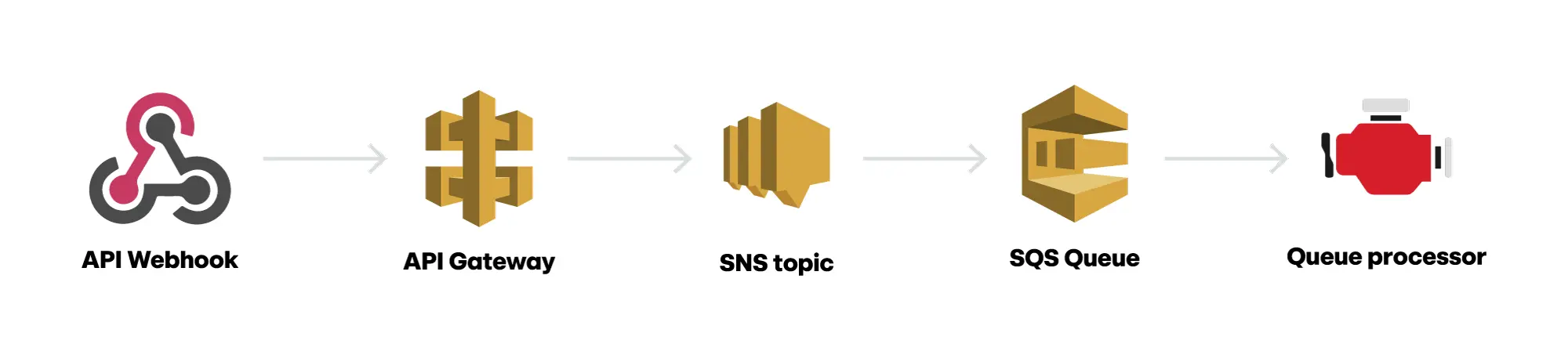
AWS API Gateway webhooks processing flow
To meet our processing goals, we send every HTTP request that comes into our API Gateway straight into SNS, which will in turn deliver it to an SQS queue. The API Gateway will respond successfully to the webhook and at our leisure, we can process the messages from SQS complete with retries and scalable processing. It’s a completely asynchronous request-processing pipeline.
Your turn
The key is to make sure that the request that API gateway submits to SNS is in a format that SNS expects. When defining an integration request, API Gateway offers mapping templates to rewrite the incoming webhook body into a new SNS message. Here’s how to set it up.:
- Configure an API Gateway method and select SNS as the AWS Service. Use
POSTas the HTTP method and set the content-type header toapplication/x-www-form-urlencoded - Specify an API Gateway mapping template. Use this example to take the webhook body and turn it into the SNS message body for the example SNS topic:
Action=Publish&TopicArn=$util.urlEncode('arn:aws:sns:us-east-2:123456789012:example-sns-topic-name)&Message=$util.urlEncode($input.body)And with that, any requests sent to the API Gateway endpoint will be forwarded to the SNS topic. Every webhook request body will be the message body, and SNS can distribute it to an SQS queue.
Boring success
Internally we’ve found this to be a very reliable receiver for webhooks. The full implementation uses a Lambda method to authenticate webhook senders, but even with that addition, it has scaled gracefully as more customers use it, and the monthly costs are very low. Our CloudWatch metrics for API Gateway show a long history of boring success, which for cloud infrastructure, is the best kind.

이 게시물이 도움이 되었나요?


면책 조항: 이 블로그 게시물은 정보 제공만을 목적으로 Zscaler에서 작성하였으며, 정확성, 완전성 또는 신뢰성에 대한 어떠한 보증도 없이 "있는 그대로" 제공됩니다. Zscaler는 제공된 정보를 기반으로 수행된 조치나 오류 또는 누락에 대해 어떠한 책임도 지지 않습니다. 이 블로그 게시물에 링크된 제3자 웹사이트나 리소스는 편의를 위해서만 제공되며, Zscaler는 해당 웹사이트의 콘텐츠나 관행에 대해 책임을 지지 않습니다. 모든 콘텐츠는 예고 없이 변경될 수 있습니다. 이 블로그에 접속함으로써 귀하는 본 약관에 동의하며 귀하의 필요에 따라 정보를 확인하고 사용할 전적인 책임이 귀하에게 있음을 인정합니다.

