Zscaler 블로그
Zscaler 블로그의 최신 업데이트를 이메일로 받아보세요
Agentless Security Helps Water and Electric Systems Meet Zero Trust Goals

The security of our nation’s infrastructure has been a strong focus, with mandates coming from the White House in the form of executive orders and funding being allocated from the Infrastructure Investment and Jobs Act. This is due to utility organizations having become increasingly vulnerable to modern threats given the amount of legacy operational technology (OT) they employ.
OT and internet of things (IoT) technologies were initially designed to deliver speed and transaction efficiency first, with security as a secondary goal. This has made OT and IoT a favorite target for cybercriminals, with a 400% increase year over year, according to Zscaler ThreatLabz research. In fact, 61% of all breaches targeted operational technology-connected organizations.
Consequently, many official agency notifications have been issued, from CISA to the Department of Energy to the EPA. All of these guidelines include similar advice on the path forward:
- Reduce exposure to public-facing internet
- Develop and exercise cybersecurity incident response
- Conduct inventory of OT/IT assets
- Reduce exposure to vulnerabilities
To meet these goals, microsegmentation is widely held as the key to stopping the spread of threats from OT into IT. This approach also allows organizations to meet zero trust requirements, advancing this new standard for cybersecurity architecture.
Segmentation on the WAN and the LAN
Zero trust strategy outlines the need for four areas of segmentation.
- User segmentation
- Workload segmentation
- Branch/campus segmentation
- Device segmentation
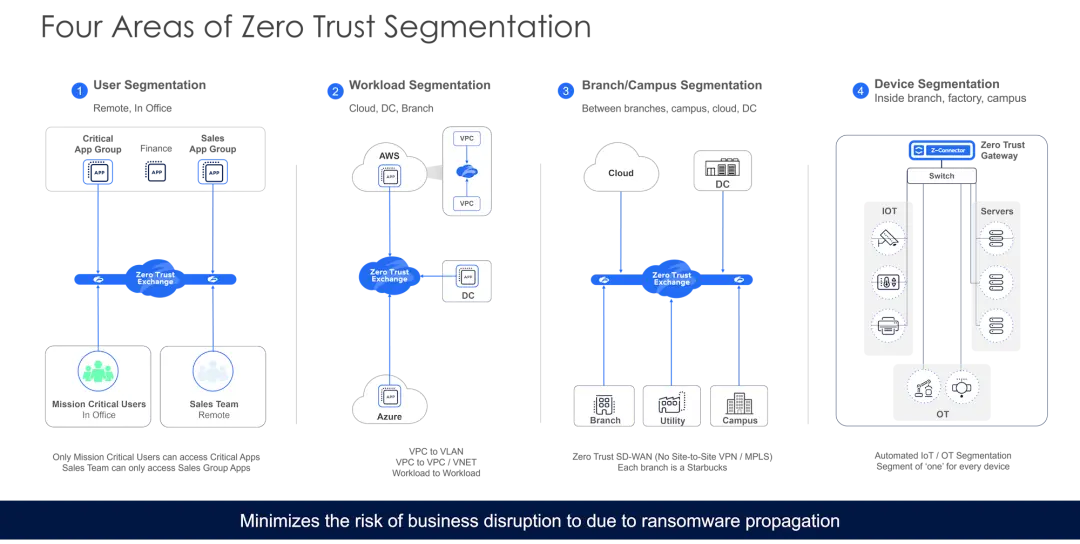
For device segmentation for local traffic not leaving the LAN or the branch, a new method of segmentation is required. Zscaler already delivers user, workload, and branch segmentation via the Zero Trust Exchange in the Zscaler Cloud. For water and electric organizations, the segmentation of these local devices can prove difficult as many times a software agent simply cannot be deployed on the device. These devices could be legacy technology, unable to accept modern agents, or could be owned or operated by third parties, presenting an access challenge. This is why an agentless approach is key to zero trust implementation.
Agentless Zero Trust Segmentation
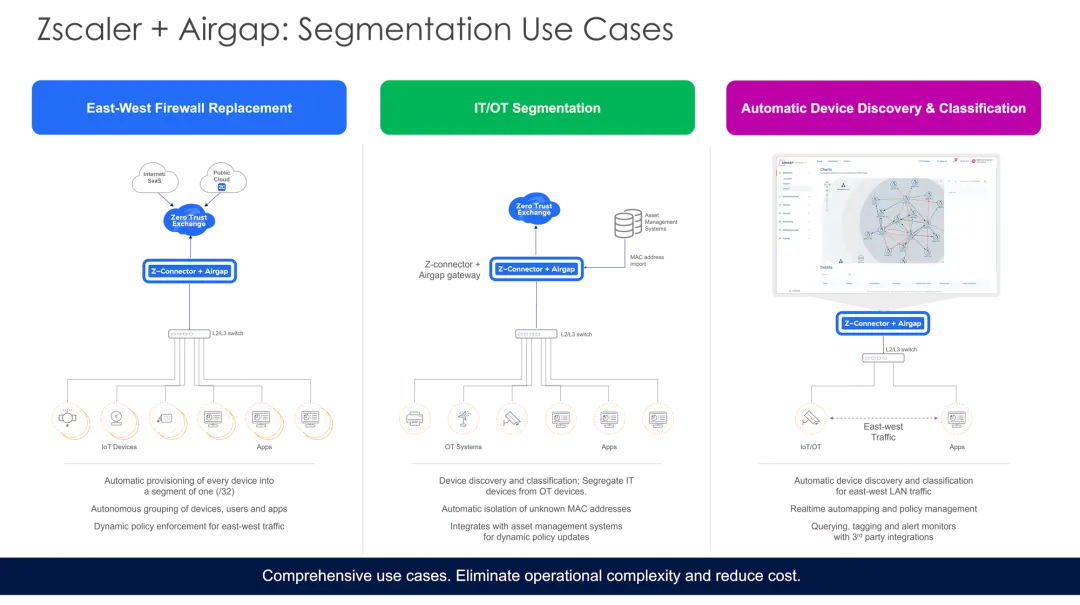
With our recent acquisition of Airgap, Zscaler enables automatic device discovery and ringfences each device into a “network of one” and classifies them into asset groups (IT, OT, printers, etc.). With classification, technologies can be segmented into logical groups, providing IT and OT separation.
Zscaler Device Segmentation assumes the role of default gateway for protected VLANs to keep traffic moving. This use of a gateway, rather than a local switch, increases the security with minimal impact on speed (adding only 70 microseconds of latency). This approach replaces east-west firewalls with microsegmentation and allows organizations to:
- Auto provision every endpoint
- Automatically classify end points into groups
- Enforce group-based policies
- Enforce policies based on threat level
Zscaler’s technology also includes a ransomware kill switch, disabling non-essential device communication to halt lateral threat movement without interrupting business operations.
More information
The Zscaler Device Segmentation Solution Team hosted a Carahsoft webinar that detailed how Zscaler helps organizations employ microsegmentation and operate with zero trust principles. You can check out the webinar for more details and watch a live demo of the solution.
Download the solution brief: Zero Trust Security for Critical Infrastructure.

이 게시물이 도움이 되었나요?


면책 조항: 이 블로그 게시물은 정보 제공만을 목적으로 Zscaler에서 작성하였으며, 정확성, 완전성 또는 신뢰성에 대한 어떠한 보증도 없이 "있는 그대로" 제공됩니다. Zscaler는 제공된 정보를 기반으로 수행된 조치나 오류 또는 누락에 대해 어떠한 책임도 지지 않습니다. 이 블로그 게시물에 링크된 제3자 웹사이트나 리소스는 편의를 위해서만 제공되며, Zscaler는 해당 웹사이트의 콘텐츠나 관행에 대해 책임을 지지 않습니다. 모든 콘텐츠는 예고 없이 변경될 수 있습니다. 이 블로그에 접속함으로써 귀하는 본 약관에 동의하며 귀하의 필요에 따라 정보를 확인하고 사용할 전적인 책임이 귀하에게 있음을 인정합니다.


