Zscaler 블로그
Zscaler 블로그의 최신 업데이트를 이메일로 받아보세요
Beyond Patient Zero: Why Detection is Dead and Quarantine is King
A recent survey found the median ransomware variant can encrypt nearly 100,000 files (about 53.93GB) in 43 minutes.
This is why “Time to Detect” is starting to feel like a comforting statistic from a slower decade.
In times where ransomware can encrypt 300 files in under a minute, detection is a consolation prize, not a strategy. If your security tool alerts you five minutes after a user has downloaded a malicious file, the damage is already in motion.
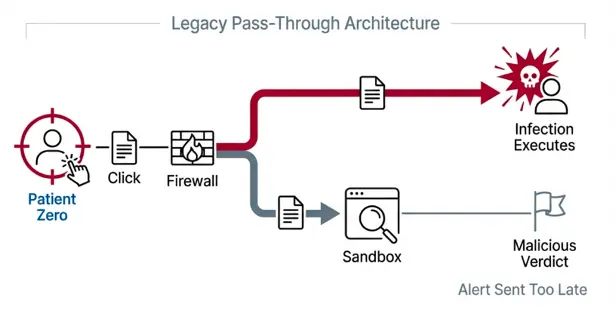
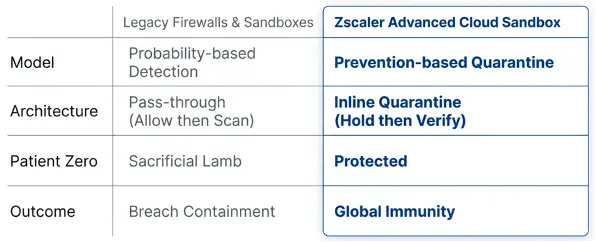
This is the "Patient Zero" Paradox: Traditional security tools often allow the first user to download a file while analyzing it in the background. They sacrifice the security of that first user to maintain speed for everyone else.
It’s time to retire the "detect and remediate" model. To stop modern threats, we must move to a "quarantine and prevent" architecture.
The Flaw in "Allow and Scan"
Legacy sandboxing solutions (and even some modern firewalls) operate on a pass-through architecture. They inspect traffic, but to avoid latency, they often allow a file to pass through to the endpoint before the verdict is ready.
If the file turns out to be malicious, the alert comes too late. The code has already been executed. The endpoint is compromised, data creates a blast radius, and the organization is now in a reactive state of breach containment.
This approach treats the first victim (Patient Zero) as a sacrificial lamb.
The Solution: AI-Driven Quarantine
Zscaler AdvancedCloud Sandbox isn't just about scanning more files; it's about fundamentally changing when the verdict is applied.
1. Hold the File, Not the Verdict
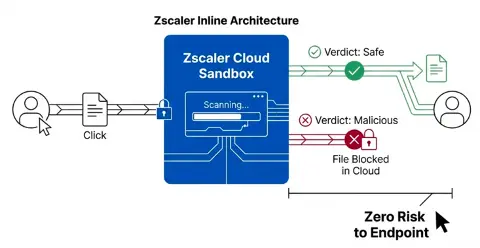
Advanced Cloud Sandbox utilizes AI-Driven Quarantine to hold suspicious files in the cloud environment while they are analyzed. The user does not receive the file until it is verified as safe.
- This protects the first user (Patient Zero) from infection, rather than just alerting you after the fact.
- It eliminates the "race condition" where malware races to encrypt files before the sandbox finishes its analysis.
2. Balancing Risk and Speed with AI
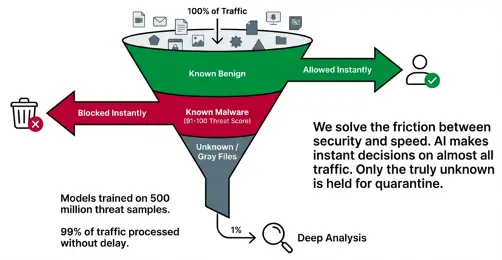
A common hesitation with quarantine is the fear of disrupting business velocity. "We can't have users waiting for downloads." Zscaler resolves this friction using AI Instant Verdicts.
By training models on over 500 million threat samples, the sandbox can instantly identify and block high-confidence threats (91-100 threat score) inline.
- Benign files are allowed instantly.
- Obvious malware is blocked instantly.
- Only the truly unknown, "gray" files are held for deeper analysis.
3. The "Cloud Effect": Turn Attack on One Into Immunity for All
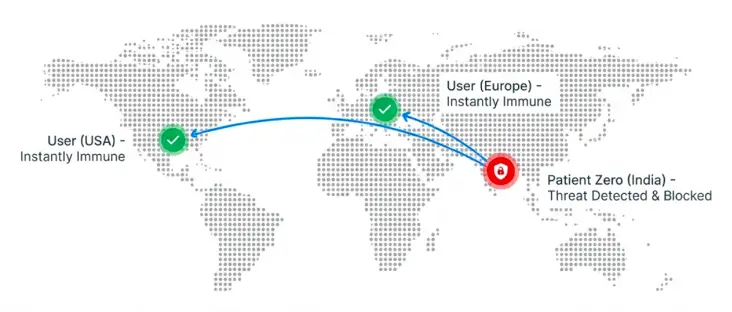
In a distributed enterprise, an attack on one user is an attack on all. The Zscaler architecture leverages the Cloud Effect: once a new threat is identified and blocked for one user (or even a different customer entirely), that intelligence is instantly shared globally.
- If a user in India downloads a zero-day file and our sandbox identifies it as malicious, that file signature is instantly blocked for every other Zscaler customer globally.
- When your user attempts to download that same file 10 minutes later, they are protected instantly. We don't need to re-scan it; the verdict is already known. Standard sandbox customers miss out on this real-time, global immunity.
Closing the Resilience Gap
Adopting a quarantine-first model is about more than technical efficacy; it’s about business continuity.
- Eliminate the "Safe Site" Blind Spot: The 'Developer Blind Spot' was the defining theme of late 2025. Campaigns targeting the npm and PyPI ecosystems (such as the 'Shai-Hulud' malicious packages) proved that developers are the new high-value targets. These attacks didn't come through sketchy websites; they came through 'trusted' repositories and legitimate-looking scripts. Because Basic Sandbox often ignores script files or archives from 'neutral' URLs, these supply chain attacks walked right past the perimeter.
- Prevent Supply Chain Poisoning: By stopping "Patient Zero," you prevent the initial foothold that attackers use to move laterally. You aren't just saving one laptop; you are protecting the integrity of the wider network.
- Regulatory & Compliance Maturity: For regulated industries, proving that you have controls in place to prevent malware—rather than just detect it—is a cleaner, stronger narrative for compliance frameworks and Zero Trust maturity.
The Bottom Line
If your sandbox policy is set to "Detect," you are operating on a probability model that assumes you can clean up a mess faster than an attacker can make one.
But true security goes beyond just blocking threats, it must also accelerate your operations. By leveraging the Zscaler Sandbox API, you can evolve your SOC from a reactive cleanup crew into a proactive intelligence hub. This integration empowers your team to:
- Automate Analysis
- Enrich Investigations
- Operationalize Intel
To truly secure the modern enterprise, you must transition to Advanced Cloud Sandbox.
Stop relying on finding the needle in the haystack after it pricks you. Insist on a system that keeps the needle out of your hand entirely.
Want to talk to an expert? click here.

이 게시물이 도움이 되었나요?


면책 조항: 이 블로그 게시물은 정보 제공만을 목적으로 Zscaler에서 작성하였으며, 정확성, 완전성 또는 신뢰성에 대한 어떠한 보증도 없이 "있는 그대로" 제공됩니다. Zscaler는 제공된 정보를 기반으로 수행된 조치나 오류 또는 누락에 대해 어떠한 책임도 지지 않습니다. 이 블로그 게시물에 링크된 제3자 웹사이트나 리소스는 편의를 위해서만 제공되며, Zscaler는 해당 웹사이트의 콘텐츠나 관행에 대해 책임을 지지 않습니다. 모든 콘텐츠는 예고 없이 변경될 수 있습니다. 이 블로그에 접속함으로써 귀하는 본 약관에 동의하며 귀하의 필요에 따라 정보를 확인하고 사용할 전적인 책임이 귀하에게 있음을 인정합니다.


