Zscaler 블로그
Zscaler 블로그의 최신 업데이트를 이메일로 받아보세요
Global Access, Local Control: Breaking Geo Restrictions with Zscaler Internet Access


Built upon the core tenet of unrestricted access to global resources, the internet was hailed as an open gateway that fostered a borderless digital economy where businesses could operate, collaborate, and expand freely.
Fast forward to 2025—it’s a tangled web of geo-restrictions, compliance hurdles, and access roadblocks that’s turning that dream into a logistical headache.
I’ll let data back that claim. A European Commission study found that 89% of consumers and organizations hit a geo-blocking wall when trying to access digital content or services. Meanwhile, 38% of consumer goods retailers and almost 68% of online content providers actively restrict access based on location.
For enterprises with a global footprint, this digital red tape isn’t just an inconvenience—it’s a business bottleneck.
Critical applications become inaccessible, employees struggle with regional content limitations, and compliance teams are stuck playing a never-ending game of regulatory whack-a-mole.
The result? Delays, inefficiencies, and security blind spots.
The Invisible Walls of the Internet: How Geo-Restrictions Are Holding Businesses Back
Governments, financial institutions, and SaaS providers implement IP-based restrictions for various reasons, ranging from enforcing regulatory compliance to honoring licensing agreements and addressing an array of cybersecurity concerns.
However, these restrictions can create three primary challenges:
1. Access Denied: The SaaS Lockout Problem
Almost 95% of businesses globally rely on third-party SaaS applications for critical workflows, yet many of these cloud services and third-party SaaS applications enforce IP allowlisting—using the source IP address of incoming traffic as a filtering mechanism, restricting access based on predefined IP allowlists.
These applications require traffic to originate from a preregistered, unique IP address, typically associated with the organization. If user traffic originates from an unregistered IP address—whether within or outside the organization—access is denied.
In some cases, applications enforce geographic restrictions as well—allowing access only if the traffic originates from specific countries. Without a consistent, dedicated IP, businesses find themselves locked out—struggling with blocked integrations, broken workflows, and frustrated teams left stranded at the door.
2. Lost in Translation: The Content Localization Dilemma
Cloud services often determine language settings and access permissions based on the user’s IP address.
But when traffic is routed through an international data center, things can go sideways—users might be served content in the wrong language or, worse, blocked from accessing region-specific services altogether.
The result? A frustrating experience filled with misaligned language and unnecessary workarounds.
Read this blog for a deeper context.
3. Regulatory Compliance: A High-Stakes Balancing Act
With over 130 countries implementing data localization laws—including GDPR in the EU, the Personal Data Protection Act in India, and Australia’s Privacy Act—organizations are under immense pressure to store, process, and log data within national borders.
However, managing data residency across multiple jurisdictions is like juggling knives. One wrong move, and businesses risk non-compliance penalties, legal repercussions, loss of customer trust, disrupted operations, and weakened security posture.
If businesses don’t solve these challenges, they risk reduced productivity, compliance violations, and increased security vulnerabilities.
The Cascading Effect
Geo-restrictions aren’t just an IT headache. They ripple across security, operations, customer experience, and revenue growth, creating roadblocks that many businesses don’t see until they hit them head-on.
Enterprises relying on third-party integrations often struggle with unpredictable IP changes that disrupt SaaS authentication, break API connections, and force manual reconfigurations, leading to service downtime and operational inefficiencies.
And the financial impact isn’t trivial—maintaining extensive allowlists, deploying VPNs or proxy servers, and managing cross-border data transfer fees can quickly add up, turning compliance into a costly burden.
The cascading effect further continues as employees, frustrated by access limitations, resort to consumer-grade VPNs, unapproved proxies, and shadow IT solutions—bypassing corporate security controls and increasing exposure to data leaks, malware, and account lockouts.
These restrictions also directly impact business expansion by limiting access to regional SaaS platforms, complicating market entry, and creating roadblocks in regulatory reporting.
Even customer experience takes a hit—misconfigured content localization can serve the wrong language, pricing, or regional products, while authentication failures tied to IP-based security policies frustrate remote workers and global teams.
Data and Content Sovereignty with Zscaler Internet Access
Zscaler can now help you overcome geo-restriction challenges. Zscaler Internet Access (ZIA)™ offers flexible and scalable options to deliver secure and fast access to local content, facilitate in-country data logging, and enable access to source IP restricted content with zero operational overhead.
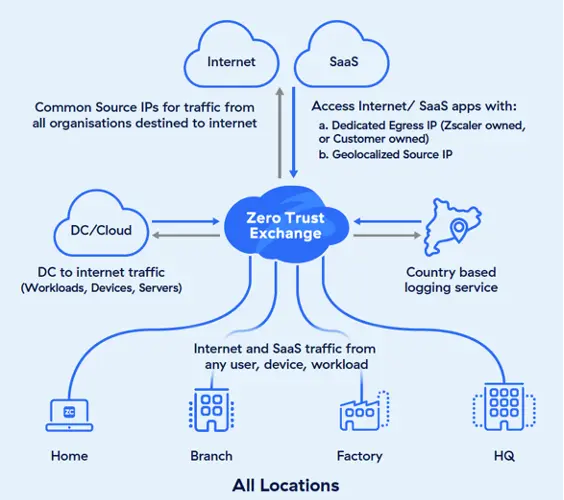
1. Dedicated IPs: A Stable Foundation for Secure Access
For businesses relying on applications with strict IP allow-listing requirements, maintaining a consistent and trusted network identity is essential. This is enabled at scale by Zscaler Managed Dedicated IPs which can either be Zscaler or customer owned.
Zscaler Managed Dedicated IPs: A designated pool of IP addresses assigned specifically to the organization, ensuring seamless access to SaaS applications without the disruptions caused by changing or shared IP
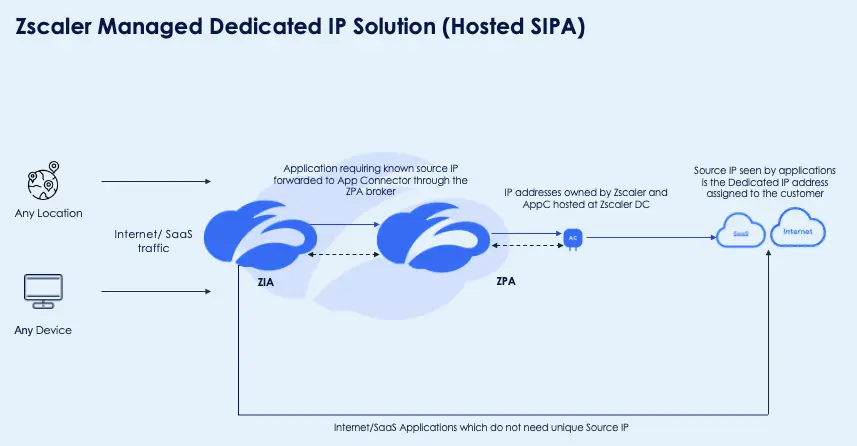
Bring Your Own IP (BYOIP): Allows businesses to use their own IP addresses via Zscaler, maintaining full control over their network identity while integrating smoothly with security policies and compliance frameworks.

With a dedicated IP strategy in place, organizations eliminate access disruptions, simplify security configurations, and ensure seamless integration with third-party services—keeping workflows uninterrupted and security posture intact.
2. Country-Based Geolocalization: Keeping Traffic Where It Belongs
Instead of routing traffic through distant, non-local data centers, Zscaler can map outbound traffic to a country-specific IP. This ensures users receive the right content, correct language settings, and unrestricted access—all while staying compliant with regional regulations.

With a country-based geolocation strategy, businesses get:
- Seamless access to geo-restricted content: Users can reach region-specific SaaS platforms, government portals, and compliance-restricted applications without any roadblocks.
- A truly localized experience: Content, services, and security settings align with the user’s actual location, reducing friction and improving usability.
- Stronger regulatory adherence: Data residency requirements are met by ensuring traffic remains within the appropriate geographic boundaries, mitigating compliance risks.
By aligning traffic routing with geographic policies, organizations eliminate unnecessary restrictions, improve user experience, and maintain compliance—without sacrificing security or performance.
Read this blog to learn more about Zscaler’s geolocalization capabilities.
3. Country-Based Logging: Ensuring Compliance Without Compromise
To comply with stringent data localization laws, businesses often need to store sensitive logs within designated geographic boundaries. A country-based logging approach allows enterprises to:
- Meet regulatory requirements: Store and process logs within specific regions to comply with frameworks like GDPR, India’s Data Protection Act, and Australia’s Privacy Act.
- Maintain control over sensitive data: Ensure visibility and governance by keeping security logs within approved jurisdictions.
- Reduce cross-border data transfer risks: Minimize exposure to legal and compliance complexities by aligning logging practices with local mandates.
By adopting country-based logging, businesses can confidently adhere to regional regulations while maintaining full control over their security and compliance posture.

Why It Matters: Secure, Compliant, and Unrestricted Access = Unlocked Business Potential
Overcoming geo-restrictions goes beyond resource access—it’s about empowering global operations, ensuring compliance, and strengthening security. With the right approach, businesses can:
Enhance operational efficiency: Ensure uninterrupted access to critical SaaS applications and integrations, eliminating delays and inefficiencies.
Achieve seamless compliance: Meet global data localization laws effortlessly with country-based logging and regulatory alignment, avoiding legal risks and audit failures.
Strengthen security posture: Eliminate the need for unapproved VPNs and workarounds, reducing exposure to data breaches, cyberthreats, and unauthorized access.
Reduce IT overhead and costs: Say goodbye to constant IP reconfigurations, allow-list updates, and expensive cross-border data transfers, freeing up IT resources.
Enable global expansion: Unlock new markets with unrestricted access to regional SaaS platforms, regulatory portals, and customer engagement tools, driving business growth.
With Zscaler Internet Access, enterprises gain seamless, secure, and compliant access—unlocking the full potential of a truly borderless digital economy.
Conclusion: A Borderless Future Starts Now
In a world where business knows no borders, your digital infrastructure shouldn’t either. Zscaler can help you achieve a smarter, more seamless approach to data and content sovereignty.
Want to learn more? Join us for our upcoming ZIA Innovations launch webinar, where we’ll dive deep into the latest advancements in data and content sovereignty, along with 10 more new features and capabilities.

이 게시물이 도움이 되었나요?


면책 조항: 이 블로그 게시물은 정보 제공만을 목적으로 Zscaler에서 작성하였으며, 정확성, 완전성 또는 신뢰성에 대한 어떠한 보증도 없이 "있는 그대로" 제공됩니다. Zscaler는 제공된 정보를 기반으로 수행된 조치나 오류 또는 누락에 대해 어떠한 책임도 지지 않습니다. 이 블로그 게시물에 링크된 제3자 웹사이트나 리소스는 편의를 위해서만 제공되며, Zscaler는 해당 웹사이트의 콘텐츠나 관행에 대해 책임을 지지 않습니다. 모든 콘텐츠는 예고 없이 변경될 수 있습니다. 이 블로그에 접속함으로써 귀하는 본 약관에 동의하며 귀하의 필요에 따라 정보를 확인하고 사용할 전적인 책임이 귀하에게 있음을 인정합니다.


