
Many healthcare organizations operate in a regional or semi-regional model with a large percentage of workers within a 100-mile radius. Mission critical healthcare applications and services are primarily delivered via two to three data centers centered within those same regional areas to reduce cost (networking, storage, compute, etc.) and maintain high availability.
Even prior to the pandemic, leading healthcare organizations seeking to improve patient care were embracing telemedicine, the remote diagnosis and treatment of patients by means of telecommunications technology. Radiology services are no exception, with teleradiology expanding rapidly due to technology innovation combined with an aging population. With all the benefits of remote radiology, the lack of broadband network availability and a scarcity of skilled radiologists limit market growth.
Offering hybrid or completely remote radiologist positions can help attract and retain the best talent and unlock the entire country for potential candidates…if your network was built to support them.
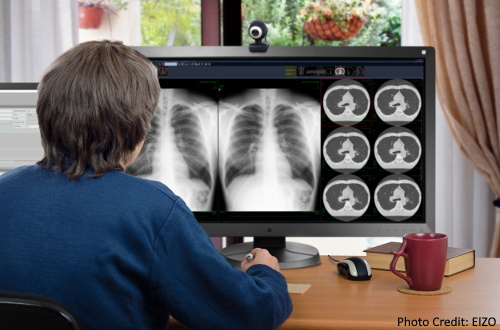
As we have heard from many of our customers, limitations to their existing regional data center model and corresponding VPN solutions have become an inhibitor to productivity for remote radiological image reading. In one case, a specialist in Oregon accessed the PACS (picture archiving and communication systems) via VPN into an overloaded Virginia data center. The application performance was so poor, the doctor was ready to quit, patient care suffered, and IT needed a solution, fast.
Healthcare traditionally leans on thin client solutions for remote workforce connectivity. This customer tested several thin client options and found none of them resolved the poor performance issues. Enter Zscaler Private Access (ZPA).
ZPA is a cloud-delivered, zero trust network access (ZTNA) service that provides secure access to all private applications, without the need for a remote access VPN. In a very short period, the doctor was connected and reading images with LAN-like performance, resulting in better patient outcomes and faster differential diagnosis, which led to increased billing capacity and improved caregiver satisfaction.
Because the PACS was accessed through Zscaler’s cloud delivered security service, deployed in 150+ data centers throughout the world, the VPN was no longer the bottleneck. Together with Zscaler, the IT team quickly delivered an infinitely scalable secure solution to support the business’s objectives. If/when the application migrates to PaaS or IaaS, the Zscaler platform easily extends without the need for expensive private connections or complex VPN and network routing.
And since no article today would be complete without it, let’s talk about zero trust. Based on the principle of least privilege, it establishes context such as a user’s location, their device’s security posture, the content being exchanged and the application being requested.
The PACS application, and only the PACS application, was available to the doctor after successful SAML authentication via Zscaler’s integration with any SAML 2.0 provider (like Okta or Microsoft). To further reduce risk, the organization could leverage its existing investments in conditional access policies. Additionally, posture driven differentiated access could be provided based on results from Zscaler’s integration with leading endpoint detection and response vendors like Crowdstrike and Microsoft, further ensuring the right access based on real time conditions of the user and device.
There is also the issue of compliance and data protection, as teleradiology moves sensitive patient data from the scan location to the location of the remote radiologist. The Zscaler Cloud Security platform enables complete SSL inspection at scale, without latency and capacity limitations. Read more about how Zscaler not only enforces and supports HIPAA’s Security and Privacy Rules, but fulfills the healthcare industry’s requirements of reliability, availability, and scalability.
“We were able to effectively address our HIPAA and PHI requirements with Zscaler’s Zero Trust Exchange,” states a CISO at a large private hospital in the Los Angeles area. “Further, our radiologists were able to access images more directly with faster upload times, allowing for a faster differential diagnosis and completion of radiology reporting. The net result is improved revenue cycles and a reduction in expensive networking infrastructure and helpdesk tickets, thereby positively impacting our cost structure.”
Teleradiology in the U.S. is expected to grow at a CAGR of 22.27% from 2022 to 2027, with almost 127 million X-ray procedures, 80 million CT scans, and 40 million MRI scans performed every year. An increasing percentage of these scans will be read via teleradiology. Organizations need IT infrastructure that ensures high performing remote radiology for quality patient care, compliance and to meet business objectives.
Zscaler’s healthcare team is here to review your infrastructure needs through a whiteboard session, demo or architectural workshop. Visit our healthcare page to set up a complimentary session!


