Zscaler 블로그
Zscaler 블로그의 최신 업데이트를 이메일로 받아보세요
Identifying Vulnerabilities with Cloud Sandbox’s Zero Day Virtual Machine Scan
As a pioneer of cloud-based security, Zscaler operates a network of over 160 global data centers that have the necessary infrastructure to:
- Intercept data flowing between client and server for 9,400+ global customers
- Scan and analyze over 500 billion daily transactions for threats
- Process 500 trillion daily signals for our AI/ML cloud effect that continuously detects and prevents threats
Zscaler’s Cloud Sandbox now provides customers an environment in which they can deploy new virtual machine (VM) types and apply the latest vendor-provided patches. Cloud Sandbox detonates sample binaries on a fully patched VM to derive a score based on a binary’s behavior: the higher the value, the greater the risk of exploitation. This blog looks at how Zscaler is able to achieve this and reduce patch deployment friction for security operations teams.
Determining a Vendor-supplied Patch’s Impact with Zscaler’s Cloud Sandbox
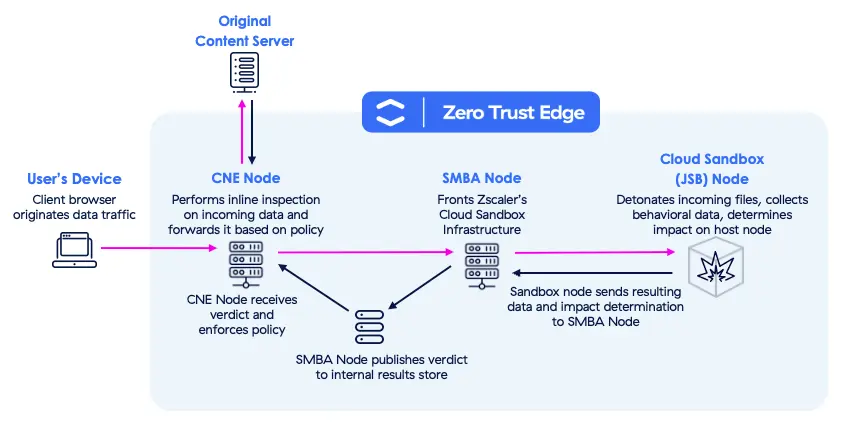
Operating the world’s largest security cloud platform means we can rapidly evaluate the behaviour and efficacy of the latest third-party vendor patches when applied. There are multiple nodes in Zscaler’s infrastructure that comprise the infrastructure required to execute data interception and inspection – here’s a look at what each edge component does:
- The first hop from the customer is a Cloud Enforcement Node (CNE) node, which is an explicit proxy that an endpoint client browser or other application points to.
- The requests from application-to-application servers are directed to OCS (Original Content Server) via the CNE node.
- The CNE node is configured explicitly as a proxy on the client endpoint application and performs inline inspection on incoming data.
- The CNE node forwards the data based on policy to the SM Behavioral Analytics (SMBA) node. This node fronts the Cloud Sandbox infrastructure. The data can take the form of various file types such as .exe, .dll, .pdf etc.
- SMBA nodes forward the data to the Sandbox Nodes (JSB) for detonation.
- The JSB nodes detonate the incoming data as a file type, collect behavioral data and determine the impact on the host node. This data is sent back to the SMBA node.
Every SOC Team’s Dream: Knowing the Impact of Vendor Patches Before Applying Them
Patch rollout is a very cumbersome process operationally for IT and security teams: they have to apply and verify that the patches were applied properly—and this process must be applied for multiple patches.
Before applying and rolling out patches, these teams would ideally have a rating that indicates how the patch impacts overall data flow in an organization, which could be any of the following:
- Fixing known vulnerabilities
- Uncovering latent vulnerabilities
- Though unlikely, introducing additional vulnerabilities
All these outcomes could impact data flow, including if a new vulnerability is detected and if it could be blocked by security policies customers configure and add in their Zscaler tenant.
With such a rating, operations teams could make better decisions on which patches can be applied immediately without causing disruption versus those that pose more risk of interrupting workflows.
Zscaler’s Cloud Sandbox now provides customers an environment in which they can deploy new virtual machine types and apply the latest vendor-provided patches. Cloud Sandbox detonates these binaries on a fully patched VM to derive a score based on a binary’s behavior: the higher the value, the greater the risk of exploitation.
Cloud Sandbox VM Score Report Provides Threat Score with Behavioral Indicators
Comparing this score of a given binary on a fully patched VM (referred to as “Zero Day VM” going forward in this entry) helps customers understand the value of the patch.
For example, assuming the score of a binary in a regular unpatched VM is X and the same as Y on Zero Day VM we can determine the outcome would be the final one in this list of potential impacts:
- X > Y: Zero Day VM score decreased: the applied patches fixed some of the vulnerabilities.
- X < T: Zero Day VM score increased: the applied patches detected latent vulnerabilities, e.g., zero day detection of vulnerabilities.
- X = Y: Zero Day VM score is negligible: the risk negates the value of a patch that is supposed to address a specific vulnerability
Let’s look at an example of how this works: a customer submits a suspected zero-day exploit sample in two virtual machine environments: a "Regular VM" with limited patches and a "Zero Day VM" that was fully patched.
Despite the Zero Day VM being fully patched, the exploit was still successfully executed, confirming it was a true zero-day vulnerability. The resulting report below shows a threat score of 100 for the exploit. Further, the report also identifies behavioural characteristics that support this finding in addition to security bypass, networking and stealth tactics and techniques.
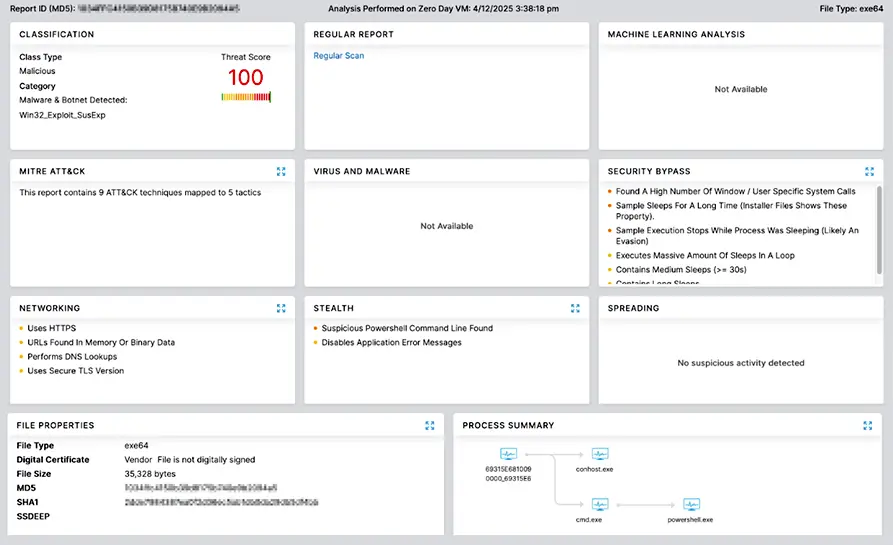
Zscaler's Cloud Sandbox effectively mitigated the threat. It not only accurately identified the novel exploit behavior but, more importantly, blocked the attack based on behavioral detection. This proves Cloud Sandbox’s ability to provide proactive protection against emerging threats by recognizing the underlying exploit technique (e.g., anomalous system calls, memory manipulation) rather than relying on a specific signature.
Learn more about how Zscaler’s Cloud Sandbox can help your SOC team achieve greater operational efficiencies like this while bolstering your security posture.

이 게시물이 도움이 되었나요?


면책 조항: 이 블로그 게시물은 정보 제공만을 목적으로 Zscaler에서 작성하였으며, 정확성, 완전성 또는 신뢰성에 대한 어떠한 보증도 없이 "있는 그대로" 제공됩니다. Zscaler는 제공된 정보를 기반으로 수행된 조치나 오류 또는 누락에 대해 어떠한 책임도 지지 않습니다. 이 블로그 게시물에 링크된 제3자 웹사이트나 리소스는 편의를 위해서만 제공되며, Zscaler는 해당 웹사이트의 콘텐츠나 관행에 대해 책임을 지지 않습니다. 모든 콘텐츠는 예고 없이 변경될 수 있습니다. 이 블로그에 접속함으로써 귀하는 본 약관에 동의하며 귀하의 필요에 따라 정보를 확인하고 사용할 전적인 책임이 귀하에게 있음을 인정합니다.


