Zscaler 블로그
Zscaler 블로그의 최신 업데이트를 이메일로 받아보세요
Nevada Ransomware: Yet Another Nokoyawa Variant

Key Takeaways
- Nevada ransomware was advertised in criminal forums in December 2022 as part of a new ransomware-as-a-service affiliate program
- Nevada is written in the Rust programming language with support for Linux and 64-bit versions of Windows
- Zscaler ThreatLabz has identified significant code similarities between Nevada and Nokoyawa ransomware including debug strings, command-line arguments and encryption algorithms
- The Nokoyawa ransomware codebase has been continuously modified with at least four distinct variants (including Nevada) that have emerged since February 2022
- The Nokoyawa threat group appears to operate two parallel code branches written in different programming languages designed to confuse researchers and evade detection
Zscaler ThreatLabz has been tracking the Nokoyawa ransomware family and its predecessors including Karma and Nemty ransomware. The original version of Nokoyawa ransomware was introduced in February 2022 and written in the C programming language. File encryption utilized asymmetric Elliptic Curve Cryptography (ECC) with Curve SECT233R1 (a.k.a. NIST B-233) using the Tiny-ECDH open source library combined with a per file Salsa20 symmetric key. In September 2022, a Rust-based version of Nokoyawa ransomware was released. This new version used Salsa20 for symmetric encryption, but the ECC algorithm was replaced with Curve25519. In December 2022, Nevada ransomware was advertised in criminal forums. ThreatLabz has determined that Nevada shares significant code with the Rust-based variant of Nokoyawa. In January 2023, ThreatLabz also identified another version of Nokoyawa written in C that is similar to the original version, but uses the same configuration options (passed via the command-line) as the Rust-based Nokoyawa 2.0.
In this blog, we analyze Nevada ransomware and how it compares to the other versions of Nokoyawa ransomware. Based on the numerous similarities, the Nokoyawa threat group appears to utilize two separate branches for ransomware attacks.
Technical Analysis
ThreatLabz has identified at least four distinct versions of Nokoyawa ransomware. For clarity, we will use the version numbers 1.0, 1.1, 2.0 and 2.1 (Nevada) based on code similarities. Table 1 illustrates the similarities and differences between all four versions of Nokoyawa ransomware including Nevada.
|
Attribute |
Nokoyawa 1.0 |
Nokoyawa 1.1 |
Nokoyawa 2.0 |
Nokoyawa 2.1 (Nevada) |
|
Encryption algorithms |
SECT233R1 + Salsa20 |
SECT233R1 + Salsa20 |
X25519 + Salsa20 |
X25519 + Salsa20 |
|
Encryption library |
Tiny-ECDH |
Tiny-ECDH |
x25519_dalek |
x25519_dalek |
|
Programming language |
C/C++ |
C/C++ |
Rust |
Rust |
|
Encryption Parameters |
Hardcoded |
Passed via command-line |
Passed via command-line |
Hardcoded |
|
Import Hashing |
No |
Yes |
No |
No |
|
CIS Exclusion |
No |
No |
Yes |
Yes |
|
Architecture |
x64 |
x64 |
x64 |
x64 |
|
Earliest known compilation date |
February 2022 |
January 2023 |
September 2022 |
January 2023 |
Table 1. Comparison between different versions of Nokoyawa ransomware
There are a few commonalities between all Nokoyawa variants such as being compiled only for 64-bit versions of Windows and using a relatively obscure method to delete Windows Shadow Copies. The latter entails calling the function DeviceIoControl (shown in Figure 1) with the undocumented control code parameter IOCTL_VOLSNAP_SET_MAX_DIFF_AREA_SIZE (0x53C028) with a maximum size of 1, which causes Windows to delete all shadow copies as a result.
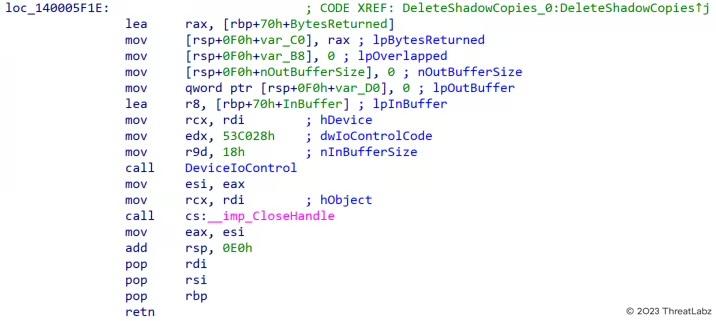
Figure 1. Nokoyawa/Nevada code to delete Windows Shadow Copies
All versions of Nokoyawa support the command-line parameters --file (to encrypt a single file) and --dir (to encrypt a directory). However, Nokoyawa 1.1 and 2.0 require a configuration to execute the ransomware via the --config command-line parameter. The configuration parameter is a Base64 encoded JSON object that has the following keys and values shown in Table 2.
|
Key |
Description |
|
NOTE_NAME |
Ransom note filename |
|
NOTE_CONTENT |
Ransom note content |
|
EXTENSION |
Encrypted file extension (also used as the Salsa20 nonce) |
|
ECC_PUBLIC |
Curve25519 public key |
|
SKIP_EXTS |
File extensions that will not be encrypted |
|
SKIP_DIRS |
Directories that will not be encrypted |
|
ENCRYPT_NETWORK |
Encrypt network shares |
|
DELETE_SHADOW |
Delete Windows shadow copies |
|
LOAD_HIDDEN_DRIVES |
Unhide hidden drives and encrypt files |
Table 2. Nokoyawa 1.1 and Nokoyawa 2.0 ransomware configuration parameters
Nokoyawa 1.1 also has a --safe-mode command-line option to reboot the system into Windows safe mode prior to file encryption to maximize the number of files that can be encrypted by loading the minimal set of applications, and therefore, minimize the number of open file handles that may interfere with encryption. In addition, Nokoyawa 1.1 is the only variant that obfuscates the Windows API functions that are called during runtime by resolving each name via CRC32 hash.
In Nevada ransomware, the encryption parameters are hardcoded in the binary, but the other command-line options are virtually identical to Nokoyawa 1.1 and 2.0 (with the exception of a new feature to self-delete the ransomware binary after file encryption is complete). Nevada also supports a -help command-line argument, which prints the usage shown below in Figure 2.
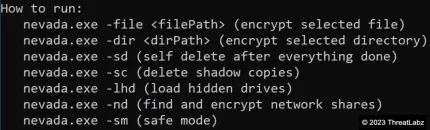
Figure 2. Nevada ransomware command-line help
In order to reduce the risk of law enforcement actions, Both Nokoyawa 2.0 and Nevada check whether the infected system is located in a former Commonwealth of Independent States (CIS) country. The former calls the Windows API GetSystemDefaultLCID for language IDs (between 1049-1092 or 2073) and the latter calls GetUserDefaultUILanguage (between 1049-1090) to determine the system's locale and language, respectively. Some of these language IDs include countries outside of the CIS countries, which may be to simplify the code by adding a range of values rather than individually checking each value.
Nokoyawa 1.0 and Nokoyawa 1.1 share about 39% of the same code, while Nokoyawa 2.0 and Nevada share more than 87% of the same code according to BinDiff.
Debug Print Statements
Another similarity between Nokoyawa 2.0 and Nevada are debug print statements, which are very similar or identical. Figure 3 shows an example for a function that creates a thread and prints a debug statement to the console.
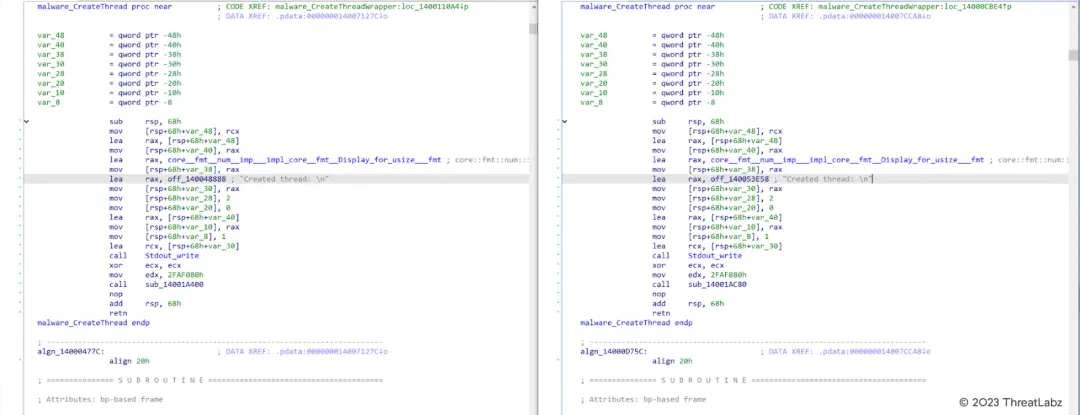
Figure 3. Comparison of CreateThread function and debug print statements in Nokoyawa 2.0 (left) and Nevada (right)
Many strings have also been slightly altered between Nokoyawa 2.0 and Nevada as shown in Table 3.
|
Nokoyawa 2.0 |
Nokoyawa 2.1 (Nevada) |
|
CIS lang detected! Stop working... |
CIS. STOP! |
| Successfully deleted shadow copies from | Shadow copies deleted from |
|
Couldn't create ransom note |
Failed to create ransom note |
|
Couldn't seek file: |
Failed to seek file: |
|
Couldn't read file: |
Failed to read file: |
|
Couldn't write to file: |
Failed to write file: |
|
Couldn't rename file |
Failed to rename file |
Table 3. Comparison between debug print strings in Nokoyawa 2.0 (left) and Nevada (right)
Encryption Algorithms
Nokoyawa 1.0 and 1.1 use the elliptic curve SECT233R1 (NIST B-233) via the Tiny-ECDH library to generate a per file Salsa20 key. Nokoyawa 2.0 and Nevada use Curve25519 via the open source x25519_dalek Rust library to derive a Salsa20 encryption key per file. In Nokoyawa 1.1 and 2.0, the file extension (as described in Table 2) is used as the nonce. The original version of Nokoyawa and Nevada ransomware use the hardcoded nonce values lvcelvce and pmarpmar, respectively.
Conclusion
Zscaler ThreatLabz has identified two parallel versions of Nokoyawa ransomware with implementations in C and Rust. These two branches may be indicative of a source code leak, or designed to evade host-based security software and divert attention. In conclusion, Nevada ransomware appears to be the latest variant of the Rust-based version of Nokoyawa rather than an entirely new ransomware family.
Cloud Sandbox Detection
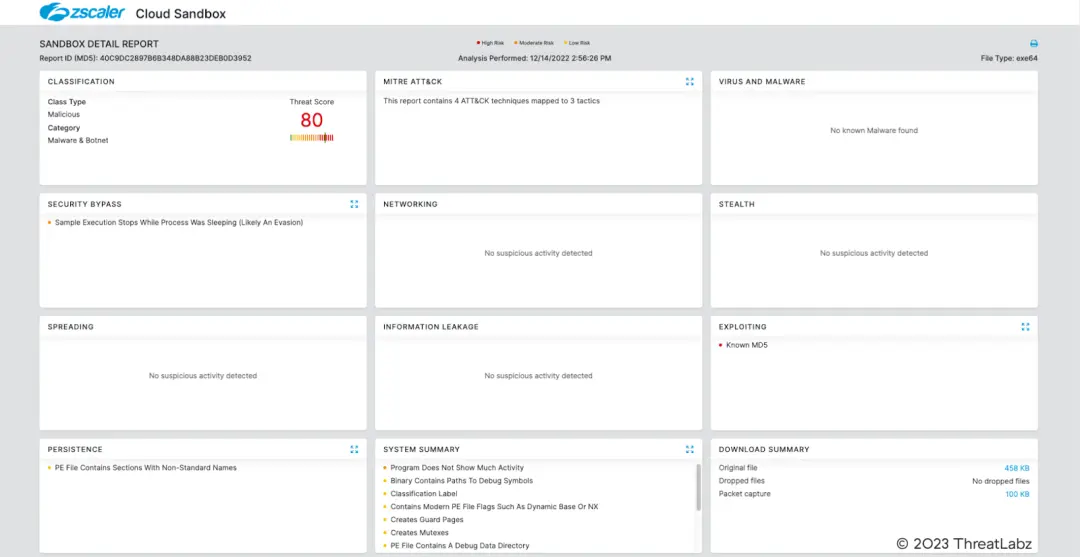
In addition to sandbox detections, Zscaler’s multilayered cloud security platform detects indicators related to Nokoyawa at various levels with the following threat names:
Indicators Of Compromise (IOCs)
|
SHA256 |
Description |
|
a32b7e40fc353fd2f13307d8bfe1c7c634c8c897b80e72a9872baa9a1da08c46 |
Nokoyawa ransomware 1.0 |
|
3339ba53e1f05f91dbe907d187489dbaba6c801f7af6fd06521f3ba8c484ec6c |
Nokoyawa ransomware 1.1 |
|
7095beafff5837070a89407c1bf3c6acf8221ed786e0697f6c578d4c3de0efd6 |
Nokoyawa ransomware 2.0 |
|
855f411bd0667b650c4f2fd3c9fbb4fa9209cf40b0d655fa9304dcdd956e0808 |
Nokoyawa ransomware 2.1 (Nevada) |

이 게시물이 도움이 되었나요?


면책 조항: 이 블로그 게시물은 정보 제공만을 목적으로 Zscaler에서 작성하였으며, 정확성, 완전성 또는 신뢰성에 대한 어떠한 보증도 없이 "있는 그대로" 제공됩니다. Zscaler는 제공된 정보를 기반으로 수행된 조치나 오류 또는 누락에 대해 어떠한 책임도 지지 않습니다. 이 블로그 게시물에 링크된 제3자 웹사이트나 리소스는 편의를 위해서만 제공되며, Zscaler는 해당 웹사이트의 콘텐츠나 관행에 대해 책임을 지지 않습니다. 모든 콘텐츠는 예고 없이 변경될 수 있습니다. 이 블로그에 접속함으로써 귀하는 본 약관에 동의하며 귀하의 필요에 따라 정보를 확인하고 사용할 전적인 책임이 귀하에게 있음을 인정합니다.