Blog de Zscaler
Reciba en su bandeja de entrada las últimas actualizaciones del blog de Zscaler
How to Secure Developer Workflows: TLS/SSL Inspection and Code Sandboxing for CI/CD Pipelines


The Developer's Dilemma: Innovate Rapidly without Compromise
Developers use cloud-based code repositories, CI/CD pipelines, and tools to build and deploy applications faster than ever before. While this transformation fuels innovation, it also introduces new attack vectors that can compromise your organization’s infrastructure, valuable data, and intellectual property.
Zscaler Internet Access can now help security and IT teams secure development workflows with two new capabilities: automated TLS/SSL inspection and code sandboxing.
Automate TLS/SSL Inspection for 30+ Popular Developer Tools
Developers rely on dozens of tools and languages like GitHub, Docker, and Python to streamline their workflows and release rapidly. These tools—and the sensitive data transported through them—are frequent targets of attacks hiding in encrypted traffic. To mitigate risk without adding friction, Zscaler can help your security team automate TLS/SSL inspection for encrypted traffic across 30+ popular developer tools and frameworks.
Traditionally, TLS/SSL inspection has been fraught with challenges, including slowing down workflows and frustrating developers. Zscaler changes that narrative by easily integrating its scalable architecture with developer tools and frameworks.
Zscaler Internet Access (ZIA) includes TLS/SSL inspection to identify threats hidden in encrypted traffic without compromising speed or performance—and now, we’re extending this protection to developer environments: whether it’s inspecting upload activity to repositories, monitoring API calls from microservices, or filtering potentially harmful web traffic in third-party tools, Zscaler empowers security teams to safeguard every node in the developer pipeline.
Integration Made Simple
Zscaler TLS/SSL inspection integrates effortlessly into developer workflows, requiring minimal adjustments to existing tools or frameworks. Developers can continue using their preferred platforms while Zscaler handles the heavy lifting in the background. Security teams can even customize policy enforcement based on developer tool usage, ensuring security without introducing inefficiencies. Learn more with the following resources:
- Read this blog to learn the steps to build a custom CA store needed to inspect encrypted traffic with ZIA, and integrate it with various developer tools and frameworks.
- Watch this on-demand webinar for an expert-led discussion of the challenges and methods to inspect encrypted traffic in developer workflows.
For us, Zscaler’s SSL inspection was a big driver. We were worried about the threats we were missing in encrypted traffic.
— Munish Dargan, Lead Enterprise Architect and IT Leader, Genpact
Sandboxing Developer Scripts to Reduce Risk
Threat actors constantly change their attack tactics and strategies, including how they use malicious files with uncommon or new file types. Attackers also attempt to use oversized files to bypass security tool analysis. Zscaler addresses this critical challenge by using advanced sandboxing technology to inspect and analyze scripts before they can be released to customer environments. ZIA’s Cloud Sandbox now supports additional file types in addition to larger files overall based on our signal telemetry from the Zscaler Zero Trust Exchange.
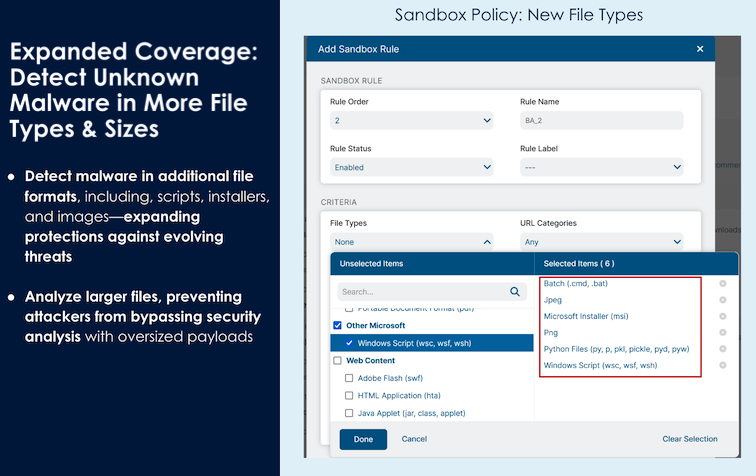
Scripts and Python related files are key in the developer ecosystem as developers often download and use code from online repositories or other external sources. These code libraries and files require examination to ensure no malicious, hidden code can be introduced into production environments.
Malware can also be embedded into images, and in a future release Zscaler will add image file support for ZIA’s Cloud Sandbox. While still a low percentage overall of malicious detections, images with malignant malware are increasing and becoming more commonplace.
Key Benefits of Inspecting Code with Zscaler Cloud Sandbox
- Real-time analysis: Unlike traditional review processes that require manual intervention, Zscaler’s sandboxing happens in real time, inspecting scripts at the speed developers need.
- Deep observability: Zscaler’s architecture analyzes scripts to detect malicious function calls, suspicious outbound communications, or anomalous behavior—without impacting the developer workflow.
- Seamless collaboration: Security teams can share sandbox findings with developers who need to tweak their code, fostering collaboration while maintaining robust protection standards.
Integrating the sandboxing capabilities of Zscaler Internet Access is straightforward thanks to its cloud native scalability and zero trust foundation. Whether securing mid-market organizations or Fortune 500 enterprises, Zscaler adapts to ensure security teams can confidently support their developers at scale.
Secure Developer Workflows Without Compromise or Blocking Innovation
Innovation shouldn’t come at the expense of security, nor should security compromise agility. By automating TLS/SSL inspection across popular developer tools and sandboxing developer scripts, Zscaler ensures continuous protection for your entire development pipeline. These advanced features enable security teams to mitigate risks while developers focus on what they do best: building software that drives your business forward.
Securing your developer workflows at scale while enabling growth is one of several topics we’ll cover during our Zscaler Internet Access Innovations webinar on April 23, 2025. We’ll take a look at the latest ZIA enhancements and show you how they can break silos without compromising on security. RSVP now and take the first step toward secure, scalable developer ecosystems!
FAQs
TLS/SSL inspection decrypts and analyzes encrypted traffic to detect threats that would otherwise pass through security tools undetected. For developer environments, this matters because most traffic to and from tools like GitHub, Docker, and CI/CD pipelines is encrypted. Without inspection, malicious payloads, data exfiltration attempts, and supply chain attacks can hide inside what appears to be legitimate, trusted communication between developer tools and external services.
Zscaler Internet Access automates TLS/SSL inspection across 30-plus popular developer tools and frameworks with minimal friction to existing workflows. Developers continue using their preferred platforms while Zscaler handles inspection in the background. Security teams can customize enforcement policies based on tool type and usage context, covering repository uploads, API calls from microservices, and third-party web traffic, all without requiring manual configuration for each individual tool or pipeline stage.
Code sandboxing executes suspicious scripts and files in an isolated environment before they can reach production systems. ZIA Cloud Sandbox analyzes scripts downloaded from external repositories, inspects for malicious function calls and suspicious outbound communication, and identifies threats embedded in uncommon or oversized file types that attackers use to bypass traditional security scanning. The analysis happens in real time, so security teams get actionable findings without creating bottlenecks in the development pipeline.
ZIA Cloud Sandbox supports developer-critical file types including scripts, Python-related files, and other code commonly pulled from external repositories. Support has also been extended to larger file sizes, addressing a known attacker tactic of using oversized files to evade security analysis. Image file support is on the roadmap for a future release, addressing the growing presence of malware embedded in image formats that are increasingly used in application development workflows.
Zscaler's cloud-native architecture performs TLS/SSL inspection and sandboxing at scale without introducing the latency that traditionally made security enforcement unpopular with development teams. Inspection runs inline at the network layer rather than requiring manual review or separate tooling. Security teams share sandbox findings directly with developers for remediation, and policy enforcement can be customized by tool type so controls are applied proportionally to risk rather than uniformly across all traffic.

¿Este post ha sido útil?


Exención de responsabilidad: Este blog post ha sido creado por Zscaler con fines informativos exclusivamente y se ofrece "como es" sin ninguna garantía de precisión, integridad o fiabilidad. Zscaler no asume ninguna responsabilidad por errores u omisiones ni por las acciones que se tomen basándose en la información proporcionada. Cualquier sitio web o recurso de terceros enlazado en esta publicación de blog se proporciona únicamente por conveniencia, y Zscaler no se hace responsable de su contenido ni de sus prácticas. Todo el contenido está sujeto a cambios sin previo aviso. Al acceder a este blog, acepta estos términos y reconoce ser el único responsable de verificar y utilizar la información de manera adecuada según sus necesidades.
Explorar más blogs de Zscaler

Content Sovereignty: Geolocalization

TLS/SSL Inspection for Developer Environments: Stop Threats Without Breaking Dev Tools

5 Encrypted Attack Predictions for 2025
Reciba en su bandeja de entrada las últimas actualizaciones del blog de Zscaler

Al enviar el formulario, acepta nuestra política de privacidad.