Blog de Zscaler
Reciba en su bandeja de entrada las últimas actualizaciones del blog de Zscaler
Zero Trust for AWS Landing Zones: A Complete Architecture Guide

This blog is co-authored by Chamandeep Singh, Security Technology Leader - Partners, AWS.
Picture the moment - you are deep in a cloud migration. You have spent months designing your AWS Landing Zone. Multi-account structure. Service Control Policies. Transit Gateway. Centralized logging. You followed every best-practice guide AWS published. It feels like the hard work is behind you. And in many ways, it is.
But the architecture diagram does not answer one question: who inspects the traffic flowing between your workloads and the internet, enforces identity-aware policy at the point of connection, and does so across hundreds of accounts at line speed without deploying inspection infrastructure in every VPC?
Two Classes of Control, Both Essential
AWS Landing Zones represent architectural maturity. A well-built Landing Zone gives you a multi-account structure enforced by AWS Organizations, guardrails through Service Control Policies, centralized security visibility via AWS Security Hub and Amazon GuardDuty, audit trails through AWS CloudTrail and Amazon CloudWatch, and a network topology, typically hub-and-spoke through AWS Transit Gateway, that gives you control over how traffic moves between accounts.
That is a strong foundation, and Zscaler builds on that foundation by delivering real-time inline traffic inspection, identity-driven policy enforcement at the point of connection, and Zero Trust protection across the full hybrid estate. Together, they cover the complete picture. And at scale, both layers are essential.
This requirement becomes more pressing as organizations adopt AI and machine learning workloads that call external APIs at high frequency, pull training data from distributed sources, and exchange inference results with downstream consumers. The volume of machine-to-machine traffic in a modern AWS environment can far exceed human user traffic. Security architectures designed around user access alone leave the majority of traffic unchecked.
Why Legacy Patterns Fail at Cloud Scale
Legacy solutions on enterprise AWS environments do provide a certain level of protection. Organizations recognize the traffic risk and respond with what they know: virtual firewalls - the same network security appliances from their data centres, redeployed in the cloud. A rational starting point. But an architectural mismatch.
Virtual firewalls were designed to enforce a perimeter. They inspect at the network layer, apply policy based on source IP and destination port, and assume a stable topology. Cloud environments are none of those things. Workloads scale dynamically, accounts multiply, and traffic patterns shift constantly. Managing rule sets at that pace, keeping HA pairs in sync, updating route tables, and writing policies for workloads that may exist for hours introduces operational complexity that grows faster than the environment it is trying to protect.
The deeper problem is that the current attack patterns have moved. Modern attacks don't break through the perimeter; they authenticate through it. Compromised credentials, stolen tokens, and misconfigured access policies mean the threat is already inside the network, moving laterally from a session that looked legitimate at the edge. Frontier AI models are accelerating this pattern, enabling attackers to craft convincing credential theft campaigns at scale, automate reconnaissance across cloud environments, and move faster than detection-based controls can respond.
Cloud-native environments require a different model - one built around identity and application context rather than network topology, and designed to enforce policy at the point of connection, not at a perimeter the modern evolving attack techniques have already learned to bypass.
Two Pillars of Zero Trust for AWS
That model exists. Zscaler's Zero Trust Exchange, a cloud-native security platform that acts as a policy broker between users, workloads, and the applications they need to reach, integrates directly into the Landing Zone architecture, addressing both how users reach applications and how workloads communicate beyond the AWS boundary.
Pillar 1: Zscaler Private Access (ZPA) - Zero Trust Access for Users
Zscaler Private Access (ZPA) replaces VPN with a fundamentally different connectivity model. Rather than granting a user access to a network segment, ZPA brokers access to a specific application, for a specific user, evaluated against identity and device context, for the duration of that session only.
The technical mechanism is an inside-out model. App Connectors are deployed in your centralized network VPC (or workload VPCs for a distributed topology) and establish outbound-only connections to the Zscaler Zero Trust Exchange. No inbound firewall rules are required. The application is never exposed to the internet - no public attack surface, no discoverable endpoint. When a user needs access, the Zero Trust Exchange brokers the connection after verifying identity and policy. If the policy check fails, there is no connection. Not a denied connection to a visible endpoint, but no connection at all.
The result is per-session, per-application segmentation. Network-based lateral movement between applications and workload accounts is significantly reduced by design, not left to policy configuration.
Pillar 2: Zero Trust Gateway (ZTGW) - Zero Trust Inspection for Workload Traffic
Zero Trust Gateway (ZTGW) secures workload traffic from the AWS Landing Zone as a fully managed service. ZTGW provides inline inspection for outbound workload traffic (north-south) and for workload-to-workload communication (east-west).
It is deployed in a single-tenant Data Plane Account within Zscaler's AWS Organization, connected to the customer environment through AWS Gateway Load Balancer endpoints via AWS PrivateLink. Zscaler provisions, operates, scales, and maintains the entire security infrastructure. There are no appliances to deploy, no load balancers to manage, and no patching cycles to plan for.
The architecture integrates natively with AWS networking constructs already present in the Landing Zone. Customers consume the service via an AWS Gateway Load Balancer endpoint (GWLBe). Workloads route traffic to the GWLBe, either in a centralized VPC or workload VPCs in a distributed model, and from there, Zscaler's managed infrastructure handles everything. No AWS IAM roles or credentials are handed to Zscaler. No existing workload VPC architecture needs to change.
Inspection covers three traffic flows:
● AWS workloads to the Internet
● AWS workloads to on-premises locations & other Public Clouds
● Workload-to-workload communication within the AWS environment
Across each of these flows, Zero Trust Gateway applies policy enforcement and threat protection. For internet-bound and cross-cloud traffic, this includes full SSL/TLS decryption, advanced threat protection, and data loss prevention, enforced through the same Zero Trust Exchange policy engine that governs user-to-application access. One consistent policy framework across the entire hybrid estate, without the operational overhead of managing the infrastructure behind it. This applies equally to machine-to-machine traffic from AI and ML workloads.
What does this Architecture look like in Practice?
The combined architecture, ZPA for user-to-application access and Zero Trust Gateway for workload egress, sits within the Landing Zone without replacing its existing structure. In practice: a developer requesting access to an internal AWS-hosted application is verified by ZPA against identity and device posture. If the check passes, a session is brokered directly to that application, nothing else. On the other hand, an EC2 workload calling an external API has its traffic intercepted at the GWLBe, inspected inline by ZTGW, and forwarded only if it clears policy; the workload itself requires no reconfiguration.
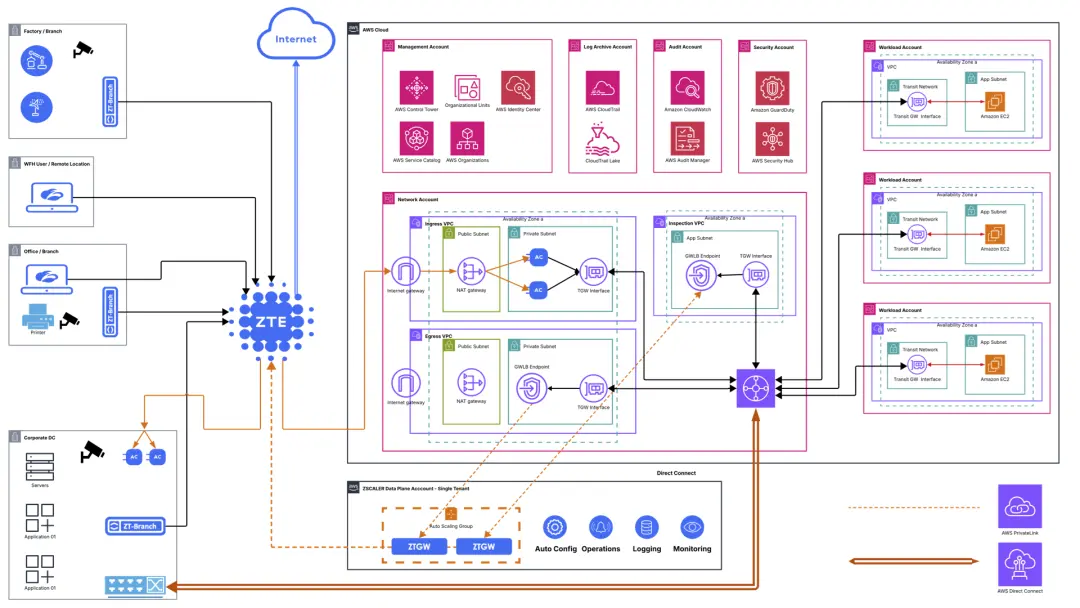
Each component sits where the traffic decision happens. App Connectors deploy in a dedicated connector VPC within the Network Account, or directly in workload VPCs for a distributed topology. So, outbound ZPA sessions originate close to the applications they represent. Zero Trust Gateway runs in a dedicated Zscaler AWS account, connected to the customer environment via GWLB Endpoints in the Egress and Inspection VPCs, so all workload egress is intercepted before it leaves the Landing Zone boundary. Traffic steering, scaling, and logging use the AWS-native constructs already in the Landing Zone - Transit Gateway route tables, Auto Scaling Groups - with no new AWS tooling required.
The result is a Landing Zone that enforces Zero Trust by design and not by policy document:
● No application carries a public attack surface unless explicitly required.
● Users get brokered access to the specific application they are authorized for, and nothing broader.
● All workload egress routed through the inspection VPC is inspected and policy-enforced, not just forwarded.
● Security policy is unified across AWS, on-premises, and other clouds - one consistent policy framework.
From an operational standpoint, both components are designed to minimize ongoing burden. ZTGW is fully managed by Zscaler and there is no inspection infrastructure for the customer to operate, patch, or scale. ZPA App Connectors are lightweight and deploy via standard infrastructure-as-code patterns; once in place, policy is managed centrally through the Zscaler console. The AWS-native constructs - Transit Gateway route tables, Auto Scaling Groups, CloudTrail logging - remain under the customer's control and integrate with existing operational tooling.
Ready to see it in your Environment?
Every Landing Zone is different - accounts, topology, traffic patterns, and existing security controls all shape where Zero Trust gets applied first and how.
If you want to map this architecture to your specific environment, there are two ways to get started:
● AWS Marketplace - Zscaler is available directly through AWS Marketplace, so procurement may count towards your AWS commitments.
● Joint Architecture Review - Engage the Zscaler and AWS teams for a working session built around your Landing Zone design, not a generic pitch. Either way, the conversation starts with your architecture, not a product feature.

¿Este post ha sido útil?


Exención de responsabilidad: Este blog post ha sido creado por Zscaler con fines informativos exclusivamente y se ofrece "como es" sin ninguna garantía de precisión, integridad o fiabilidad. Zscaler no asume ninguna responsabilidad por errores u omisiones ni por las acciones que se tomen basándose en la información proporcionada. Cualquier sitio web o recurso de terceros enlazado en esta publicación de blog se proporciona únicamente por conveniencia, y Zscaler no se hace responsable de su contenido ni de sus prácticas. Todo el contenido está sujeto a cambios sin previo aviso. Al acceder a este blog, acepta estos términos y reconoce ser el único responsable de verificar y utilizar la información de manera adecuada según sus necesidades.
Explorar más blogs de Zscaler

Zscaler Delivers Zero Trust for AWS Security Hub Customers

Zscaler Zero Trust Gateway: Fully Managed Cloud Workload Security for AWS

Enhancing AWS Workload Security with Zscaler Zero Trust Cloud
Reciba en su bandeja de entrada las últimas actualizaciones del blog de Zscaler

Al enviar el formulario, acepta nuestra política de privacidad.