Seven Elements of Highly Successful Zero Trust Architecture
An architect’s guide to the Zscaler Zero Trust Exchange





Zero trust architecture
To be successful in today’s hybrid work environment, IT and security teams need to rethink networking and security. This is where a zero trust architecture comes into play. Zero trust is a holistic security approach based on least-privileged access and the idea that no user or application should be inherently trusted. It assumes all connections are hostile and only grants access once identity and context are verified and policy checks are enforced.
Zscaler delivers zero trust through the Zero Trust Exchange—an integrated, cloud native platform that securely connects users, workloads, and devices to applications without connecting to the network. This unique approach eliminates the attack surface, prevents lateral threat movement, and protects against compromise and data loss.

THE SEVEN ELEMENTS OF ZERO TRUST
See a zero trust architecture in action
Zero trust is the next evolution of security that no longer relies on castle-and-moat security to protect hub-and-spoke networks. A true zero trust architecture securely connects users, workloads, and devices only to the apps they are authorized to access—over any network from any location—without putting either the initiator or destination app on a routable network where it can be discovered and exploited.

Verify identity and attributes
Once the user/device, IoT/OT device, or workload requests a connection, irrespective of the underlying network, the zero trust architecture first terminates the connection and verifies identity and context by understanding the "who, what, and where" of the request.
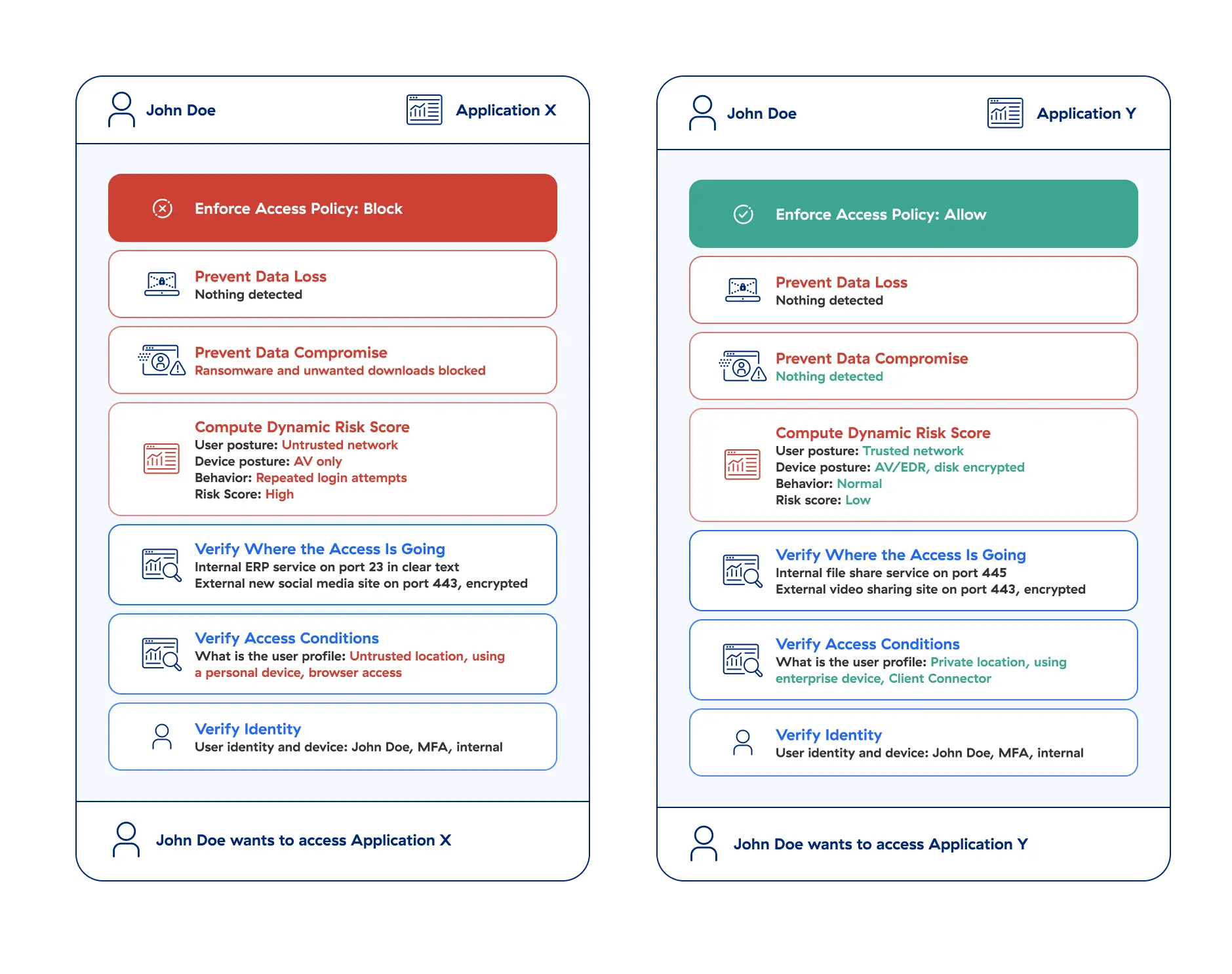
1. Who is connecting? The first element verifies the identity of the user/device, IoT/OT device, or workload through integrations with third-party identity providers (IdPs) as part of an enterprise identity and access management (IAM) provider.
2. What are the attributes? The element validates the characteristics of the connection requester, looking at attributes such as the role, responsibility, request time, location, and circumstances of the request. This profile data is collected from multiple sources, including IdP and third-party integrations.
3. Where is the connection going? This element confirms that the owner of the verified identity has the rights and meets the required context to access the requested application or resource based on segmentation rules. This entity-to-resource segmentation is the cornerstone of zero trust.

Control content and context
Once identity and context of the requesting entity are verified and segmentation rules are applied, the zero trust architecture evaluates the risk associated with the connection request, as well as inspects the traffic for cyberthreats and sensitive data.
4. Assess risk using context. This element leverages AI to dynamically compute a risk score for the user/device, IoT/OT device, or workload based on factors including device posture, threats, destination, behavior, and policy.
5. Prevent compromise. This element utilizes inline decryption and deep content inspection of entity-to-resource traffic to identify and block malicious content.
6. Prevent data loss. This element also uses decryption and deep content inspection of entity-to-resource traffic to identify sensitive data and prevent its exfiltration through inline controls or by isolating access within a controlled environment.

Enforce policy, per-session decision and enforcement
After verifying the identity/context and controlling for risk, policy is enforced before ultimately establishing a connection to the internal or external application.
7. Enforce policy. This element uses the outputs of previous elements to determine what action to take regarding the requested connection. This action can take multiple forms, ultimately resulting in a conditional allow or conditional block.
Once an “allow” decision is reached, a secure connection to the internet, SaaS app, or internal application is established. For internal apps, this is an encrypted, outbound-only tunnel that eliminates any attack surface.

See it in action
See the Zero Trust Exchange in action
Follow Jane and John Doe on their journey through the zero trust process of accessing applications to see how the seven elements are applied by the Zscaler Zero Trust Exchange.
Learn and explore resources
Accelerate Secure Digital Transformation with Zero Trust Exchange: The One True Zero Trust Platform
01 / 02