/ What Is AI Security?
What Is AI Security?
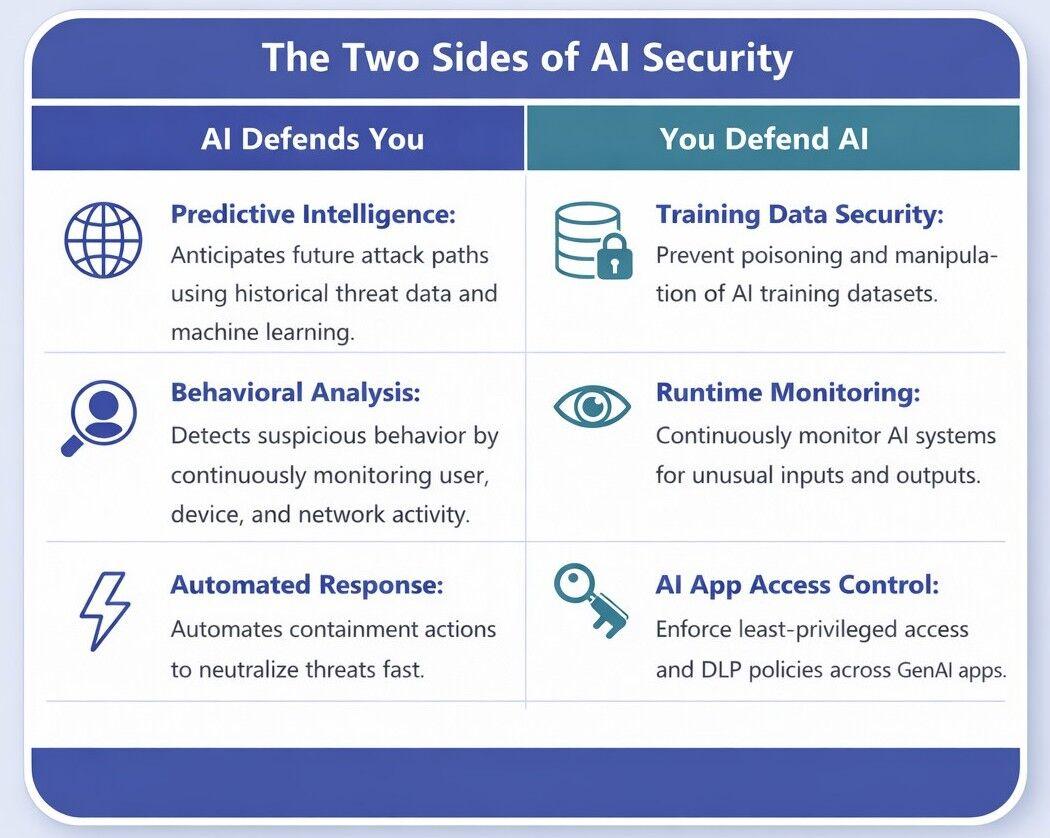
AI security means two things: protecting your AI systems from attack, and using AI to defend your enterprise. Generative AI systems are vulnerable to AI-specific attacks like prompt injection and model poisoning. At the same time, AI enhances traditional cybersecurity controls with features like predictive analytics and continuous behavioral analysis.
Overview
• Protect AI systems: AI security protects data, models, and AI infrastructure. It reduces the risk of a data breach while maintaining integrity, safety, and trust.
• GenAI expands the attack surface: GenAI boosts productivity but widens the attack surface via prompts, plugins, and APIs. Shadow AI, data leakage, and weak governance are all AI security risks.
• Secure the AI lifecycle: Organizations must secure the full AI lifecycle with layered controls across data training, deployment, and runtime.
• Apply governance frameworks: AI governance frameworks like the NIST AI RMF help organizations control GenAI usage, stop data leakage, and maintain compliance.
Why Is AI Security Important for Enterprises?
AI Security Definition
AI security is a cybersecurity discipline focused on two primary goals: 1) protecting artificial intelligence (AI) and machine learning (ML) systems from attack, and 2) leveraging AI to enhance an organization's overall security posture.
- It protects AI models, training data, and infrastructure from threats like prompt injection attacks and data poisoning.
- It also uses AI-driven capabilities like predictive analytics and behavioral analysis to improve threat detection and response.
AI security is critical because AI systems expand the enterprise attack surface. According to the ThreatLabz 2026 AI Security Report, enterprise AI and ML activity increased by 83.3% YoY in 2025. Data transfer volumes increased by 92.6% in that same time period.
But many enterprises lack the visibility and controls necessary to manage the nuances of AI security. When they ran adversarial scans on enterprise AI systems, Zscaler red teaming experts found their first critical system failure within about 16 minutes. Those experts also discovered scenarios in which a single prompt triggered a high-severity issue (ThreatLabz 2026 AI Security Report).
"At this scale [of enterprise AI adoption], AI behaves less like a set of discrete tools and more like always on infrastructure, continuously moving and transforming enterprise data.Access, however, remains far from unrestricted. Organizations blocked 39% of AI/ML transactions, reflecting persistent concerns around data exposure, privacy, and policy enforcement."
Read the Zscaler ThreatLabz 2026 AI Security Report |
Core Security Threats
Without AI security tools and best practices, enterprises face major AI risks like:
- Shadow AI and data leakage: Employees adopt new GenAI tools to improve their productivity, but many of these tools are unapproved or haven’t gone through security review. GenAI tool usage can result in compliance violations or leakage of sensitive data like proprietary code.
- Prompt injection: Bad actors can hide malicious instructions in content that AI agents read. Those instructions can give a bad actor a foothold in an enterprise’s environment, which they can then exploit in a larger cyberattack.
- Insecure integrations and third-party APIs: Many AI tools use integrations and plugins, but those connection points are frequently insecure and therefore expand the attack surface.
How AI Enhances Traditional Cybersecurity
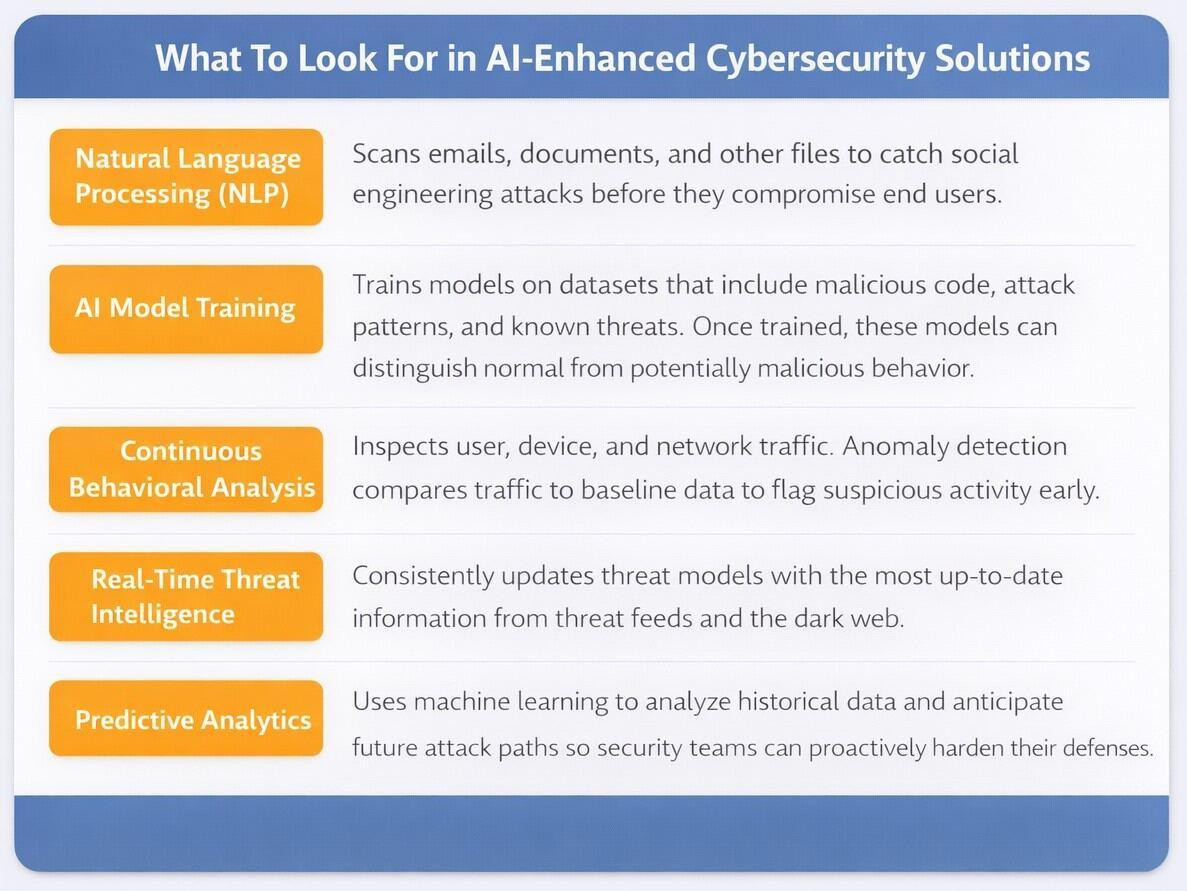
With AI, traditional cybersecurity tools can speed up existing security processes and use pattern recognition capabilities to identify and respond to attacks quickly. AI addresses traditional cybersecurity challenges like alert fatigue, manual triage requirements, and a lack of visibility into novel cyberattack patterns.
Zscaler ThreatLabz 2026 AI Security Report
Get insights into the latest enterprise AI adoption trends, risks, and security strategies.
How AI Security Protects Enterprise AI Systems
Enterprises protect their AI systems by applying security controls at each phase of the AI lifecycle.
Step 1: Secure AI training data. Model training data is the backbone of an effective AI model. Without secure, comprehensive data, an AI model will be at best ineffective, and at worst a security concern.
Enterprises validate training data’s security by tracking its lineage and movement before deployment.
Step 2: Protect deployed AI models. At this stage in the AI lifecycle, security teams focus on hardening AI systems from query-based attacks.
Some AI deployment security procedures include:
- Enforcing least-privileged access controls on chatbots with API access to sensitive datasets, like customer PII.
- Model output filtering to prevent the model from sharing sensitive information with users.
Step 3: Runtime defenses protect against prompt-related threats. Runtime for generative AI is when an AI model processes a query. Any prompt that users give generative AI models can introduce risk, and enterprises address prompt risks by:
- Establishing guardrails that restrict the model from processing external content. External content can contain malicious hidden prompts that the model interprets as a legitimate prompt from an authenticated user.
- Enabling semantic-level prompt filtering. This type of filtering understands the intent behind queries and prevents threat actors from submitting malicious prompts.
Step 4: Continuously monitor AI models and security. Enterprises employ AI-SPM to address AI model behavior drift.
What is Agentic AI Security?
Agentic AI security is a process that protects autonomous AI agents from attacks such as prompt injection and data leakage. AI agents are systems that can independently plan and execute multi-step tasks without human involvement.
AI agents typically have access to sensitive information like user credentials and internal databases. Because agents interact with other agents, external websites, and external data, they are uniquely vulnerable to compromise.
Agentic AI Risks
Because agentic AI involves chained decision-making to complete a user’s goal, it introduces risks like:
- Privilege escalation: AI agents are granted access to more resources than are strictly necessary to complete the assigned task.
- Memory poisoning: Threat actors corrupt an agent’s persistent memory with malicious instructions. A legitimate user can unintentionally execute these instructions when they engage with the agent.
- Goal hijacking: Bad actors take over the user’s instructions and prompt the agent to exfiltrate sensitive data.
Best Practices for Agentic AI Security
- Understand your AI assets: Inventory agents, models, prompts, tools, data sources, and data flows.
- Control who has access to what: Enforce least-privileged RBAC, strong authentication, scoped/short-lived credentials, locked-down tool permissions, and audit logging.
- Employ continuous, automated red teaming: Run recurring tests for jailbreaks, prompt injection, data leakage, and unsafe tool actions.
- Enforce strict guardrails: Use tool allowlists, validation, sandboxing, egress limits, PII redaction, policy filters, and approvals for high-risk actions. Enforce data integrity and governance controls to protect against data poisoning attacks.
Enforcing zero trust for agentic AI is also a best practice. When paired with real-time monitoring, zero trust helps enterprises protect against common AI attack paths.
What Are the Key Risks of AI Security?
AI security risks fall into three categories:
- Risks to enterprise AI systems like training pipelines and agents,
- Risks from AI-orchestrated cyberattacks, and
- Regulatory risks.
1) Risks to Enterprise AI Systems
Enterprise AI systems access sensitive business information and processes, which makes them a high-value target for bad actors. Enterprise AI system risks include the following:
- Prompt injection: Bad actors manipulate AI inputs and agents to exfiltrate data.
- Training data poisoning: Enterprises fine-tune AI models with internal data like customer contracts, call center transcripts, and HR records. Threat actors can poison these models with malicious data or create backdoors into AI systems.
- AI supply chain attacks: Threat actors seed malware and backdoors in the public repositories that enterprises use for their pre-trained AI models.
2) Risks From AI-Orchestrated Cyberattacks
AI acts as an attack amplifier. ThreatLabz research indicates that threat actors use AI to speed up their existing TTPs.
Here are the top ways that bad actors are using AI in their operations:
- AI-enhanced phishing and social engineering: Threat actors use AI site builders to create high-fidelity phishing sites, apps, and lures. ThreatLabz reviewed over 400k AI-generated site instances and found that 9% of them were probably used for social engineering attacks.
- Faster vulnerability exploitation: Bad actors use AI scanning tools to quickly find and exploit unpatched vulnerabilities.
- Shadow AI: Enterprises don’t always know which GenAI tools their employees are using. Security teams can’t enforce controls on apps they can’t see.
3) Regulatory and Compliance Risks
Compliant and ethical enterprise AI usage requires that organizations enforce consistent AI security guardrails. Without such guardrails, they are vulnerable to risks like:
- Data privacy violations: Regulatory frameworks like GDPR and the California Consumer Privacy Act outline how AI systems must manage sensitive data. Enterprises without AI data governance enforcement can violate these compliance frameworks and pay hefty fines.
- Lack of transparency: Because many AI systems make decisions without transparently outlining their decision criteria and processes, it’s easy for these systems to make biased decisions and erode trust.
- Intellectual property violations: Enterprises that unknowingly use copyrighted data to train their AI models are vulnerable to IP infringement claims.
Enterprises can manage AI regulatory and compliance risks using frameworks like NIST AI RMF, which helps security teams map, measure, and manage risk across the AI lifecycle.
AI Security vs. Traditional Cybersecurity vs. Cloud Security
AI security, traditional cybersecurity, and cybersecurity share a common goal of preventing unauthorized access, but these technologies differ in scope. AI security protects models, prompts, and training data from threats like prompt injection. Traditional cybersecurity and cloud security focus more on protecting networks, identities, and configurations.
What Is an AI Security Framework?
An AI security framework aligns people, processes, and technology so that organizations can manage risks consistently across teams and vendors. It provides a structured way to operationalize AI governance and security.
Without a framework, AI security is often ad hoc. Teams across the organization evaluate risk differently, accountability isn’t clearly defined, and governance gaps emerge. A formal framework establishes accountability, shared goals, and standardized processes to identify and respond to AI risks.
NIST AI RMF
NIST published the AI Risk Management Framework (AI RMF 1.0) in 2023. According to NIST, the AI RMF is a framework that helps organizations identify, measure, and respond to risks across the AI lifecycle.
The NIST AI RMF is organized around four functions:
- Govern: Establish organizational policies and accountability for AI risks. Detail the enterprise’s risk culture and set risk tolerance.
- Map: Document the enterprise AI systems’ intended uses, users, and potential impact.
- Measure: Evaluate the AI system for markers of trustworthiness, such as accuracy, robustness, security, and fairness of outputs.
- Manage: Prioritize threats and mitigate risks. Execute incident response and recovery plans.
The framework involves regular updates, in which organizations return to the map, measure, and manage stages as AI systems are updated or onboarded. The govern stage is continuously updated to reflect new threats.
Enterprise AI Security Best Practices
Enterprise AI security measures are practical enough for daily use and strict enough to meaningfully reduce AI security risks.
- Create a list of every GenAI tool and AI-enhanced SaaS app that uses AI in your enterprise environment. To prevent shadow AI creep, continuously update this list.
- Develop a plan to address the OWASP Top 10 for Large Language Model Applications.
- Use the MITRE ATLAS framework to identify common attacker TTPs and update your threat model.
- Prevent your SaaS apps from automatically using AI-powered features. This way, your security team can align those features with your company’s security posture.
- Enable least-privileged access for every user and system that can engage with an AI model.
- Enforce inline inspection across all of your AI and ML traffic.
- Evaluate every AI model’s lineage and supply chain dependencies before adopting it.
- Proactively find weaknesses with adversarial testing and red teaming exercises.
- Adopt an AI risk management framework like the NIST AI RMF.
- Update AI governance frequently to keep it up-to-date with the latest emerging risks and compliance trends.
How Zscaler Secures Enterprise AI
Zscaler extends zero trust principles to AI security. With Zscaler, organizations can find shadow AI and govern AI access.
The platform protects sensitive data where it’s most likely to leak: in prompts, responses, and AI-connected workflows.
Zscaler also helps operationalize AI governance and compliance. The platform maps risks to evolving frameworks and policies so that teams can prioritize remediation and stay audit-ready.
To learn more about how Zscaler can secure your AI, read the product brief.
Request a demo
See how Zscaler can help you secure AI adoption—without sacrificing speed, usability, or compliance.
FAQ
AI model security is the practice of protecting an AI model’s training process, artifacts, and runtime behavior from compromise. It includes controlling access to datasets and checkpoints, hardening training and hosting infrastructure, validating data and code, versioning and signing releases, and monitoring for poisoning, theft, jailbreaks, and anomalous queries.
Prompt injection is an attack where crafted input causes an AI system to ignore intended instructions or reveal restricted information. It often exploits content from documents, web pages, or tool outputs that the model treats as authoritative. Mitigations include separating data from instructions, constraining tools, and filtering or validating inputs.
Sensitive data leakage in AI occurs when confidential information is submitted to models, stored in transcripts or telemetry, incorporated into training, or echoed back in outputs. Leakage can be accidental or triggered through adversarial prompts and inference techniques. Controls include data minimization, strong access policies, redaction/DLP, retention limits, and monitoring of interactions.
Enterprise AI governance is the set of policies, roles, and review processes that define how AI is selected, built, deployed, and monitored. It covers acceptable use, data handling, model and vendor risk, documentation and testing requirements, audit trails, and accountability for changes and outcomes. Governance helps standardize decisions as AI scales across the organization.
Zero trust for AI applies “never trust, always verify” to model access, data connections, and tool execution. Each request is authenticated, authorized, and evaluated with context such as user role, device posture, and data sensitivity. Least privilege permissions and continuous monitoring reduce blast radius if an account or workflow is abused.
An AI agent is an autonomous software system that can perceive its environment, make decisions, and execute multi-step actions to achieve a goal—with minimal or no human intervention. Examples include coding assistants, research agents, and workflow automation bots.
AI Security defends your AI systems from attacks: prompt injection, data poisoning, model theft, unauthorized access. AI Safety ensures your AI produces ethical, unbiased, safe outputs even when operating correctly. Security stops attackers. Safety stops your AI from causing harm.
AI enhances cloud security solutions with automation and pattern recognition capabilities. With AI, cloud security solutions can automatically understand alert context, prioritize those alerts, and surface relevant information to security analysts for triage. Machine learning enables behavioral baselining, in which cloud security solutions establish what typical user and device behavior looks like and then flag any deviations from that baseline.
AI in threat detection helps the solution learn new attack types and automatically update security defenses without manual intervention. Machine learning in threat detection analyzes large volumes of data to find patterns and suspicious behavior that deviates from the baseline. With deep learning, threat detection can analyze malware examples and recognize those patterns in enterprise environments.
Yes. AI improves cybersecurity by automatically updating security policies, enriching alerts with contextual information, and generating audit-ready reports for compliance purposes. AI helps cybersecurity teams get ahead of novel threats by recognizing patterns and learning from example attacks to predict attacker TTPs. When cybersecurity is enhanced with AI, teams can speed up manual security processes and respond quickly to threats.
AI data security is a category of cybersecurity solutions that protect AI resources such as AI model training data, LLM APIs, prompt inputs, and GenAI apps. It helps protect against threats like prompt injection, model poisoning, and data leakage. AI data security solutions provide the access control, data classification, governance, and runtime monitoring capabilities needed to protect enterprise AI data.
AI matters in the cloud because it goes beyond traditional rule-based security. AI-powered cybersecurity detects suspicious activity and can stop threats in real time with capabilities like behavioral baselining and predictive analytics. AI in the cloud also continuously monitors environments, patches vulnerabilities, and optimizes cloud spending.