Blog de Zscaler
Reciba en su bandeja de entrada las últimas actualizaciones del blog de Zscaler
The Cost of an OT Outage Depends on How Much of the Plant You Have to Stop

Earlier this year my colleague Umang Barman spent an hour with Derek Brink of Aberdeen working through how to put a dollar figure on OT risk, in our webinar on OT risk in manufacturing. Umang spent a good part of his side of that hour arguing for segmentation inside the plant. His point was that a compromised device should take out one line rather than the whole floor. Every customer he talked to was interested in it, and he said so at the time, but nobody asked for that argument to show up in the numbers. The model priced every hour of downtime at the output of the entire plant.
The conversations since then kept bringing me back to it. At the ICS Cybersecurity Conference in October, much of the talk was about how AI lowers the skill it takes to turn access into impact on a plant floor. Two weeks later at ManuSec, our team heard mostly about how hard it is to explain OT risk to a CFO in terms that yield a decision. Then Boston Scientific attributed about $150 million in lost third-quarter sales to an August incident that disrupted its global network for eight business days. Last week the SANS Institute published its 2026 ICS/OT survey: a third of respondents reported an OT incident in the past year, up from about a fifth, and 72 percent of those incidents involved facility or system downtime. I went back through Boston Scientific's disclosure and others like it. The number we had left fixed in the model kept turning out to be where the money went, and that number is how much of the business has to stop.
How to put a dollar figure on OT cyber risk
Derek's model was for a discrete manufacturer with $100 million in revenue. It has three inputs: how often incidents happen, how long production is down, and what each production hour is worth. For this company, an hour was worth about $21,000. He added a multiplier of three to five times the direct loss to cover indirect costs such as lost customers, and that multiplier is the part of the estimate finance will push on hardest. Because every input is a range rather than a single number, Derek ran what is called a Monte Carlo simulation. Each of ten thousand runs draws a value from each range, and together the results show how likely each size of loss is, which a single best guess can't.
For that manufacturer there was a one-in-twenty chance that a single incident would cost more than $13.2 million, about 13 percent of a year's revenue. Derek's advice was to show the board the whole curve but spend the conversation on its far end, since the median is rarely what a decision turns on.
What cyberattacks have actually cost manufacturers
The objection these models draw most is that inputs like these are just estimates. Public companies have been answering that objection for years, because an incident big enough to move their results shows up in what they report. Since late 2023, US-listed companies have also had to disclose any material incident in an 8-K filing, so the public record keeps growing. Here are a few examples from the companies' own disclosures:
- Boston Scientific (2026) said its August incident took about 300 basis points off third-quarter growth. It expects another 200 to 300 basis points of impact in the fourth quarter.
- Jaguar Land Rover (2025) booked £196 million of cyber-related costs in one quarter, excluding lost sales. Production stopped for about five weeks and was not back to normal until mid-November.
- MKS Instruments (2023) put the hit to first-quarter revenue at no less than $200 million, about a fifth of the quarter it had expected. Two of its three divisions were disrupted, and the third was unaffected.
- Asahi (2025) saw sales in Japan run at roughly 70 to 90 percent of the prior year through December. It could not publish its annual results until July.
These figures measure different things, so they shouldn't be added together, but they share a cause. In each case, the money was lost because production, ordering or shipping stopped for days or weeks. None of these companies has said an attacker reached a control system.
Two of them also show that a company doesn't have to stop everything. The division MKS kept running was the Atotech business it had bought six months earlier. Asahi said the failure was limited to its operations in Japan. Neither company has said why its boundary held, but in both cases it ran between one business and another.
Where the real cost came from
When a team can't tell how far an attacker has spread, the safe call is to disconnect, and that call is usually the right one. How much gets disconnected depends on the boundaries the network gives the team to work with, which were drawn long before the incident started. Across the sector, Dragos found no case in the second quarter where a ransomware operator reached a control system. When plants did stop, it was because the IT systems they rely on had either been encrypted by the ransomware or been shut down by the company as a precaution.
Plants also stop when the enterprise systems they depend on go down, even if nothing on the plant network was touched. A plant that can't schedule, release or ship product without ERP or MES has nothing to run. At Asahi, a spokesperson said "the production systems themselves were not affected by the cyberattack," yet many of its Japanese factories stopped anyway because they couldn't ship. We wrote about this pattern earlier as the containment tax, where the plant stops even though the attack never reached it.
Reading these filings changed my view of how much Umang's argument was worth. He had made the case for a smaller blast radius as a security benefit, and in these filings it shows up on the revenue line. If I were rebuilding the model today, I would add that as a fourth input, the share of production you have to stop.
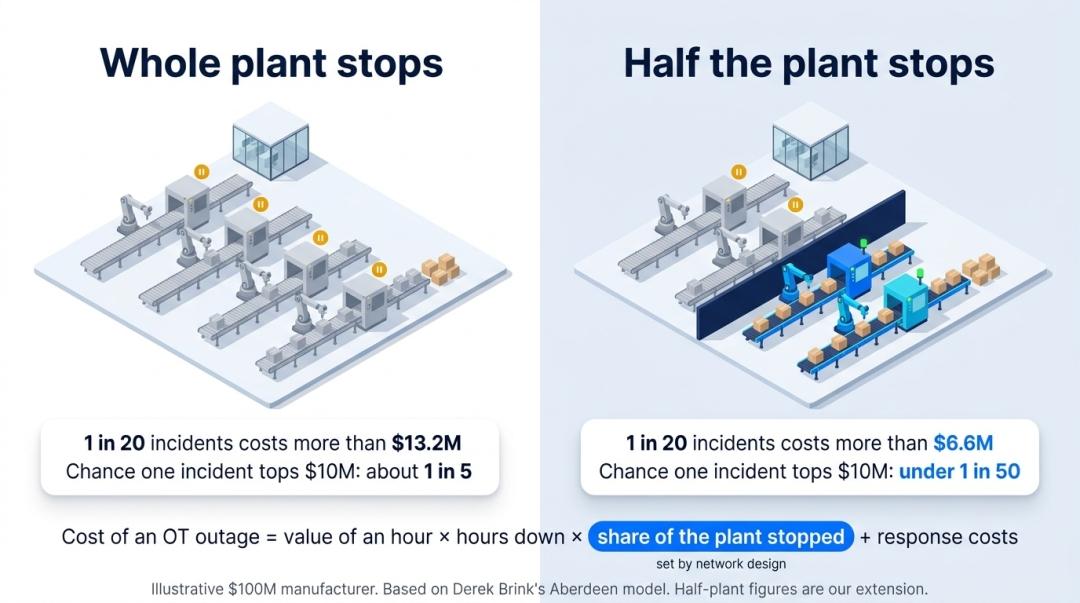
With that input, the cost of OT downtime is the value of an hour of production, times the hours lost, times the share of production that has to stop, plus the cost of the response. On Derek's numbers, stopping half the plant brings the one-in-twenty loss from about $13.2 million down to about $6.6 million. For a board whose tolerance for a single incident is $10 million, the chance of exceeding it falls from about one in five to under one in fifty.
That arithmetic is ours rather than Derek's, and it leaves two things out. Response costs such as forensics and rebuilding don't shrink with the share you stop. The share also affects how long an incident lasts, because a company that shuts everything down has to restart everything. In the ransomware cases Dragos responded to in 2024, victims that enforced segmentation between IT and OT and had tested offline backups recovered significantly faster.
Who decides how much of the plant stops
If that share matters this much, we have to make sure someone owns defining it. That is harder than it sounds, because the line usually falls between two teams. IT owns the corporate network and often the incident response plan, while OT owns the plant. The share of production that stops comes out of decisions each team makes on its own: how the network grew, which corporate systems each plant was allowed to depend on, and what the response plan says to disconnect. None of those decisions came with a price attached, so the board carries a level of risk it was never shown.
The evidence suggests many of these decisions are being made by default. In the SANS 2026 survey, 35 percent of organizations kept site-level playbooks for cyber events, and 16 percent had fully built OT cyber resilience into their business continuity and disaster recovery plans. Only 15 percent said they could keep critical processes running manually for more than 48 hours without central SCADA or DCS control, and 40 percent couldn't say either way. The network boundaries that would limit a shutdown are often thin as well. When Forescout analyzed more than 47,000 network segments this year, only 13 percent of the segments holding OT devices held OT alone.
How to stop less of the plant
Owning the share also changes how I would match investments to Derek's inputs. In the webinar we put detection under duration, but its bigger effect is on the share, because teams shut everything down when they don't know where the attacker is. That uncertainty is lasting longer. SANS found that only 41 percent of incidents this year were detected within 24 hours, down from more than half in its previous survey. With detection moved, restoration is what I would now put first under duration.
Input | What the evidence shows | What changes it |
|---|---|---|
Share of production stopped | Teams disconnect everything when they can't tell where the attacker is, and plants stop when the systems they depend on go down. | Catching movement early, for example with decoys that look like PLCs, HMIs and Active Directory servers, a boundary between corporate and each plant that lets the plant keep running when cut off, segmentation by line, and a plan to run without enterprise systems. |
Hours down | Companies measure outages by how long it took to restart: clean backups, rebuilding identity systems and, in regulated plants, revalidation. | A restart order decided in advance, and fast remote access for vendors and responders. |
How often incidents happen | Dragos counted 1,140 publicly disclosed or claimed ransomware incidents at industrial organizations in the second quarter, against 657 a year earlier. Stolen VPN credentials remain a common way in. | Taking remote access off the internet and brokering access to specific systems instead of the network. |
Value of an hour | Set by the business. | Not a security lever. Finance owns this number. |
When ransomware stops a plant today, it almost always does so from enterprise IT, so the boundary between corporate and each plant is the one that matters first. That is why we put Zero Trust Branch at the IT/OT boundary and segment the plant by line and device type, leaving the time-sensitive traffic between controllers in a cell alone. Zscaler Deception places those decoys inside the plant, so the first lateral move trips an alert. Employee and vendor access goes through the Zero Trust Exchange to specific systems, as in our Zero Trust Purdue model, which takes the VPN off the internet.
The decision about what to disconnect can also be made before an incident starts. John Millsaps's team at Eaton built its ransomware response into its policies as a four-state switch. It runs from red, which blocks lateral movement, through remediation and the return of critical processes, to normal operation. Each policy is assigned to one of those states when it is written. Because each state is a set of policies rather than a pulled cable, red can stop the paths ransomware spreads on while critical processes keep the traffic they need. The later states set the order in which the business comes back, and vendors can help from wherever they are. Early on, a vendor in Germany fixed one of Eaton's plants remotely through Privileged Remote Access in a couple of hours instead of flying in. After what we heard at ICS this matters more, because attackers who need less skill and less time to reach impact leave less time to argue about what to disconnect.
No model can say what a particular incident would have cost under a different architecture. What it can show is which input each investment is meant to change.
What to bring to your next budget meeting
- Pick your two or three most critical plants and estimate what an hour of downtime costs at each. Then work with finance on how much of that is margin and how much you would recover with overtime or inventory.
- For each plant, estimate the share of production you would have to stop to contain an incident today. Add how long the plant could run without enterprise systems, and whether anyone has tested either answer by actually disconnecting a plant. Testing pays off: SANS found that organizations that test their resilience plans at least annually and build OT into business continuity planning bring their most critical facility or system back the same day 46 percent of the time, against 27 percent overall.
- Bring insurance into it. Policies have limits and waiting periods, and many now exclude war and state-backed attacks. Business interruption cover pays on the outage you actually have.
- For each proposed investment, show which input it changes, what the curve looks like before and after, and what it costs. Derek framed this as cost avoidance rather than a return on investment.
Where I would start now
In the webinar, Derek said senior leaders often push back on the frequency range. It ran from a one-in-twenty to about a one-in-three chance of a serious incident in a given year, and he called that argument a good sign. The input we left fixed is the one these companies ended up paying for. Unlike frequency, it is something a board can actually decide. If I were taking that model to a board, I would start with how much of the business it is prepared to stop in an incident and what it would take to stop less of it.
That is also a better answer to what we heard at ManuSec. A CFO asked to buy down a probability nobody trusts has reason to hesitate, but a decision about how much of the company an incident may stop is something concrete to fund.
If you want to work through that question for your own plants, request an OT architecture workshop. We will sit down with your OT and network teams and map what would stop in an incident today and how much could keep running. You can also hear from our customers directly on how they use Zscaler for OT security.

¿Este post ha sido útil?


Descargo de responsabilidad: Esta entrada de blog ha sido creada por Zscaler con fines únicamente informativos y se proporciona "tal cual" sin ninguna garantía de exactitud, integridad o fiabilidad. Zscaler no asume ninguna responsabilidad por cualquier error u omisión o por cualquier acción tomada en base a la información proporcionada. Cualquier sitio web de terceros o recursos vinculados en esta entrada del blog se proporcionan solo por conveniencia, y Zscaler no es responsable de su contenido o prácticas. Todo el contenido está sujeto a cambios sin previo aviso. Al acceder a este blog, usted acepta estos términos y reconoce su exclusiva responsabilidad de verificar y utilizar la información según convenga a sus necesidades.
Explorar más blogs de Zscaler
Settled on Fundamentals, Stuck on Funding: What We Heard at ManuSec USA 2026

How to engage with the C-Suite on cyber risk management, part 4: creating metrics to indicate risk

The Containment Tax: When OT Outages Aren't OT Attacks
Reciba en su bandeja de entrada las últimas actualizaciones del blog de Zscaler

Al enviar el formulario, acepta nuestra política de privacidad.