Zscaler 部落格
訂閱 Zscaler 部落格,第一時間獲取最新資訊!
Atomic Habits, atomic tests

Three small steps for regular testing, one giant leap for your security program
This article was originally published by Red Canary, which is now part of Zscaler.
As it enters its fifth year post-publication, Atomic Habits by James Clear continues to shape the conversation on building systems that work for setting and accomplishing goals. If you’ve not yet read Atomic Habits (which you should!), James Clear offers a free 30-day email course, “30 Days to Better Habits: A simple step-by-step guide for forming habits that stick” that I’ve found both informative and actionable. Here’s a peek at three things you’ll learn in the early lessons:
- Choose a habit that is representative of what you want to become
- Choose a habit that is as easy as possible to perform
- Fit your habit into your daily routine
In reflecting on how we might leverage these, their applicability to security testing immediately comes to mind. We’ve blogged, tweeted, and talked many times about the importance of testing security controls and processes on an ongoing basis. One thing we’ve never done is provide a clear framework for setting an atomic training program in motion. As an added bonus, we’ve provided a free tool that will make it easy to track and measure your progress.
Applying James Clear’s three-step process with Atomic Red Team
1. Choose a habit that is representative of what you want to become
In this context, what we want to become is a security program that assumes nothing when it comes to security controls or incident response. If it hasn’t been tested and proven, we can only assume that it won’t work when it matters. We’re choosing to build confidence in our security architecture, processes, and controls by testing these things on an ongoing basis, ultimately becoming a more mature and resilient organization.
Action: Select one technique and Atomic Red Team test every week
Visit https://atomicredteam.io/atomics, find a test of interest based on the technique name, tactic, or target platform. That’s it. Of course, it’s important to select a technique and test that is relevant to your environment. If you’re able to rely on an in-house threat intelligence program, select a technique based on the threats your organization has prioritized. The same applies if you work with a partner who can help you identify high-likelihood, high-impact adversary techniques. If neither of these applies, a great place to start is with a freely available resource, like our own Threat Detection Report, that makes it easy to identify and understand the techniques that adversaries leverage most frequently.
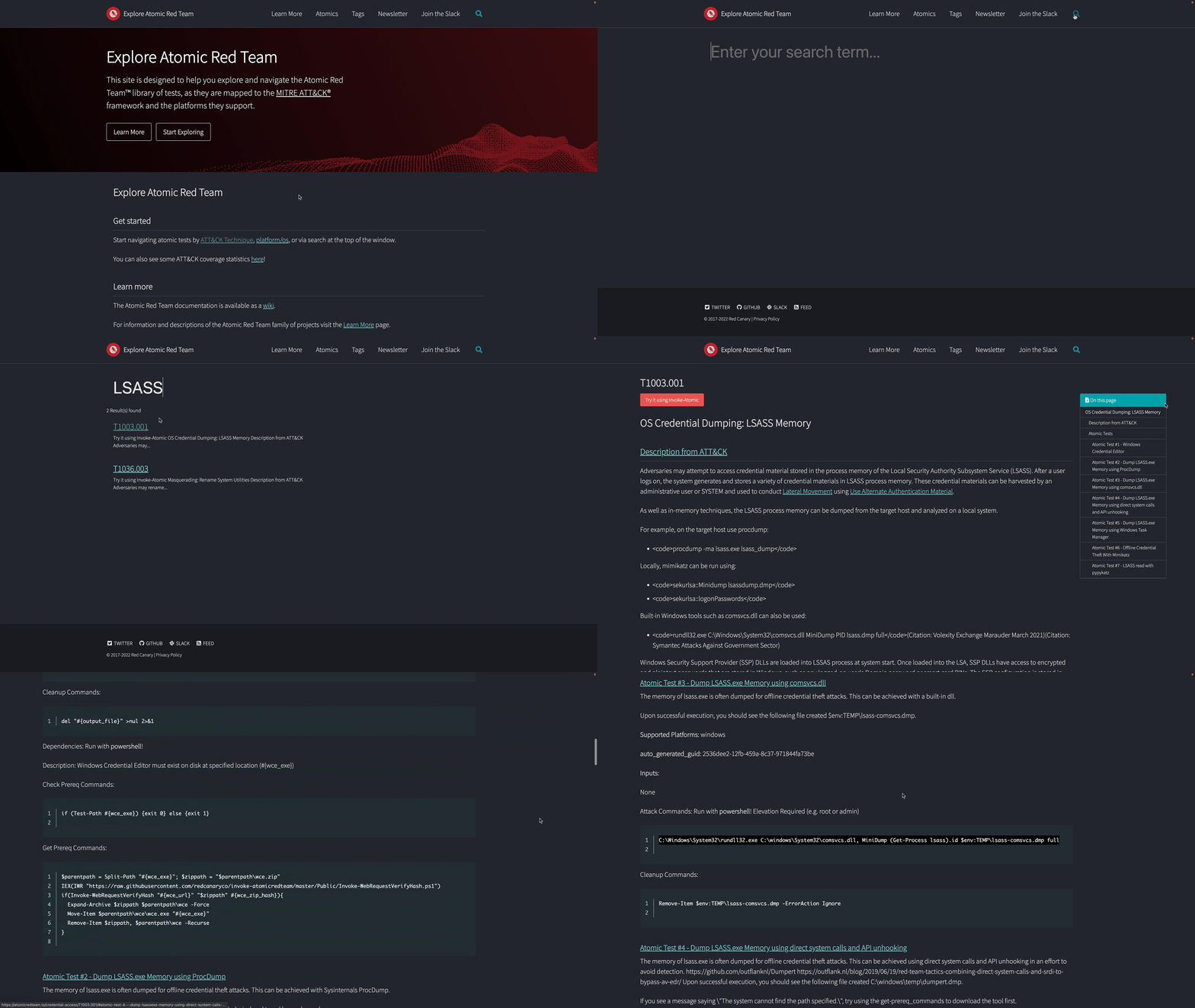
2. Choose a habit that is as easy as possible to perform
Most security programs think “we need to test this stuff,” resulting in an annual red team engagement. An annual test is better than no test, to be certain. However, a few dozen atomic tests throughout the year are more immediate, less expensive, and substantially more impactful.
Action: Create a checklist of the places that are most important to review immediately following execution of the Atomic Red Team test
The purpose of this step is to make it as fast and repeatable as possible to determine whether the test resulted in any defensive telemetry, ranging from log entries to alerts to confirmation that the activity was blocked outright. For example:
- Check log management for signals from the target endpoint or user
- Review target system logs for related events
- Check your Security Information and Event Management (SIEM) or log aggregator for alerts
- Look through your endpoint protection dashboard for alerts
- and so on . . .
It’s likely that you’ll build this list once, and evolve it over time. Even the act of identifying a new source of defensive telemetry that wasn’t initially identified can be considered an improvement.
3. Fit your habit into your routine
We’ve heard from hundreds of individuals and teams over the years about their approaches to testing with Atomic Red Team, and the teams that have done this most consistently have all made time and space for it as a part of their ongoing operational cadence. Some examples of where and how teams have fit atomic testing in their routine:
- as part of weekly/monthly learning activities (i.e., “brown bag” learning sessions)
- as a component of periodic purple team activities
- as a part of periodic maintenance windows (this is crucial as pre- and post-change testing can help to find regressions)
Action: Set aside 30 minutes per week to perform a test
For some, setting aside 30 minutes every week might seem like a challenge. For those in highly operational roles, such as incident response, you might not have the luxury of guaranteeing any given block of time. If you find yourself in this situation, challenge your manager with finding and making the space for you to do this. Alternatively, ask your manager to do this themselves! It might seem as though this type of work is a “want” and not a necessity, but if you aspire to run a program that is mature and effective, it cannot be achieved without making time for readiness activities alongside reactive, operational work.
A free tool for tracking your test activity
What gets measured gets managed. In the interest of making it easier to document and measure your test coverage, results, and overall progress, you can use or adapt this Google Sheets template. For each test that you perform, capture whether you:
- Observed the activity: This could be a single system log entry indicative of the behavior or any other source of data that would make it possible to detect, investigate, or respond to the activity in the future. We cannot detect what we cannot see, so this visibility measure is particularly important.
- Detected the activity: Did any of your analytics or security tools alert you following the test? Did your managed service provider or other security partners notice anything malicious or suspicious? Note that most MITRE ATT&CK techniques are not malicious or even suspicious on their own, so detections should not be treated blindly as pass/fail criteria.
- Blocked the activity: For the subset of tests where the behavior or the technique has no redeeming quality (think “techniques indicative of Mimikatz”), or where you have analytics that are high confidence signals of adversary activity, was it blocked or otherwise prevented by one of your technical controls?
This is a very basic set of data points, and that’s intentional. By focusing on a limited, consistent set of data that can be used to measure test coverage and outcomes, we leave room for teams to perform tests using any mechanism that they choose. You can copy and paste an Atomic Red Team test into your terminal every Friday morning, or you can use something like Invoke-Atomic to schedule periodic, distributed tests of varying complexity at predictable or random intervals.
If you’re using this system, document template, or otherwise performing Atomic Red Team tests as part of your program, we’d love to hear from you! Email us at [email protected].
Additional resources
- Read: Atomic Habits by James Clear, the book that started it all
- Learn: 30 Days to Better Habits, James Clear’s free email-based course
- Join: Atomic Red Team on Slack
- Subscribe: The monthly Atomic Newsletter
- Explore: Atomic Red Team tests on atomicredteam.io
WHERE TO START?


免責聲明:本部落格文章由 Zscaler 製作,僅供資訊參考,並以「現狀」提供,不保證其準確性、完整性或可靠性。Zscaler 對任何錯誤或遺漏,或基於所提供的資訊而採取的任何行動不承擔任何責任。本部落格文章中連結的任何第三方網站或資源僅為方便起見而提供,Zscaler 對其內容或做法概不負責。所有內容如有變更,恕不另行通知。存取此部落格,即表示您同意這些條款,並承認您有責任自行驗證並根據您的需求適當使用資訊。

