Zscaler 部落格
訂閱 Zscaler 部落格,第一時間獲取最新資訊!
Securing Government Workload Communications in the Public Cloud

As government agencies continue their journey towards digital transformation, many are embracing hybrid cloud deployments to modernize their operations. A transition to a public or private cloud brings new challenges, especially when it comes to securing workload communications. In this blog, we will delve into the reality of hybrid cloud deployments and explore how Zscaler's zero trust architecture provides a comprehensive solution for securing government workloads in the public cloud.
The Expanding Definition of Hybrid Cloud
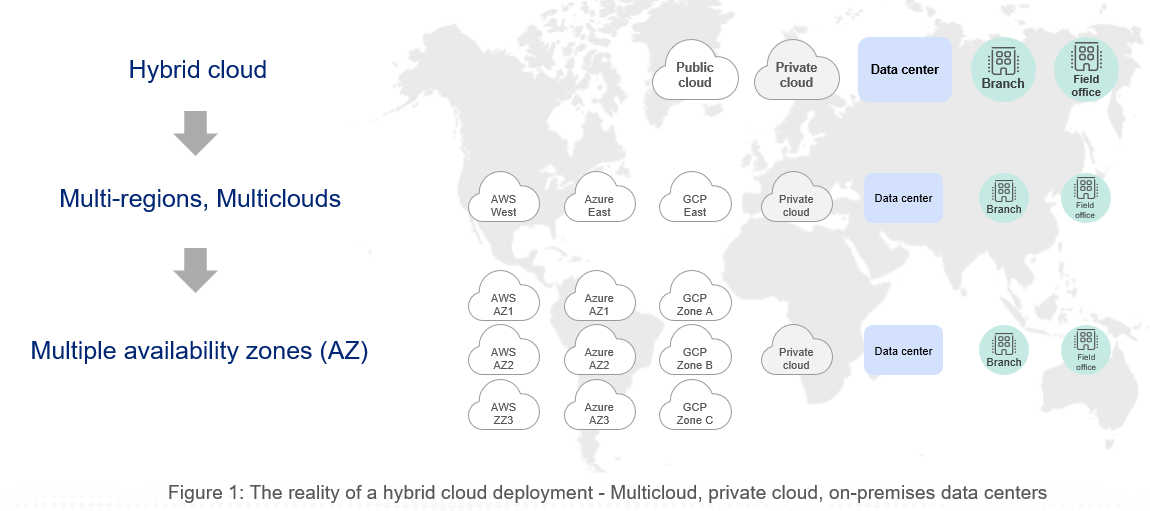
Hybrid cloud deployments have become increasingly complex as agencies expand their infrastructure across multiple regions and clouds. Rather than relying on a single cloud or region, agencies leverage different regional clouds to ensure availability and scalability. Additionally, within a specific region, agencies may need to consider availability zones to ensure business continuity. Figure 1 illustrates scenarios of hybrid cloud deployments.
Workload Communications in the Public Cloud
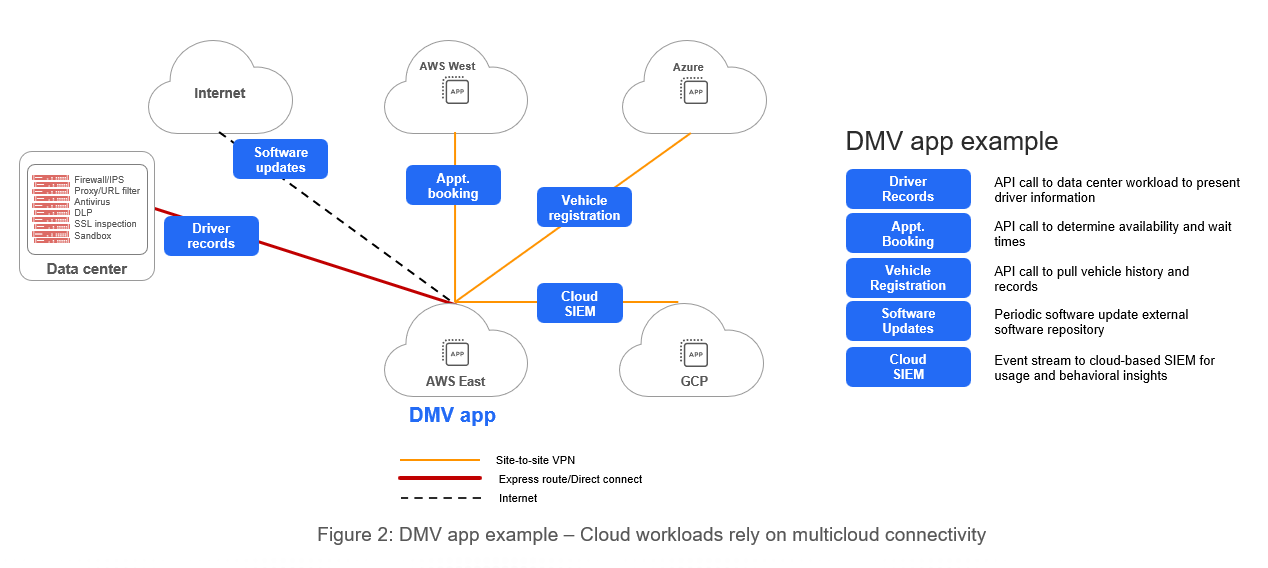
To illustrate the challenges of workload communications, let's consider the example of a Department of Motor Vehicles (DMV) application deployed in the AWS GovCloud. This application needs to interact with other workloads or applications, such as a CRM or ERP system in the data center, to access driver records. It may also need to communicate with scheduling applications in different regions or clouds, and even access vehicle registration information stored in a different cloud provider such as Azure. Additionally, the DMV application may require software updates and send logs to the Google Cloud Platform. Figure 2 shows
Legacy Architecture Challenges
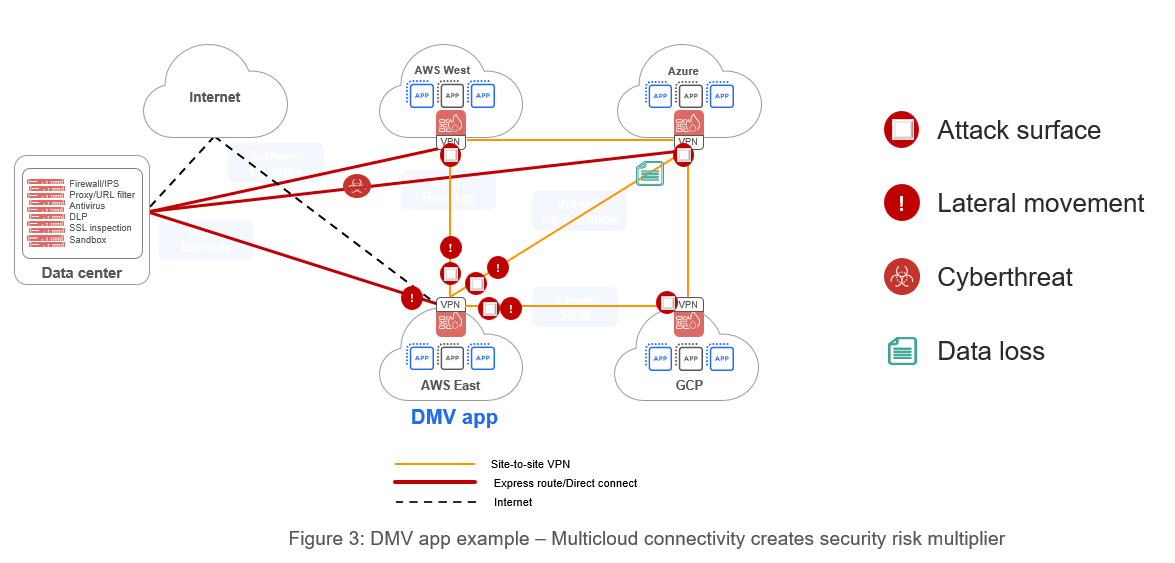
Traditionally, agencies have extended their on-premises architecture to the cloud by deploying firewalls and VPNs. While this approach may provide initial security, it also amplifies lateral movement, increases cyberthreats, and exposes the infrastructure to data leaks. Moreover, deploying and managing multiple firewalls and VPNs across different cloud environments and regions adds complexity and operational costs.
Introducing Zscaler's Zero Trust Approach
Zscaler offers a cloud-delivered security platform based on zero trust principles to address the challenges faced by government agencies in securing workload communications. By adopting a zero trust proxy-based architecture, Zscaler eliminates the expanded attack surface and lateral movement risks associated with legacy architectures.
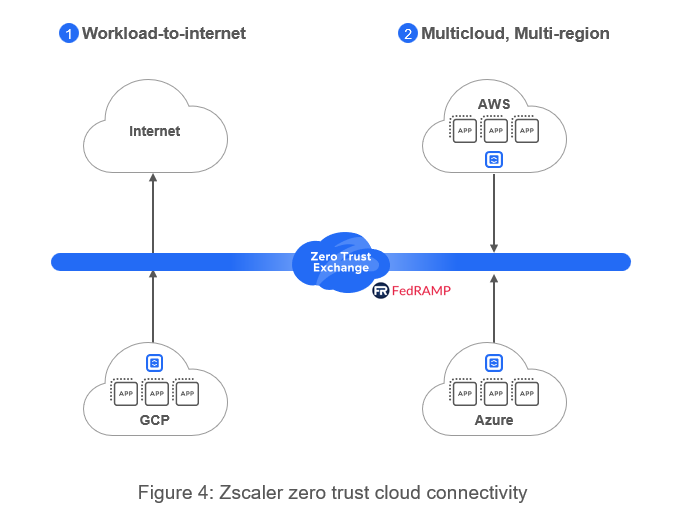
Connectivity and Security
Zscaler's platform provides both connectivity and security for workloads in the public cloud. It ensures secure connectivity by allowing access only to specific URLs or APIs, preventing open access to the internet. Workload-to-workload communications are based on least privileged access, ensuring that each workload can only communicate with authorized resources. Before any connection is established, zero trust-based authentication and authorization checks are performed, further enhancing security.
Threat Prevention and Data Protection
Zscaler's platform offers comprehensive threat prevention and data protection capabilities. It provides URL filtering, intrusion prevention, DNS protection, and behavior analysis, all backed by AI and ML-based risk analysis. Inline data protection ensures that sensitive data does not leak from workloads, with features such as regex-based checks, exact data management matching, OCR technology for file inspection, and AI/ML-based data classification.
TLS Decryption at Cloud Scale
With the increasing prevalence of encrypted traffic, TLS decryption at cloud scale becomes crucial. Zscaler's platform provides 100% inspection of traffic without compromising performance. This allows for effective threat prevention and data protection, ensuring the safety of data packets and preventing malicious intent.
Granular App-to-App Segmentation
Zscaler enables granular app-to-app segmentation, eliminating the need for expensive networking infrastructure or additional layers of segmentation software. This ensures that workloads can only access authorized resources, providing an additional layer of security.
The Common Platform Advantage
Zscaler's platform offers a common platform for securing workloads across multiple clouds. By installing lightweight cloud connectors in different clouds, agencies can benefit from standardized and consolidated security operations. This approach simplifies security management, reduces operational complexity and costs, and ensures consistent security policies across multiple clouds. It stops external threats, by protecting egress traffic from any malicious payload. It protects against insider threats by eliminating the threat of a bad actor within the agency who's got the credential to inflict harm, either by inserting a payload, a malicious payload, or trying to exfiltrate data sensitive data.
The Zero Trust Exchange is designed to eliminate lateral movement and reduce the attack surface significantly. Moreover, Zscaler's platform is both FedRAMP and StateRAMP Authorized and GovCloud ready.
For more information on Zscaler Workload Communications:
Watch the Webinar: Ensuring Cloud Workload Security for Federal and State Government


免責聲明:本部落格文章由 Zscaler 製作,僅供資訊參考,並以「現狀」提供,不保證其準確性、完整性或可靠性。Zscaler 對任何錯誤或遺漏,或基於所提供的資訊而採取的任何行動不承擔任何責任。本部落格文章中連結的任何第三方網站或資源僅為方便起見而提供,Zscaler 對其內容或做法概不負責。所有內容如有變更,恕不另行通知。存取此部落格,即表示您同意這些條款,並承認您有責任自行驗證並根據您的需求適當使用資訊。