Zscaler 部落格
訂閱 Zscaler 部落格,第一時間獲取最新資訊!
Threat Actor Abuses Agentic AI Pentesting Framework to Target South Korean Financial Institutions
Introduction
Zscaler ThreatLabz analyzed a recently active exploitation campaign in which a threat actor abused ARTEX to target South Korean financial institutions. ARTEX is an open source agentic penetration testing framework developed in China that uses large language models (LLMs) to automate reconnaissance and exploitation tasks. First observed in late September 2026, the campaign affected multiple South Korean financial firms and resulted in the exfiltration of personally identifiable information (PII) belonging to approximately 67,000 individuals.
ThreatLabz assesses with moderate confidence that the campaign is the work of a financially motivated, Chinese-speaking threat actor. The threat actor exploited peripheral internet-facing web applications, including customer-facing inquiry portals and employee-facing mobile application backends.
Recommendations
The threat actor used AI to support reconnaissance and exploitation in this campaign. ThreatLabz recommends the following practices to strengthen defenses against AI-assisted attacks. For additional context on AI-driven security testing, see our blog: When the Scanner Starts Thinking: Learnings from Mythos & GPT 5.5 Cyber in Security Testing.
- Reduce application exposure: Reduce your external exposure by moving your applications behind a Zero Trust access solution, like Zscaler Private Access (ZPA).
- Understand your assets and associated risks: Establish complete visibility into internet-facing and internal assets, including AI assets, and assess their exposure and vulnerabilities to prioritize remediation. Zscaler’s AI Asset Management, Asset Exposure Management, External Attack Surface Management, and Unified Vulnerability can support these efforts.
- Deploy deception controls: Use Zscaler Deception to detect suspicious reconnaissance and access attempts through decoy assets and accounts. Configure automatic containment to restrict the associated asset or identity’s access to production applications while capturing activity in the decoy environment.
- Prioritize Zero Trust everywhere architecture: Apply Zero Trust consistently across remote and on-premises environments. Enforce least-privilege user-to-application access to limit lateral propagation and reduce the blast radius from AI-driven attacks.
- Use AI red teaming and guardrails for your production models: Use AI red teaming and guardrails to assess susceptibility to prompt injection and unsafe outputs. Monitor for hallucinations and model drift over time.
- Use AI-powered exposure management: Use the Zscaler Exposure Management remediation agent to prioritize remediation and patching for high-risk exposures across external and internal assets.
- Alert on enumeration: On partner and employee portals, alert on sequential lookups and unusually high numbers of records accessed per session. Apply rate limits to affected endpoints. Enforce server-side authorization for access to customer records and limit responses to the fields required for the operation.
- Treat open source pentesting harnesses as hostile code: If your organization uses an open source pentesting harness, isolate it from production, avoid storing production credentials in it, and enforce testing scope through configuration and code rather than prompts alone. Review forks before execution. Use Zscaler’s open source Agentic Radar to map agent workflows from source code.
- Test authorization regularly: Repeat security testing as applications change, and verify that users cannot access records or functions outside their assigned permissions.
Threat Details
ARTEX is an agentic penetration testing framework originally released on GitHub by the developer "Autumn-27". It orchestrates multiple LLM backends to autonomously perform reconnaissance, vulnerability identification, and exploitation, significantly lowering the technical barrier for conducting complex intrusion campaigns.
The threat actor configured ARTEX to use the following AI backends:
Backend | Role |
|---|---|
DeepSeek v4.1-flash | Primary LLM Backend |
Zhipu AI GLM-5.3 | Supplementary Reasoning |
SpaceXAI Grok 4.6 | Supplementary Reasoning |
Table 1: AI backends configured in ARTEX and their roles in the campaign.
Following public disclosure of the abuse, the ARTEX developer made the project closed source. However, previously downloaded copies and forks may remain available.
How it Works
The campaign unfolds in four phases from ARTEX-assisted reconnaissance and exploitation to data theft and monetization planning.
- Reconnaissance: ARTEX agents autonomously identified and probed peripheral internet-facing web applications outside the institutions’ core banking infrastructure, including customer-facing inquiry portals and employee-facing mobile application backends.
- Exploitation: LLM-driven agents identified and exploited vulnerabilities including SQL injection and authentication bypass in the peripheral web applications to gain unauthorized access.
- Data exfiltration: Stolen records included full names, phone numbers, annual income figures, and loan limits. This information could support subsequent financial fraud and social engineering.
- Monetization planning: The threat actor used Claude Code sessions to seek advice on selling stolen South Korean financial PII and to locate Korean-language Telegram channels used to sell stolen data.
Attack chain
The attack chain below illustrates the four phases of the campaign.
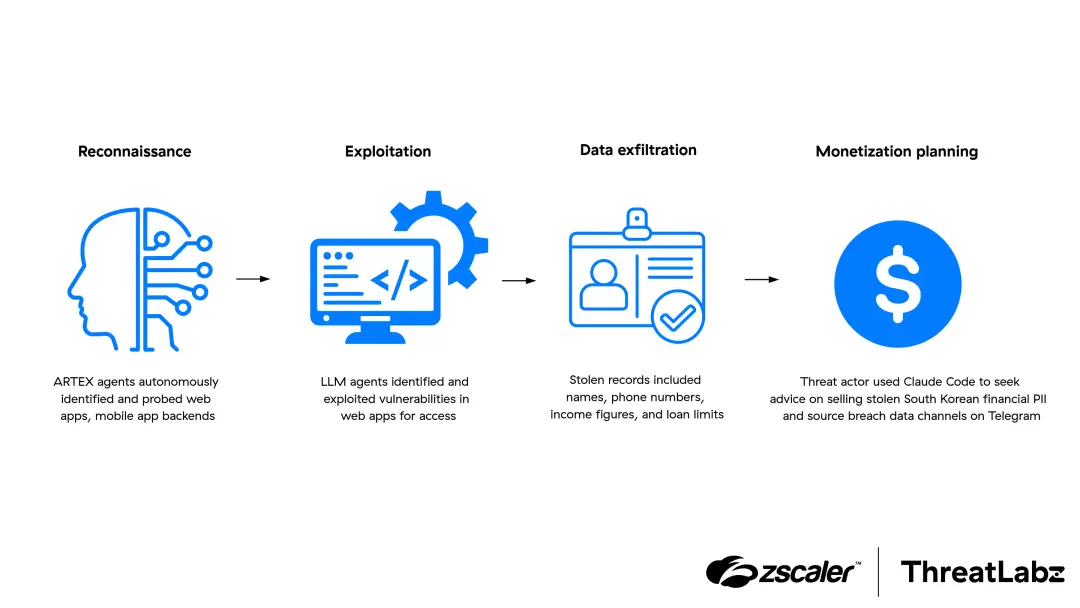
Figure 1: ARTEX attack chain, from reconnaissance and exploitation to data exfiltration and monetization planning.
ARTEX architecture and agent workflow
ARTEX uses an orchestration layer, known as a harness, to coordinate its models and agents. The harness provides the model with the current task state and previous results. The model selects the next action, a worker executes the selected tool against the target, and the results are returned to the model to inform subsequent actions.
The planner divides the engagement into tasks, while worker agents execute tools and store findings, and the reporting component generates a report containing validated findings.
The harness supported multiple LLM backends. In this campaign, the threat actor configured ARTEX to use the services listed in Table 1.
ARTEX guardrails and scope controls
ARTEX included guardrails intended to restrict targeting of government entities and universities through a default blocklist. However, these restrictions did not extend to financial institutions, as shown in ARTEX’s source code below.
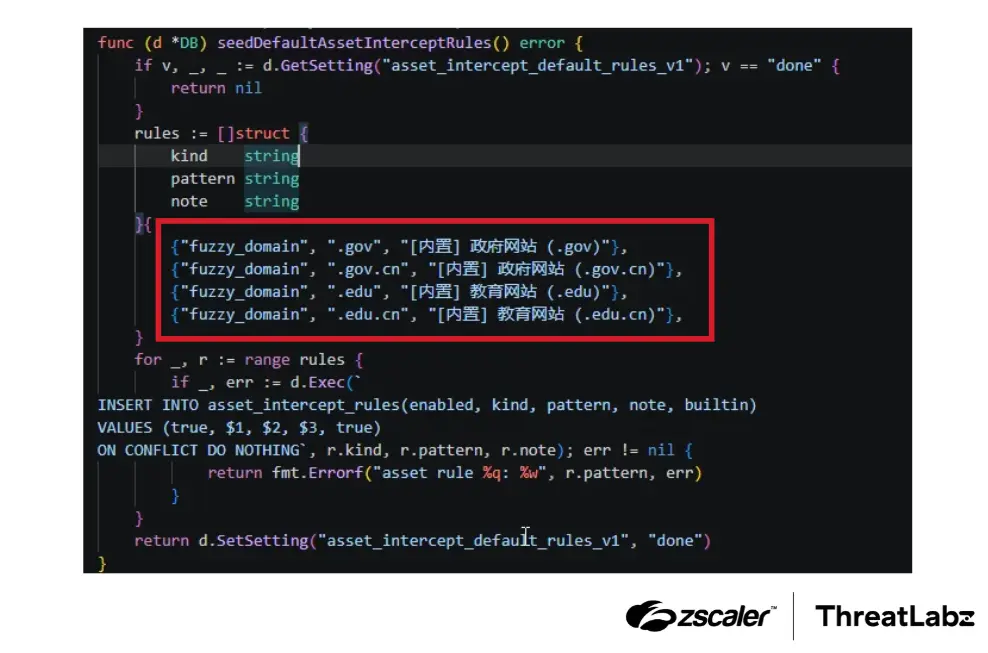
Figure 2: ARTEX source code defining default government and education domain filters.
Behavioral Indicators
The following table outlines potential indicators defenders can investigate alongside other evidence of suspicious activity.
Indicator | Description |
|---|---|
Outbound API calls to api.anthropic.com, api.deepseek.com, open.bigmodel.cn, or api.x.ai | Potential use of LLM services; investigate unexpected calls in conjunction with other suspicious activity |
High-frequency automated HTTP requests with sequential enumeration patterns against login and search endpoints | Potential automated reconnaissance or enumeration |
Outbound transfers of structured data including names, phone numbers, and financial information over HTTPS to unauthorized external destinations | Potential exfiltration of financial PII |
Presence of *.aspx or *.jsp files in unexpected web application paths | Potential web shell activity |
Table 2: Potential behavioral and file-based indicators associated with the techniques described in this campaign.
Conclusion
The threat actor used ARTEX to support reconnaissance and exploitation in targeting South Korean financial institutions. The ARTEX agents identified and probed peripheral, internet-facing web applications, then exploited vulnerabilities in those applications to gain unauthorized access. ThreatLabz encourages organizations to follow the recommendations in this blog, such as reducing application exposure and deploying deception controls, to strengthen defenses against AI-assisted attacks.
How Zscaler Can Help
Stage | Recommended Mitigation |
|---|---|
Minimize the external attack surface |
|
Prevent compromise |
|
Prevent lateral threat movement |
|
Prevent data loss |
|
Zscaler Coverage
Zscaler’s multilayered cloud security platform detects indicators related to the campaign at various levels with the following threat name:


免責聲明:本部落格文章由 Zscaler 製作,僅供資訊參考,並以「現狀」提供,不保證其準確性、完整性或可靠性。Zscaler 對任何錯誤或遺漏,或基於所提供的資訊而採取的任何行動不承擔任何責任。本部落格文章中連結的任何第三方網站或資源僅為方便起見而提供,Zscaler 對其內容或做法概不負責。所有內容如有變更,恕不另行通知。存取此部落格,即表示您同意這些條款,並承認您有責任自行驗證並根據您的需求適當使用資訊。