/ What Is Spear Phishing? (And How It Differs from Phishing)
What Is Spear Phishing? (And How It Differs from Phishing)
Spear phishing is a type of cyberattack that uses "social engineering" techniques through email or other messaging to deceive a specific individual into divulging sensitive information, downloading ransomware or other malware, and more. Spear phishing attacks use publicly available or stolen personal data and other information specific to their targets to make their deception more convincing than other broader phishing techniques.
Introduction
Humans make mistakes—and that is the basis for the success of both phishing and spear phishing. Both leverage human fallibility to trick, deceive, and pressure people into taking actions that play into the hands of cybercriminals, contrasting with other cyberattacks that target data and systems directly.
Consider the scale and evolution of the threat landscape:
- 202% Surge in Email Attacks: Phishing attacks based on emails jumped by 202% in 2024, according to the SlashNext 2024 Phishing Intelligence Report.
- 3.4 Billion Daily Messages: An estimated 3.4 billion phishing emails, many of them automated, are sent every day.
- 393% Increase in Finance & Insurance: The finance and insurance sector experienced both the highest number of phishing attempts and the most significant increase in attacks, rising 393% compared to the previous year.
- High Breach Impact: According to a report by Barracuda Networks, spear phishing represents less than 1% of total phishing attacks due to the time-consuming research required, yet it is responsible for a disproportionately large percentage of successful breaches.
- AI-Powered Escalation: AI chatbots and large language models (LLMs) are empowering criminals to create increasingly sophisticated phishing attacks, according to TechTarget.
Spear Phishing vs. Phishing: What’s the Difference?
While both attacks rely on psychological manipulation to access credentials, devices, or data, spear phishing differs from generic (bulk) phishing primarily in its target audience and level of customization:
Origins and Evolution of Phishing
Phishing originated in the mid-1990s, when the term was first used in a Usenet newsgroup during attacks associated with America Online (AOL). According to Phishing.org, hackers stole AOL passwords and generated randomized credit card numbers to open accounts for spamming other users. After AOL implemented security measures, attackers began impersonating AOL staff, asking users to verify their account or billing data. To learn more about foundational phishing mechanics, read our companion guide, What Is Phishing?
How Spear Phishing and Phishing Attacks Work
A phishing or spear phishing attempt starts as an email, social media message, text message, or phone call that appears to come from a legitimate, trusted source. The goal is to evoke fear, curiosity, responsibility, or a sense of urgency to persuade the recipient to click a malicious link, download a compromised file, transfer funds, or divulge sensitive data.
To fool the recipient, attackers mimic corporate logos and branding, spoof caller IDs or email addresses, and build bogus websites. For example, a phishing email might copy visual elements from a target’s bank and prompt them to verify a transaction on a fake login page.
In spear phishing, attackers devote extensive time to researching the target’s work, personal life, friends, and family. Because the communication appears to come from a known contact—such as a manager requesting urgent financial details, a customer service agent responding to a complaint, or a charitable organization asking for donations—the target lets their guard down. Once the user takes the bait, the attacker can steal identity information, install malware, or gain entry to the organization’s IT environment.
The Role of Generative AI and Deepfakes
Recent iterations of phishing heavily leverage generative AI. Harvard Business Review warns that GenAI tools make phishing emails "more advanced, harder to spot, and significantly more dangerous," enabling threat actors to fully automate campaigns using LLMs like ChatGPT. For instance, Zscaler ThreatLabz demonstrated how a convincing fake Microsoft login page can be generated with just three prompts.
Deepfake phishing takes AI manipulation further by fabricating audio, video, or images to gain trust:
- Voice Cloning: With just a few minutes of audio samples, deepfake voice generators can realistically imitate an executive or colleague for phishing phone calls (vishing).
- Workforce Impersonation: According to a CIO article, North Korean threat actors are using deepfakes to impersonate U.S. citizens during the hiring process to win cybersecurity jobs at American corporations and exfiltrate sensitive data. Read more about these insider threats in Red Canary’s 2025 Threat Detection Report.
Real-World Phishing Examples
- Change Healthcare (2024): Malicious actors breached Change Healthcare’s IT system after harvesting employee logins through phishing attacks. The criminals disrupted operations, stole patient data, and demanded a ransom they ultimately did not honor.
- Starbucks Brand Impersonation: Attackers targeted Starbucks customers using spoofed email addresses and official corporate branding, offering a "free coffee gift" via malicious links designed to harvest personal and financial information.
Types of Spear Phishing and Related Phishing Techniques
Threat actors use a wide range of specialized techniques across targeted spear phishing and broader phishing campaigns:
Targeted Spear Phishing Variations
- Whaling: Aimed at "high-value" individuals with privileged access to sensitive data or finances, such as a company CEO, senior executive, celebrity, or politician.
- Business Email Compromise (BEC) & CEO Fraud: Attackers use spear phishing to compromise an organization’s email system or create lookalike accounts to impersonate an owner, colleague, or CEO. Often paired with wire fraud, these attacks pressure employees into transferring funds or sensitive data.
- Clone Phishing: Phishers replicate legitimate emails previously sent by trusted sources (like financial institutions or business services) and replace the original links or attachments with malicious ones—often indicating the attacker already has some access to the victim's email environment.
- Angler Phishing: Hackers pose as company customer service representatives on social media (e.g., LinkedIn or X/Twitter) or via text message to address customer complaints or offer deals, tricking users into divulging credentials.
- Brand Impersonation & Malware Delivery: Attackers pose as a familiar brand using phony websites or apps to steal credentials, or attach malicious executables designed to disrupt IT systems.
Broader Phishing Delivery Vectors
- Quishing (QR Code Phishing): Uses fake Quick Response (QR) codes embedded in emails, texts, signage, or publications to redirect users to malicious websites. Quishing is especially dangerous because scanning a code on a mobile device often bypasses traditional corporate email security controls.
- Smishing (SMS Phishing): Executes attacks via text messaging, exploiting lower user awareness around mobile links (e.g., fake urgent bank alerts).
- Adversary-in-the-Middle (AiTM): Attackers send a phishing email linked to a proxy server positioned between the user and the legitimate website they are impersonating, capturing login credentials and session cookies in real time.
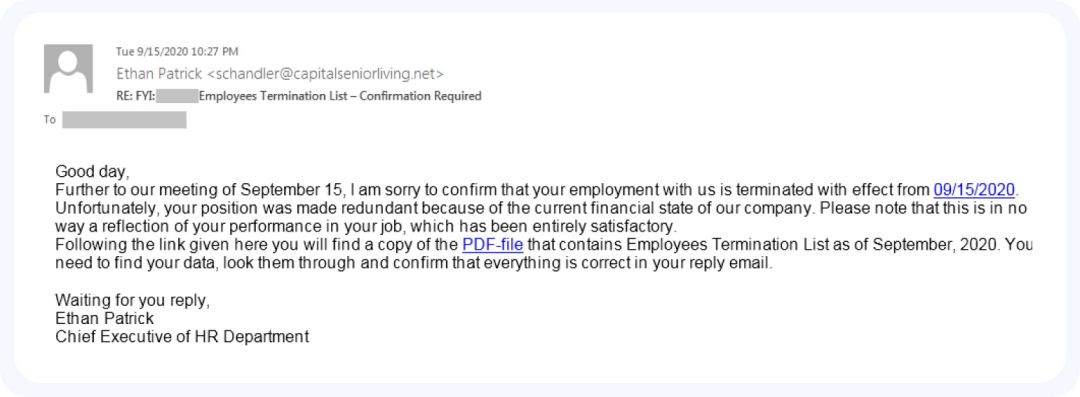
An example of a spear phishing email. Pay attention to the unusual phrasing and the framing of specific details.
Who Are the Targets of Spear Phishing?
- Privileged Individuals: While anyone can be targeted using stolen personal details, employees with elevated roles, financial authority, or administrative permissions face the greatest risk.
- Finance and Insurance: Driven by the potential for immediate financial fraud and identity theft, this sector remains the top target for phishing campaigns.
- Distributed Businesses: Infiltrating corporate networks gives attackers access to massive volumes of sensitive data, costing millions in recovery, fines, and lost trust. The shift to cloud environments and remote work has expanded the corporate attack surface, introducing new vectors for compromise.
How to Identify a Spear Phishing Attack
Because phishing exploits human vulnerability, security awareness training must help users recognize psychological triggers and technical red flags across emails, texts, phone calls, and social media:
- Emotional Triggers & Urgency: Scams often manufacture a crisis (e.g., account cancellation or penalties) or an urgent deadline. In spear phishing, urgency is frequently tied to professional responsibility—feeling pressured by a sender posing as an executive to transfer funds immediately or risk your job.
- Unusual Requests & Overpromising: Be wary of odd requests lacking explanation (such as a bank asking you to confirm your identity via a wire transfer) or offers that sound too good to be true.
- Suspicious Links, Attachments, and Overlooked Details: Always hover over links to verify that the destination URL and domain extension (.com, .org, .edu) match the legitimate organization. Look closely for mismatched or slightly altered sender email addresses.
- Frequently Imitated Senders: Zscaler ThreatLabz research found that Microsoft remains the most imitated brand, accounting for 43.1% of phishing attempts, with OneDrive and SharePoint also ranking among the top five targeted brands.
- Unusual Language or Poor Quality: Traditional bulk phishing often features generic greetings ("Dear Sir or Madam"), spelling errors, or awkward phrasing from foreign translation. However, because LLMs can generate flawless text, users must also watch for subtle shifts in tone or writing style that don't match a known colleague's normal voice.
How to Prevent and Defend Against Spear Phishing
Increasing user awareness—through role-specific training and regular simulated phishing attacks—is essential, but human vigilance alone cannot stop highly researched spear phishing. Organizations must combine strict verification policies with a layered, cloud-native security architecture:
1. Enforce Strong Identity, Email, and Policy Controls
- Phishing-Resistant MFA: Require multifactor authentication based on public/private key cryptography, such as FIDO (Fast Identity Online) security keys or authenticator apps (e.g., Okta Verify, Google Authenticator), to defend against AiTM tactics that intercept SMS codes.
- Email Authentication & Cloud Email Security: Implement Domain-based Message Authentication, Reporting and Compliance (DMARC) alongside Sender Policy Framework (SPF) and DomainKeys Identified Mail (DKIM) to verify sender domains and stop spoofing. Pair this with cloud email security products and spam filters to quarantine suspicious messages before they reach the inbox.
- Out-of-Band Financial Verification: Establish strict verification procedures for all financial transactions and sensitive data requests—even when they appear to come directly from the CEO or CFO.
- Streamlined Incident Reporting: Provide a built-in email reporting button and an incident response playbook. Encourage teams to report incidents externally to the U.S. Federal Trade Commission and the Anti-Phishing Working Group.
- Continuous Patching & Endpoint Hygiene: Update software promptly to minimize vulnerabilities, enforce strong password policies, restrict what employees share on social media, and maintain updated endpoint antivirus protections.
2. Implement Inline Network and Zero Trust Protections
- Encrypted Traffic Inspection: More than 95% of attacks use encrypted channels. Combine end-to-end encryption of data in transit with full inline TLS/SSL inspection so malicious payloads cannot hide in encrypted traffic.
- Advanced Threat Protection & Browser Isolation: Use inline sandboxing to quarantine and analyze unknown files, and deploy browser isolation and URL filtering to block newly registered or fraudulent domains from launching.
- Threat Intelligence Feeds: Enrich security telemetry with automated context on reported URLs, indicators of compromise (IOCs), and attacker tactics, techniques, and procedures (TTPs) to accelerate detection and remediation.
- Zero Trust Architecture: Enforce granular segmentation, least-privileged access, and continuous monitoring so that even if a user falls for a spear phishing lure, the attacker cannot move laterally across the network.
How Can Zscaler Help?
User compromise is one of the most difficult security challenges to overcome because it relies on exploiting human trust at close range. To minimize the risk and impact of spear phishing, organizations need automated prevention controls built on a holistic zero trust strategy.
The Zscaler Zero Trust Exchange™ platform minimizes the attack surface and stops spear phishing at every stage of the attack chain:
- Preventing Initial Compromise: Full TLS/SSL inspection, AI-powered phishing detection, browser isolation, and policy-driven URL filtering block access to malicious websites and fake login pages in real time.
- Preventing Lateral Movement: With the Zero Trust Exchange, users connect directly to applications—never to the corporate network—ensuring that malware or compromised credentials cannot move laterally across your environment.
- Stopping Insider and Compromised-User Threats: Our cloud proxy architecture stops private application exploit attempts and detects sophisticated attack techniques with continuous inline inspection.
- Stopping Data Loss: Integrated Data Loss Prevention (DLP) inspects data in motion and at rest to prevent active attackers from exfiltrating sensitive credentials or intellectual property.
Protect your organization against spear phishing attacks with the power of a complete zero trust architecture.
Protect your organization against spear phishing attacks with the power of a complete zero trust architecture.
Suggested Resources
Frequently Asked Questions
While most phishing targets victims at random, spear phishing targets specific individuals. Attackers generally already have some information about their targets before they carry out the attack, which they can use to make their phishing messages much more convincing.
Between 2013 and 2015, an attacker invoiced Facebook and Google for roughly US$100 million while posing as Quanta, a real technology firm that worked with them. The companies only recovered about half after the attacker was charged.
In 2016, a BEC scammer defrauded the Belgium-based Crelan Bank of more than 70 million euros by posing as an executive and requesting transfers of funds.
Cybercriminals generally craft a spear phishing attack after obtaining information about their target, either stolen or from publicly available sources, such as social media.
If you receive a phishing email, report it. Don’t respond to it or otherwise interact with it. Your security team, incident response, or IT personnel will notify relevant parties such as software vendors to reduce the likelihood of a repeat attack.
The most common types of phishing attacks come through email, with messages designed to trick you into giving up your data or downloading malware. Voice phishing attacks (vishing) and SMS message phishing (smishing) are also becoming more common.