/ What Is AI Security Posture Management (AI-SPM)?
What Is AI Security Posture Management (AI-SPM)?
AI security posture management (AI-SPM) is a security framework that protects enterprise AI assets. It secures AI models, data pipelines, apps, and infrastructure from AI-specific threats that cloud security posture management (CSPM) and data security posture management (DSPM) tools miss. AI-SPM continuously assesses AI ecosystems to identify and remediate threats, policy violations, and regulatory noncompliance.
Key Takeaways
AI security posture management continuously discovers, monitors, and secures AI models, transactions, and datasets.
• AI-SPM protects against AI-specific attack paths such as jailbreaking, prompt injection, and exploitation of over-privileged non-human identities (NHIs).
• It’s essential to adopt zero trust alongside AI-SPM. Inline zero trust proxies continuously verify user identities and sanitize AI model outputs. This process enhances AI-SPM and creates proactive defenses for AI assets.
• AI-SPM streamlines compliance audits. It benchmarks AI model configurations and data flows against compliance frameworks such as the NIST AI Risk Management Framework, the EU AI Act, and GDPR.
“AI/ML activity increased 83% year-over-year, reaching nearly one trillion transactions across an ecosystem of more than 3,400 applications.Enterprises blocked 39% of overall AI/ML transactions, underscoring continued concerns about data exposure, privacy, and policy alignment as AI usage expands.”— Read the ThreatLabz 2026 AI Security Report |
But traditional security tools such as data security posture management (DSPM) and cloud security posture management (CSPM) can’t keep up. They don’t provide the visibility or control over AI assets that’s necessary for AI security.
What Security Risks Does AI Introduce?
Threat actors use AI to conduct attacks at record speed, as shown in recent VPN security research from ThreatLabz.
GenAI tools and other AI systems also introduce unique AI security risks, such as:
- Shadow AI usage and improper usage of unsanctioned LLMs, which causes data leakage. If an employee shares sensitive business data with a public GenAI application, that model provider can retain the data and use it to train future models.
- Jailbreaking attacks happen when threat actors bypass an AI model’s safety guardrails. Threat actors manipulate AI models to share sensitive data like personally identifiable information (PII) from customers.
- Prompt injection attacks happen when threat actors hide malicious instructions in assets like files and databases. When AI models reference those assets to answer user queries, they execute the instructions.
- Threat actors use non-human identities, such as those granted to AI agents, to breach enterprise systems.
What Makes Up an AI-SPM Solution? Core Components and Features
A complete AI security posture management architecture includes five core components to protect AI systems:
AI-BOMs and Centralized AI Asset Inventories
AI asset management tools give visibility into AI ecosystems. They generate an AI bill of materials (AI-BOM) for every model, dataset, library, and plugin. AI-BOMs capture information about model provenance, versioning, data training sources, and licensing.
AI asset registries act as centralized databases that catalog and monitor every AI asset across the entire enterprise. These registries record assets such as embedded AI tools, commercial LLMs, and self-hosted models.
Vulnerability and Risk Assessment Engine
Threat intelligence works with behavioral baselining and dynamic risk scoring to inspect enterprise AI assets by integrating:
- OWASP Top 10 for Large Language Model Applications, which identifies common vulnerabilities in generative AI applications.
- MITRE ATLAS matrix for AI systems, which maps known attacker TTPs that target AI assets.
- Dynamic risk scoring, which assigns and updates risk scores based on real-time signals. These signals include everything from configuration changes to unusual behavior patterns.
AI Data Loss Prevention (DLP)
AI data loss prevention (DLP) is typically deployed as an inline proxy that sits between users and AI applications.
- Inline prompt inspection and dynamic masking automatically redacts or blocks information before it reaches model APIs. Information blocked includes sensitive data like financial records, proprietary code, PII, and protected health information (PHI).
- Context-aware data classification uses machine learning instead of static regex to analyze conversational nuance and intent behind prompts.
- Response filtering sanitizes LLM outputs to prevent jailbreaking attempts and leakage of sensitive training data.
Automated Policy Enforcement
AI-SPM integrates with existing identity and access management (IAM) and SecOps infrastructure to enforce access policies for AI assets.
- Granular and identity-aware access controls enforce role-based permissions. These permissions govern which users or service accounts can query AI models.
- Dynamic API rate limiting blocks suspicious volumes of API requests, which are indicative of model denial of service (MDoS) attacks or data exfiltration attempts.
- Entity isolation can revoke user access to AI assets if the system identifies suspicious behavior.
Compliance Mapping and Reporting
AI-SPM simplifies AI governance by:
- Comparing your enterprise’s AI asset inventory and configuration states against global standards, including the NIST AI Risk Management Framework (RMF) 1.0 and NIST AI 600-1, the EU AI Act, and ISO/IEC 42001.
- Generating audit-ready reports to show compliance with data privacy laws, such as GDPR, CCPA, and HIPAA.
How AI-SPM Secures the AI Lifecycle
AI-SPM platforms address security across the full AI lifecycle:
Step 1: Discover and Map the AI Attack Surface
AI-SPM platforms continuously scan environments such as:
- AI models from model providers including OpenAI (ChatGPT), Google (Gemini), Anthropic (Claude), and Meta (Llama)
- Enterprise AI cloud platforms including Amazon Bedrock, Azure AI Foundry, and Google Vertex AI
- Third-party AI model hosting platforms including Hugging Face and Replicate
- Private LLM deployments that are for internal employee use only
Step 2: Assess Security Posture and Prioritize Risk
Vulnerability scans review code, models, and dependencies. They detect configuration drift in API integrations and flag other runtime vulnerabilities.
AI-SPM assesses each model’s susceptibility to different types of AI attacks including model denial of service (MDoS) attacks. It creates a dynamic risk graph that automatically assigns priority scores to risks based on contextual information.
Step 3: Secure Data in Motion
AI-SPM intercepts all prompts submitted to AI systems and analyzes them for suspicious behavior.
Dynamic data masking automatically redacts or masks any sensitive information that users input into a GenAI prompt. The platform also scans LLM outputs for sensitive data, secrets, and malicious payloads before they reach users.
Step 4: Automate Remediation and Threat Containment
AI-SPM uses agentic SecOps workflows and triggers automated response playbooks via its SOAR integration. It also flags AI configuration drift.
Step 5: Maintain Compliance
AI-SPM continuously audits AI assets to maintain compliance with regulatory requirements such as the EU AI Act, NIST AI RMF 1.0, NIST AI 600-1, and industry-specific data security frameworks like HIPAA.
AI-SPM also tracks configuration and posture drift over time.
AI-SPM Architecture: How AI-SPM, DSPM, and CSPM Integrate
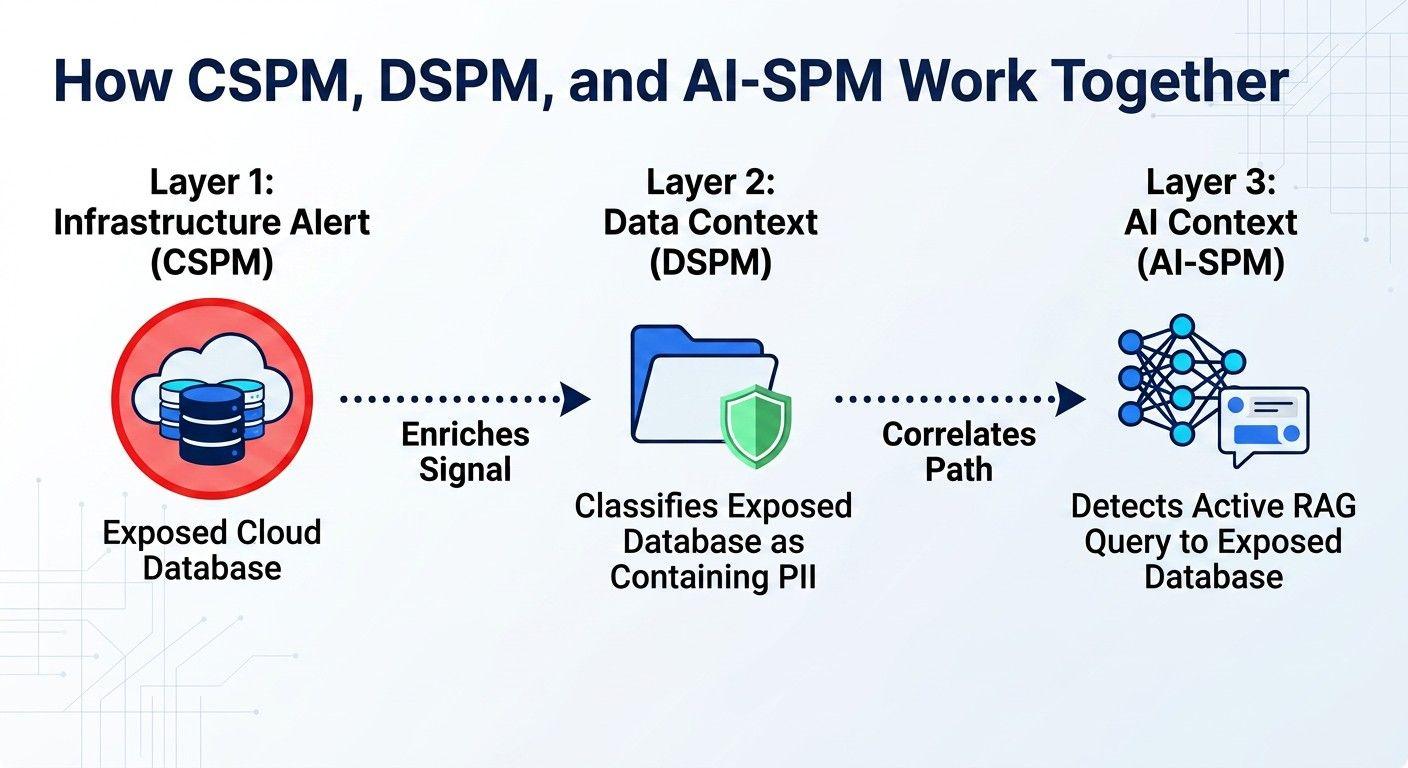
AI-SPM works with DSPM and CSPM to act as a unified security stack that monitors risk across AI assets, cloud infrastructure, and data.
Data security posture management (DSPM) monitors data movement, location, and access controls. It finds sensitive records in the organization and surfaces misconfigurations and overly permissive access policies to other tools, which can enforce those policies.
Cloud security posture management (CSPM) monitors and flags misconfigurations in cloud resources such as virtual machines, container registries, and identity and access management (IAM) permissions.
By sharing telemetry, AI-SPM, DSPM, and CSPM can map attack paths that cross traditional security boundaries. They correlate signals to generate an alert for a single incident, and that unified context gives security teams a better understanding of attacker TTPs for that incident.
How Do Enterprises Use AI-SPM? Key Use Cases
Detect and Manage Shadow AI
Enterprises use AI-SPM to manage shadow AI. Shadow AI refers to GenAI apps and other AI tools that employees adopt without security or IT’s approval. Without AI-SPM, IT can’t map the entire AI attack surface.
Secure Regulated Data in Machine Learning Pipelines
Enterprises use AI-SPM to secure custom machine learning models. The platform scans training databases for regulated data, such as PII and PHI, and flags it for removal.
AI security posture management also tracks and validates the source, or provenance, of training datasets.
Maintain Regulatory Compliance
AI-SPM automates auditing requirements that are outlined by the NIST AI Risk Management Framework. It also helps organizations comply with a range of regulatory requirements, such as:
- GDPR Article 17, also known as the Right to Erasure or the “right to be forgotten.” But removing personal data from LLMs is a challenge. AI-SPM maintains GDPR compliance by flagging PII for removal before it enters any LLM.
- The 45 CFR Section 164.308 of HIPAA requires regular risk analysis of all systems that handle protected health information.
Manage Industry-Specific AI Security Concerns
Why Zero Trust Architectures Matter in AI Security
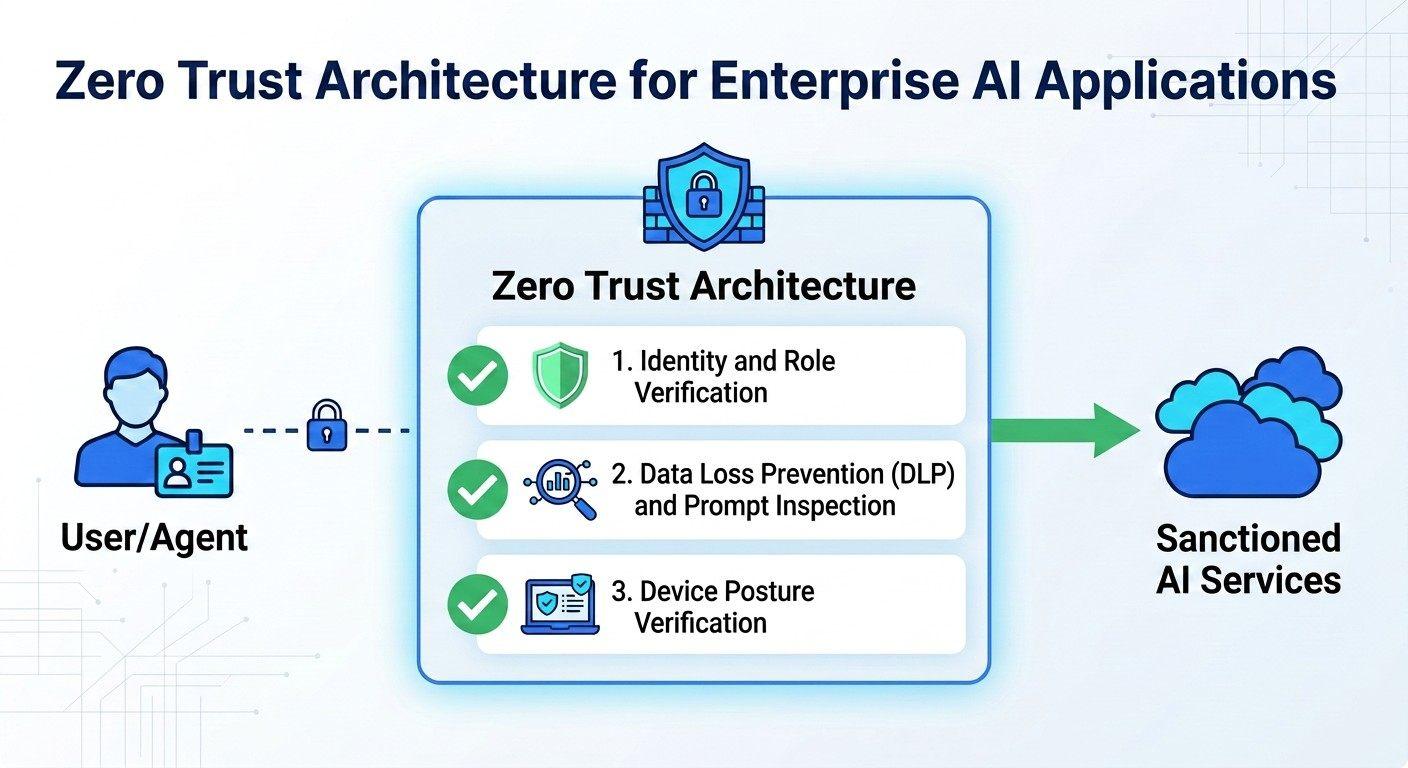
Because AI interactions are decentralized and ephemeral, traditional perimeter-focused network defenses can’t secure them. For example, a firewall can’t prevent an employee from sharing proprietary source code with a public GenAI tool.
Zero trust architectures are the most effective approach to securing these types of interactions. With zero trust, enterprises continuously verify each user, data flow, and model request at the transaction level.
How To Build an AI-SPM Program
Building an AI-SPM program helps organizations move from reactive threat detection towards a proactive, governance-led security model. To get started, enterprises should follow these steps and best practices:
Step 1: Establish Governance and Risk Baselines
- Create a cross-functional AI security committee with members across security, legal, and machine learning teams. This establishes AI-SPM program ownership early.
- Define data classification policies that determine the types of data, such as PII or intellectual property, LLMs can access.
- Classify AI model risks by model type, such as self-trained internal models and public APIs.
Step 2: Define AI Model Adoption and Approval Workflows
- Create a list of all sanctioned AI models, GenAI apps, and other AI tools. Share that list with every employee and contractor in the organization.
- Make it easy for developers to submit new AI models or AI apps for security review and approval.
To get visibility into your current AI usage at this stage, create AI asset registries and dynamic AI-BOMs.
Step 3: Enforce Zero Trust and Least-Privileged Access Controls
- Define and enforce role-based access control (RBAC) for AI models and GenAI apps.
- Establish non-human identity access controls. These controls prevent agentic AI from executing high-risk actions without human approval.
As you implement zero trust, it’s a best practice to establish user-inherited RAG access policies. These policies prevent AI models from sharing sensitive files with unauthorized users.
Step 4: Adopt AI Threat Detection
- Integrate AI-SPM alerts into your SIEM and SOAR platforms.
- Update incident response playbooks to address AI-specific security weaknesses and attack types.
- Enable your SOC with AI security training.
AI-SPM best practices at this stage include deploying inline inspection proxies into your runtime environments. These proxies detect and block threats such as malicious prompts and suspicious transaction volumes.
Step 5: Run Threat Simulations
- Complete tabletop exercises that simulate common AI attack paths such as RAG data breaches.
- Audit simulations to ensure that regulatory compliance rules work as expected.
- Refine access controls, data classification rules, and runtime threat detection thresholds based on feedback from simulated attacks.
Zscaler AI Security Posture Management
Zscaler AI-SPM is a core component of Zscaler AI Data Security. When Zscaler AI-SPM and data security posture management (DSPM) work together, they provide end-to-end visibility into AI models, sensitive inference data, model deployments, and risk correlation.
Zscaler identifies security and compliance risks that traditional tools often miss. The platform protects enterprise AI assets through:
- AI Asset Management automatically discovers and inventories all AI assets. It maps associated cloud resources and data pipelines to give security teams a comprehensive AI-BOM for each asset.
- Granular data security uses AI-enhanced data classifiers to secure unstructured datasets used for training, fine-tuning, and grounding AI models.
- Advanced risk management scans enterprise AI deployments for vulnerabilities and correlates threat data to identify misconfigurations, analyze user permissions, and generate guided remediation workflows.
Request a demo to see Zscaler AI-SPM in action.
Suggested Resources
AI-SPM helps organizations manage and secure their AI models and associated resources by continuously monitoring for vulnerabilities, data exposures, and misconfigurations, thus reducing risks and supporting compliance in increasingly complex AI-driven environments.
AI-SPM addresses risks such as unauthorized data access, model manipulation, insecure deployments, data leakage, and regulatory non-compliance, helping to ensure both the security and integrity of AI assets throughout their lifecycle.
AI-SPM focuses specifically on protecting AI systems, models, and data pipelines, while cloud security posture management (CSPM) is designed for managing cloud security posture broadly, covering various cloud resources but typically not AI-specific risks or workflows.
AI-SPM is a security solution that protects enterprise AI assets by monitoring and flagging threat vectors, data leakage, and prompt injection attacks. LLM monitoring is an engineering tool that tracks AI model performance, latency, and output quality. LLM monitoring focuses on MLOps, while AI-SPM focuses on AI security.
Yes, AI-SPM can detect and mitigate prompt injection attacks. When AI-SPM is paired with zero trust, the platform uses inline inspection proxies to scan user queries for malicious prompts and sanitize or block adversarial payloads before they reach the AI model’s API. AI-SPM also scans agentic AI outputs and flags high-risk actions for human review before those actions are executed.
Sanctioned AI includes enterprise-approved and vetted AI tools that comply with company security policies. Shadow AI refers to unsanctioned AI models, browser plugins, and other GenAI tools that employees use without the approval of IT. Shadow AI introduces the risk of data exposure and regulatory noncompliance.
Yes, AI-SPM tools can discover unauthorized or unmanaged AI models and workloads (“shadow AI”) within an organization’s environment and help security teams assess, monitor, and bring them under governance.
Yes, AI-SPM works with privately hosted and open-source AI models. AI-SPM scans and secures self-hosted open-source models that run on virtual private clouds (VPCs) or container clusters. It monitors runtime configurations, RAG connections, and user prompts for privately-hosted models while applying the same security controls that it does for public and commercial APIs.
Yes, AI-SPM can govern and secure agentic AI workflows. It identifies active autonomous agents and maps their non-human identity (NHI) credentials. AI-SPM enforces least-privileged access controls, monitors model context protocol (MCP) server communications, and flags unauthorized system write commands to prevent privilege escalation for AI agents.
AI-SPM automates compliance auditing for the NIST AI Risk Management framework by continuously mapping user permissions, model configurations, and data flows to the NIST framework’s core functions. It continuously scans AI deployments for vulnerabilities and misconfigurations. AI-SPM reduces reliance on manual audit checklists and provides dynamic measurements of AI model trustworthiness, transparency, and safety.
Yes, AI-SPM can audit models that were trained on external, scraped datasets. AI-SPM works alongside DSPM to verify data provenance and scan training datasets for intellectual property, PII, and other risky data. It flags any sensitive data in the dataset and helps identify compliance and security risks.