Zscalerのブログ
Zscalerの最新ブログ情報を受信
Understanding the Threat Hunting Lifecycle

Hunting traditional bad guys depends on traditional evidence. They're out in the world, leaving traces—witnesses, footprints, fingerprints. Cybercriminals, on the other hand, can be virtually invisible. They have no face to sketch, no witnesses, and only the faintest of trails to follow.
And that means by the time you notice something out of place, it's often too late to stop the attack.
You can't effectively defend your critical assets against today's fast, stealthy adversaries by chasing after them. Instead, you need a proactive defense strategy, including continuous monitoring, threat intelligence, and robust incident investigation and response. This is where threat hunting comes in: a well-structured threat hunting lifecycle helps you uncover unseen risks, prepare for unknown threats, and boost your overall defense.
What is threat hunting?
Threat hunting is a hands-on, proactive process that looks for threats hiding in your network. Unlike threat detection, which responds to specific triggers, threat hunting can start with something as small as a hunch that something isn't quite right, and kick off an investigation into the shadowy places detection tends to miss. The goal is to keep you ahead of attackers, instead of a step behind.
Threat hunting vs. threat detection
"Ahead" is the operative word here. The difference between threat hunting and threat detection is in how they approach—or don't approach—threats. Threat detection is reactive, using automated systems to flag known indicators of compromise (IOCs) and behavioral anomalies.
Threat hunting, on the other hand, is proactive. It involves actively searching for threats and weak points that evade automated systems. A threat hunting team is like a squad of elite guards trained to spot the earliest, subtlest warning signs of an impending attack, and stop it before it starts.
Why proactive threat hunting matters
Putting on sunscreen is easier than treating a bad sunburn. Getting an oil change is cheaper than having your engine replaced. By that same token, adopting a proactive threat hunting strategy helps you:
- Prevent threats from escalating. Cyberthreat hunters spot risks before they grow into breaches, ransomware attacks, insider threats, and more. Early detection gives you the edge you need to stop an attack before damage is done.
- Speed up incident response times. Threat hunting combines human skill with automation, enabling your security team to more quickly investigate and verify threats. This gives threat actors less time inside your environment for reconnaissance, creating backdoors, etc.
- Protect your reputation and bottom line. A single breach cost the victim organization an average US$4.44 million last year, according to IBM and Ponemon. That includes fines, lost customers, and more, and it's astronomically higher than the cost of proactive threat hunting.
- Improve your overall defenses. Finding well-hidden threats and weak spots helps you refine your strategies and procedures to increase your security posture over time.
Improvement over time might be one of the more easily overlooked benefits, but in the long run, it's one of the most important. That’s why it's right at the heart of the threat hunting lifecycle.
What is a threat hunting lifecycle?
A threat hunting lifecycle is an iterative approach that helps teams continually streamline and enrich their efforts for better and better results. It's a framework that guides hunting processes from beginning to end, and then starts all over.
Threat hunting methodologies vary greatly, so there's no single, definitive threat hunting lifecycle. Still, most approaches share a core set of basic steps:
1. Collect and analyze high-quality data from across the organization.
Good insights only come from good data. This includes network logs, endpoint activity reports, user behavior, and external threat intelligence feeds. Specialized tools like behavioral analytics can help establish a baseline for normal activity from which to draw further insights.
2. Develop a hypothesis about where a threat might exist.
From the baseline, threat hunters can identify deviations that could signal impending attacks. For example, they might study logins outside normal business hours or unusual patterns of data transfers. Creativity and critical thinking are key here—qualities automated systems don't have.
3. Investigate and validate the hypothesis.
Threat hunters search for evidence: signs of malware, abnormal traffic, unauthorized access, and so on. Crucially, they also verify that these are real threats, not false positives. That way, they spend more time addressing true risks, instead of chasing down impossible travel errors.
4. Continuously improve the entire process.
Every hunt generates insights, even if it ultimately doesn't find a real threat. These insights help organizations tweak tools and adjust their approaches. This way, processes gradually get faster, techniques get sharper, and defenses grow stronger.
Our threat hunting methodology
That's what threat hunting looks like in theory. But what does it look like in practice? First, let me provide a little context.
At Zscaler, we know the best signals power the best response. Our zero trust platform inspects all traffic between users, resources, and destinations. We collect, correlate, and monitor signals across our entire global install base—sourced from 500+ billion transactions each day. That massive data set gives us powerful telemetry our threat hunters can use to identify and defend against the latest threats, exploits, and attack tactics.
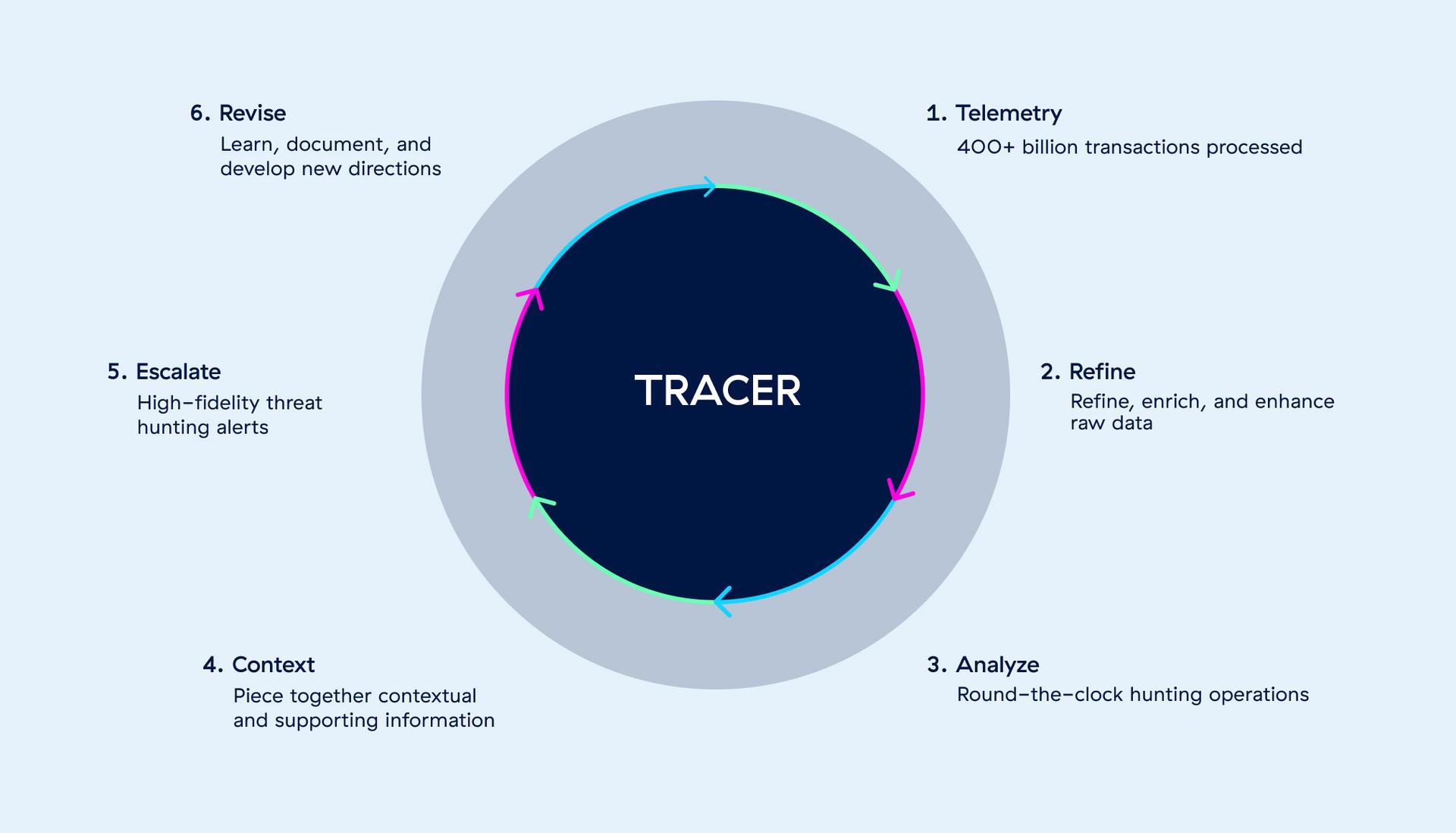
Merging zero trust principles, threat intelligence, hypothesis testing, and proven playbooks enables us to hunt threats rapidly and accurately. And we bring it all together by blending human expertise with advanced AI and automation. We call our approach TRACER.
Here’s how the TRACER model works:
- Telemetry: Our platform's 500+ billion daily transactions give our hunters unrivaled visibility into real-time data on traffic patterns and emerging threats.
- Refine: Our hunters enrich that data with high-quality threat intelligence and AI-assisted tooling, highlighting areas that warrant further exploration.
- Analyze: Our global team investigates leads 24/7, performing structured, unstructured, and situational hunting based on available IOCs and anomalies.
- Context: Our analysts correlate their findings with intelligence from external data sources to build clear, actionable insights.
- Escalate: Threat hunting alerts with rich context are immediately sent to the security operations center/incident response team.
- Revise: The team documents methods and outcomes and refines playbooks to improve the efficiency and efficacy of future hunts.
Putting proactive threat hunting to work
With today's threats stealthier, faster, and hitting harder than ever, adopting proactive threat hunting is just a matter of having the right tool for the job. Highly skilled attackers call for highly skilled defenders, full stop. That being said, let's take a moment for a reality check.
The biggest hurdle is this: many organizations, even those with a separate security team distinct from IT, simply don't have the resources for a dedicated threat hunting team. Sufficiently skilled experts are tough to hire, and the salaries and security tools necessary to maintain a team are prohibitively costly. It sounds like a lose-lose situation: stretch your wallet paying for your own hunting team, or break the bank recovering from attacks.
But there's a third option: managed threat hunting.
With a managed threat hunting service, you get all the expertise, threat intelligence, and 24/7 operations at a lower, predictable cost. Results are fast, and it's easy to scale without the need to hire, train, and equip an in‑house team.
How Zscaler Threat Hunting can help
Zscaler Managed Threat Hunting provides a team of experts who work around the clock to uncover hidden signs of potential threats. Armed with our proven TRACER methodology and sophisticated machine learning models, Our Managed Threat Hunting service helps you:
- Hunt and disrupt advanced threats: Leverage the expertise of our human-driven hunt team to detect and neutralize emerging and advanced persistent threats (APTs).
- Reduce alert fatigue: Let our 24/7 hunt team and proprietary tooling distill billions of transactions into context-rich alerts and actionable insights, freeing up your team to focus on critical tasks.
- Stop threats earlier: Detect and disrupt attacks earlier in the kill chain by analyzing web traffic instead of waiting for endpoint-based indicators of compromise.
- Access tailored threat hunting support: Upgrade to Advanced service for personalized onboarding, strategic briefings, tactical reports, and ongoing, customized threat hunting expertise.
Start building your threat hunting strategy today to stop advanced threats tomorrow. Ready to find out more?
FAQs
Threat hunting is the proactive process of searching for hidden cyberthreats in your network before they can cause harm. Unlike threat detection, which is reactive and relies on automated alerts triggered by known indicators, threat hunting involves experts investigating suspicious patterns and weak points manually. It’s about being one step ahead of attackers, finding what automated systems miss, and stopping threats before they escalate.
Organizations should ideally conduct threat hunts continuously or on an ongoing basis. Threat hunting is not a one-time activity; it’s a proactive step in maintaining robust cybersecurity as threats evolve daily. Many organizations also conduct hunts regularly after major changes, such as system upgrades, or in response to significant events like mergers, data leaks, or known breaches. Managed services can ensure round-the-clock hunts for organizations with limited resources.
Tracking Key Performance Indicators (KPIs) helps improve hunting efforts over time. Your program should be sure to measure KPIs such as:
- Mean Time to Detection (MTTD): How quickly threats are identified.
- Mean Time to Response (MTTR): How fast incidents are resolved after detection.
- False Positive Reduction Rate: The ability to weed out irrelevant alerts.
- Threats Discovered: The number of previously undetected threats uncovered.


免責事項:このブログは、Zscalerが情報提供のみを目的として作成したものであり、「現状のまま」提供されています。記載された内容の正確性、完全性、信頼性については一切保証されません。Zscalerは、ブログ内の情報の誤りや欠如、またはその情報に基づいて行われるいかなる行為に関して一切の責任を負いません。また、ブログ内でリンクされているサードパーティーのWebサイトおよびリソースは、利便性のみを目的として提供されており、その内容や運用についても一切の責任を負いません。すべての内容は予告なく変更される場合があります。このブログにアクセスすることで、これらの条件に同意し、情報の確認および使用は自己責任で行うことを理解したものとみなされます。


