/ What Is SASE (Secure Access Service Edge)?
What Is SASE (Secure Access Service Edge)?
Secure access service edge (SASE) is a cloud-delivered architecture that converges SD-WAN with security service edge (SSE) technologies such as SWG, CASB, ZTNA, and FWaaS into a single platform. SASE securely connects users, devices, and apps from any location.
Why Is SASE Important?
Gartner defined SASE in 2019 to solve one problem: how to securely connect distributed users to business-critical systems, applications, and services.
SASE responds to trends like cloud adoption, SaaS app usage, and remote work by converging SD-WAN with security service edge (SSE) technologies. Enterprises that deploy SASE benefit from optimized network performance and security for their cloud-first, distributed operations.
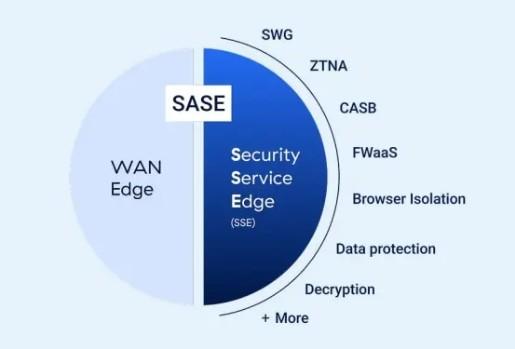
SASE applies security and enforces access as close to users as possible. It dynamically applies security policies and helps organizations enforce zero trust principles.
Core Components of SASE
SASE can be broken down into six elements. Four of these elements constitute security service edge (SSE) components.
Choosing between SSE and SASE is largely a conversation about prioritization. SSE is faster to deploy than SASE, but it doesn’t provide the network transformation of SASE.
Many organizations start with SSE adoption to immediately improve their security posture. Then, they deploy SASE later, when they have the resources available to modernize their networking infrastructure.
SASE includes the following core components:
- Software-defined wide area network (SD-WAN) applies dynamic path selection to automatically select the best route for traffic to the internet and cloud apps.
- Secure web gateways (SWGs) prevent unsecured internet traffic from entering your internal network.
- Cloud access security brokers (CASBs) prevent data leaks, malware, regulatory noncompliance, and risky GenAI app usage.
- Firewall as a service (FWaaS) replaces physical firewall appliances with cloud firewalls that deliver advanced Layer 7/next-generation firewall (NGFW) capabilities.
- Zero trust network access (ZTNA) applies zero trust principles and enforces granular least-privileged access policies.
- A single dashboard that simplifies change control, patch management, outage window coordination, and policy management.
How Does SASE Work?
Secure access service edge works by using SD-WAN and SSE technologies to enforce policy wherever users, devices, and applications are.
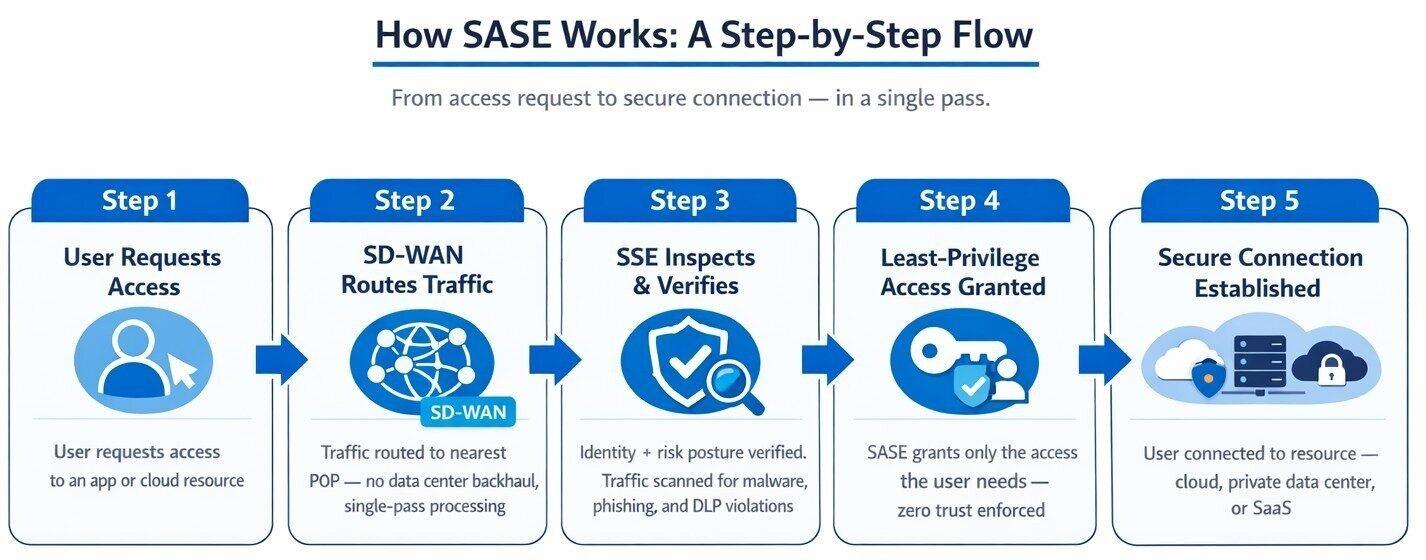
Here's how SASE works:
Step 1: A user requests access to an app or a cloud resource.
Step 2: The SASE platform uses SD-WAN to route that traffic through its globally distributed network of points of presence (PoPs).
Step 3: SASE uses its SSE functionality to verify user information like identity and risk posture. Traffic is scanned for malware, phishing, and DLP policy violations.
Step 4: The SASE platform grants the user least-privileged access to the requested resource.
Step 5: SASE connects the user directly to their resource, regardless of if that resource is hosted in the cloud, in a private data center, or in a SaaS environment.
What Are the Use Cases for SASE?
Secure access service edge solves a range of challenges, but most organizations deploy it to address one of three use cases: hybrid and remote workforce enablement, branch and retail location security, and global operations connectivity.
Hybrid and Remote Workforce Enablement
As enterprises deploy hybrid and remote work models, security teams need a solution that enforces policy regardless of user location.
Real-world example: A SaaS company replaced their legacy VPN technology with ZTNA and immediately deployed remote access 5x faster than before. The company also cut the time it took to grant users to network resources from days to weeks, and sometimes minutes.
Securely Connects Branch and Retail Locations
Historically, branch and retail environments use physical security appliances at each location. But these appliances incur high maintenance costs, and they’re difficult to keep up-to-date.
SASE solves this problem by moving all networking and security to the cloud.
Real-world example: A large company in the food and beverage industry deployed SASE to secure its SaaS, internet access, operational technology (OT) traffic, and industrial IoT (IIoT) traffic.
After the deployment, the company prevented 4 million policy violations and blocked 14,000 threats monthly. The team also saved 70% on hardware, updates, and licensing costs by retiring their legacy VPNs.
Enables Global Connectivity
Global organizations need security and networking performance that’s consistent across users, facilities, and countries.
Real-world example: A leading technology company adopted a single SASE platform to replace legacy VPNs, improve web traffic security, and streamline policy enforcement.
The company enabled its 320,000 employees to work remotely within two weeks. It also cut management and operational costs by 70% through virtualization and infrastructure simplification.
How SASE Solves AI Challenges
When organizations deploy AI-powered SASE, they benefit from:
1. AI Traffic Optimization
AI and ML activity increased 83% year over year from 2024 to 2025 (ThreatLabz 2026 AI Security Report). But tools like on-prem gateways, physical firewalls, and local area networks (LANs) were designed for human-driven, not machine-driven, traffic.
As enterprises increase their AI usage, they require more bandwidth and the ability to manage greater volumes of east-west traffic, which tools like agentic AI generate in large quantities.
SD-WAN provides the high bandwidth, low latency, and traffic prioritization that enterprises need to manage their AI traffic.
2. Shadow AI Visibility
Unsanctioned generative AI app usage, or shadow AI, can result in data leakage. SASE surfaces shadow AI, applies least-privileged access to sensitive GenAI apps, and enforces inline data loss prevention (DLP) policies to block risky AI transactions.
3. Agentic AI and Embedded AI Security
Agentic AI security involves both securing the enterprise’s AI agents and protecting against agentic AI cyberattacks.
The first reported AI-orchestrated espionage campaign happened in 2025. In that campaign, a state-sponsored group automated between 80% and 90% of its attack with agentic AI (ThreatLabz 2026 AI Security Report). ThreatLabz researchers anticipate that we’ll see more AI-powered ransomware attacks in the future.
Embedded AI, or AI capabilities that are embedded in SaaS apps like Salesforce and ServiceNow, is another risk. Enterprises often don’t have full visibility into which apps have embedded AI, or how that embedded AI is secured and patched.
Embedded AI represents one of the fastest growing and least visible sources of enterprise AI risk.– Read the ThreatLabz 2026 AI Security Report |
Common SASE Myths
As SASE deployments grow in popularity, there are still some common misconceptions about what it does and who it’s for.
Isn’t SASE Just a VPN in the Cloud?
No. SASE and VPNs take different approaches to access. A VPN creates an encrypted tunnel that puts the user on the network. VPNs grant broad access without continuous verification.
SASE enforces zero trust by limiting access to specific apps and by continuously verifying identity and context. Unlike VPN, SASE automatically includes a full security stack to grant secure remote access.
Doesn’t Adopting SASE Mean Giving Up Other Security Tools?
SASE doesn’t require a rip and replace approach. Many enterprises implement a phased SASE rollout where they adopt SSE before adding SD-WAN. This approach is a great opportunity to integrate SASE with existing security tools like endpoint detection and response.
SASE proposes an ideal end state for an organization’s architecture. It doesn’t require that you abandon your existing security tools.
Doesn’t SASE Just Add Security to SD-WAN?
SD-WAN optimizes networking, but it doesn’t include a native security stack.
Enterprises that use SD-WAN still need firewalls, secure web gateways, or backhauling for traffic inspection. SASE provides a single pane of glass view into networking and security, which SD-WAN alone can’t provide.
Isn’t SASE Unnecessary for Smaller Organizations?
Large enterprises pioneered SASE adoption, but they’re not the only organizations that benefit from SASE. Without SASE, smaller organizations can’t get the networking optimization or security they need to drive digital transformation.
Because SASE is a cloud-delivered service, it’s easier for small IT teams to adopt. SASE doesn’t require the capital investment or staffing needed to maintain physical appliances.
Doesn’t SASE Eliminate All Security Risks?
SASE reduces the attack surface and consistently applies security policy, but it’s not a guarantee of complete security. SASE must be configured correctly, and security teams must implement strong identity and access policies with continuous monitoring in order to gain the full benefit of SASE.
Aren’t SASE, SD-WAN, SSE, ZTNA, and VPN All the Same?
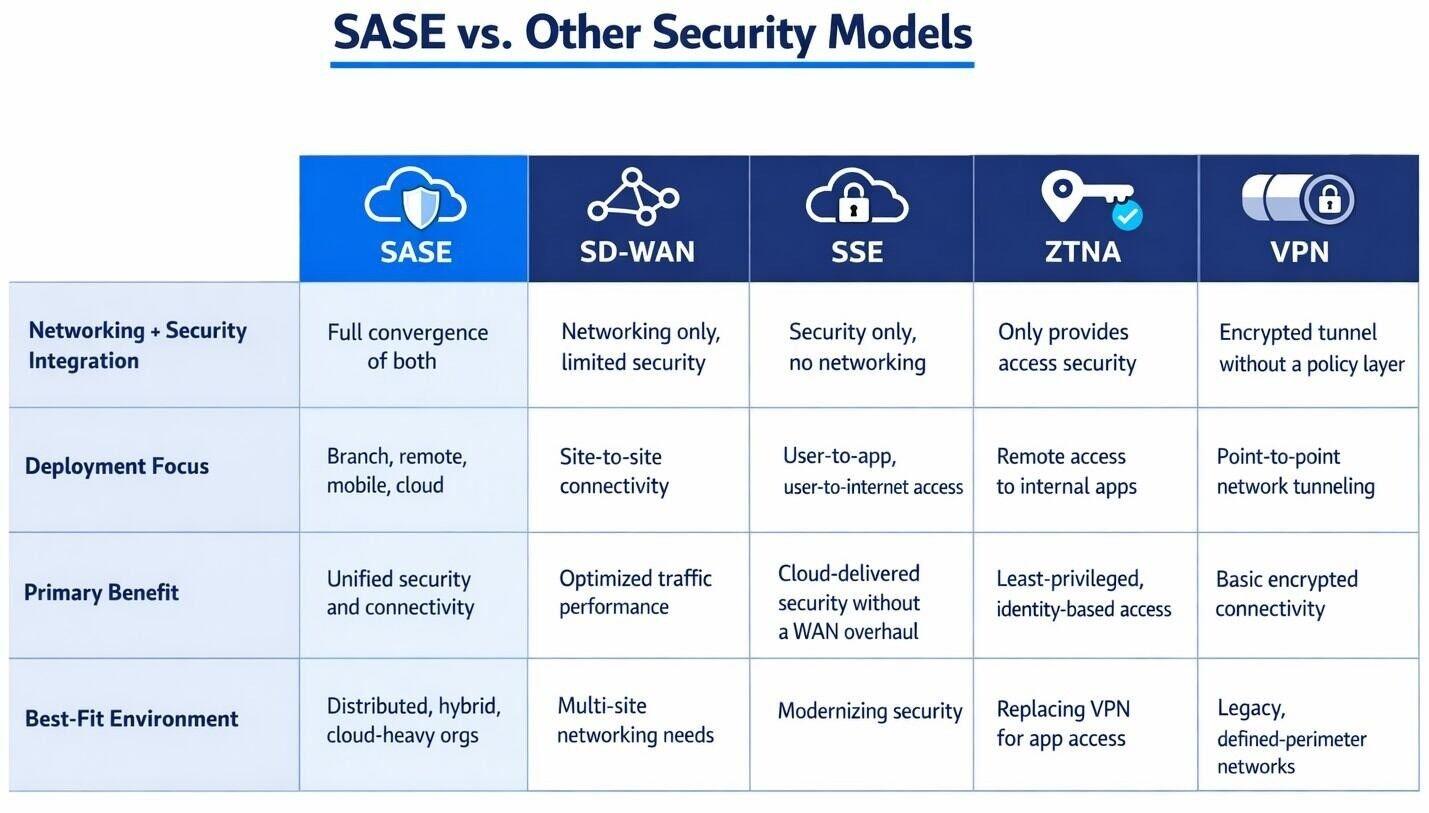
SASE, SD-WAN, SSE, and other security models each have different deployment focuses, benefits, and ideal implementation scenarios. Comparing these technologies helps clear up where SASE fits in the broader networking and security landscape.
Single-Vendor vs. Multi-Vendor SASE
What criteria should you use to evaluate SASE vendors? To start, you’ll need to make an architectural decision between single-vendor and multi-vendor SASE.
Single-vendor SASE delivers SD-WAN and SSE capabilities from a single platform that’s built on one architecture and uses a single policy engine.
With a single-vendor model, you can’t mix specialized point products together, but you can work from one dashboard and can enforce a single set of policies across every location and user. Unlike multi-vendor SASE, no integration work is required.
Multi-vendor SASE stitches together point products, which typically includes one SD-WAN vendor and a different security vendor.
Multi-vendor SASE requires IT teams to replicate and sync policies across systems. Teams have to sort through different dashboards to compile logs, and troubleshooting individual connectivity issues frequently involves two vendors instead of one.
Most organizations choose single-vendor SASE because of its operational simplicity.
Zscaler and SASE
Zscaler Secure Access Service Edge (SASE) is a cloud native platform built on the Zero Trust Exchange, the world’s largest inline cloud security platform. Zscaler provides an AI-powered cloud framework that modernizes legacy architectures with zero trust principles.
Gartner recognized Zscaler as a Leader in the 2026 Magic Quadrant for SASE Platforms for its AI-enhanced approach to unifying network and security into a single, scalable cloud service.
Zscaler SASE provides:
- A native, multitenant cloud architecture that scales dynamically with demand.
- A proxy-based architecture for full inspection of encrypted traffic at scale.
- Security and policy brought close to users via 150+ globally-distributed PoPs.
- Zero trust network access (ZTNA) that restricts lateral movement with native application segmentation.
- Attack surface reduction that protects against cyberattacks and emerging AI risks.
To see Zscaler SSE in action, request a demo.
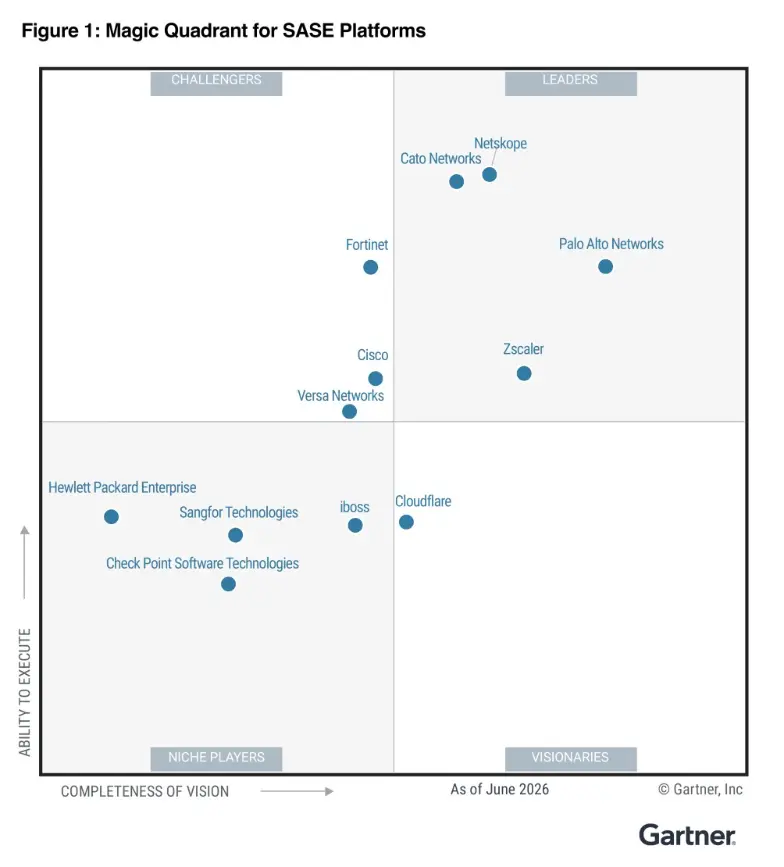
Zscaler is a Leader in the Gartner Magic Quadrant for Secure Access Service Edge (SASE).
Suggested Resources
Frequently Asked Questions
The main goal of secure access service edge (SASE) is to provide fast and secure connectivity between users and applications, on any device, in any location. SASE is designed to address modern enterprise challenges like growing cloud adoption, the rise of remote work, and the increasingly complex cyber risk landscape. Moreover, SASE helps organizations simplify their security infrastructure, improve their security posture, and reduce costs with more efficient, scalable, centrally managed security.
The key components of secure access service edge (SASE) include both networking and security. The networking component of SASE is SD-WAN, and the security side of SASE is security service edge (SSE). SSE technologies include cloud access security broker (CASB), zero trust network access (ZTNA), secure web gateway (SWG), and firewall as a service (FWaaS).
Software-defined wide area network (SD-WAN) technology is a network overlay able to use multiple types of internet connections (e.g. broadband, MPLS, LTE) to connect remote users and sites to the corporate network. It provides centralized management and control of the network to enable visibility and agility.
Secure access service edge (SASE) combines the functionality of SD-WAN with security services, such as firewall, secure web gateway, and cloud access security broker, in a cloud-based platform that enables secure, efficient connectivity between users and applications, on any device, anywhere. By integrating security functions into the network itself instead of relying on so-called “bolt-on” solutions, SASE provides a more holistic approach to network security.
Secure access service edge (SASE) usually has a higher upfront cost than VPN, but SASE has a lower total cost of ownership (TCO). SASE brings together multiple security tools into one solution, so enterprises can consolidate their legacy security tooling with SASE. And because SASE is cloud-delivered, it eliminates hardware and maintenance costs.
Yes, SASE replaces VPN technology. SASE provides zero trust network access (ZTNA) capabilities, which grant least-privileged access to specific applications. Unlike VPNs, ZTNA never grants broad user access, and ZTNA continuously verifies identity and context within each user session. VPNs place users on the network and introduce lateral movement risk, while ZTNA never places users on the network.
A firewall is a single security tool that’s traditionally deployed as a physical appliance at the network perimeter. SASE is a cloud-delivered framework that includes firewall as a service (FWaaS). SASE goes beyond firewall technology by bringing together networking and security into one platform. SASE capabilities include SD-WAN and security service edge (SSE) features like SWG, ZTNA, and CASB.
Yes, SASE can replace your on-premise firewall. SASE provides cloud-delivered firewall as a service (FWaaS), which is helpful for organizations with remote users, many physical branches, or cloud-first infrastructure. With firewall as a service, you don’t need physical firewall hardware to get consistent, policy-driven security.
Yes, SASE works with legacy devices. Because SASE is cloud-delivered, it can route traffic from existing devices through its security controls via IPsec tunnels, GRE tunnels, or lightweight connector agents. But legacy devices don’t always support SASE features like zero trust policy enforcement. Enterprises should deploy SASE alongside legacy devices before retiring those devices slowly over time.
It depends on your organization’s security requirements. SD-WAN optimizes network connectivity and traffic routing, but it doesn’t include many built-in security features. SASE layers a full security stack on top of SD-WAN. If your organization is cloud-first or mostly remote, SD-WAN alone will introduce security gaps. Only SASE can provide the breadth and depth of protection for cloud native organizations.